
Political Issues
2019: Atiku, Nigerian Youths And The National Question -By Chijioke Mbaka

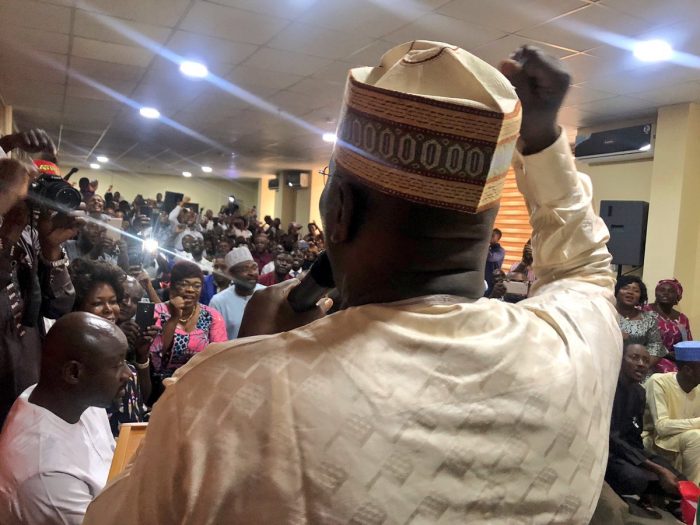
A great number of youths in Nigeria including I have observed the happenings in the Nigerian polity with some apathy and disinterest. This attitude is born not out of inherent nonchalance in some young people, but out of a perceived feeling of alienation from the mainstream of Nigeria’s economic and political life. This alienation has ensured that millions of youths in Nigeria are not active participants in the socio-economic and political life of the country. This however should never have been the case. For anything, a good number of us are informed observers of the Nigerian political and socio-economic scene – check us out on Twitter and other social media platforms. A good number has also contributed in their individual capacity to the advancement of this society. But this desire to be productive and useful has been hampered by every conceivable hurdle which ensures that millions of young people in Nigeria have not contributed significantly, and as much as they would want, to the development of their fatherland. These hurdles which include massive unemployment among the youths, poverty, little access or politicization of opportunity and empowerment structure, brutality of security operatives, like the case of the Special Anti-Robbery Squad (SARS), and non-inclusion of young people in governance while being perennially labeled leaders of the future, an elusive future, have given rise to great disenchantment.
As undergraduates when this democratic era began, we looked at Nigeria with great enthusiasm. We debated national issues amongst ourselves while in school with vigor. We carried on student unionism with swagger. At the SUG parliaments, we made oratorical speeches brimming with intellect, purpose and conviction. We were preparing ourselves for the years after school when the responsibility of leading this country would fall on our shoulders. But that day never came. On graduating, we found to our utter chagrin and dismay that that our country had little space or accommodation for the youths. The old brigade continues to hold sway and young people are viewed with distrust. With the youths suppressed in many vital areas, young people in Nigeria and by extension the whole country have been the worse for it. The only areas where the youths have found some respite are the entertainment and music industries, where their unfettered involvement and undertakings have put Nigeria firmly in the global map of show business. Think of Wizkid, Davido, Patroranking etc.
The same problem is evident in the Nigerian economic space, an oil dominated economy which accommodates only the big shots with massive capital and political clout. The easy money occasioned by this industry allows the government to chill while finances flow in thick and fast. They neglect the real sector where the drive, innovation and creativity of the youths would have found expression. As a result, unemployment has soared. The real sector as used here entails businesses that produce or manufacture high quality finished goods and services for domestic and foreign markets. It is the real source of wealth of a nation and the precursor of industrialization. It creates jobs and ensures that the productive population of a country especially the youths is gainfully employed. But Nigerian government see no need to proactively ensure a conducive business environment for the real sector to thrive. Young people who dabbled willy-nilly into business are so curtailed by the unfavourable business environment that they make little or no contribution to the wealth of the nation. Having thus lost out on leveraging on the productive capabilities of the country’s largest demographic, and hit by dwindling oil prices, the government, run by unimaginative people, and in a gesture that shows how far behind we have fallen, sought at a point to diversify the economic base of the nation through the exportation of yams!
Then there is the issue of the national question. I had the opportunity to listen to Alhaji Atiku Abubakar speak on the issue of restructuring Nigeria in Princess Alexandria Auditorium (PAA), University of Nigeria Nsukka. I listened quietly and left with the least interest. I was pleased that Atiku Abubakar, a former vice president and a northerner, was preaching true federalism. But coming then from the ruling party which does not genuinely have restructuring in its agenda, I could not be enthusiastic. A good deed may be defined in the context of where it takes place. Atiku’s message was welcomed, but other things did not add up: Atiku would never have a realistic shot at the presidency if he remained in APC; and his message was never going to receive the blessing of the party. Therefore, if he were to remain in that party, his message would not see the light of day. That is why my interest was enkindled when he resigned from APC and re-joined PDP. It is obvious that this move has advanced his message of true federalism more than any amount of rhetoric standing on the APC pulpit would have done. With that gesture, the people’s belief in his message has become more strengthened. He is home with a good number of fellow advocates, and the fact that he is PDP presidential flag bearer has lifted the innocent hopes of millions of Nigerians who are fast losing faith with this APC government and its unwise handling of this most germane issue. But this is a matter for another day.
In his declaration on 3rd December, 2017 on Facebook Live, Atiku addressed young people in particular. His message showed that he understood the difficulties youths in Nigeria are passing through. But some young people were skeptical; and the reason is obvious. The youths have passed through a lot in this country; they have been dealt the bad hand for so long by callous leaders. They have been sold short by those whom they have trusted with their destiny, like Pres. Buhari calling them lazy before the whole world. But a critical and informed observation lends credibility to Atiku and his message. Take for instance the fact that he is an entrepreneur and a big time employer of labor; his many investments and companies including the recently opened Chicken Cottage Outlets in Abuja and Yola provide means of livelihood directly and indirectly to tens of thousands of Nigerians. Majority of these are young people. His proximity to them has furnished him with a unique opportunity to interact with them, understand them better and appreciate their concerns, dreams and aspirations, an opportunity that the “army generals” like Buhari and career politicians never had. Having seen the part those young people play in the success of his own businesses, his sensibility is attuned to the giant strides this nation would most likely make if the creative drive, innovation and enterprise of 100 million young people are brought to bear on the articulation and pursuit of national development.
Furthermore, Alhaji Atiku has made giant strides in the advancement of quality education in Nigeria. He is a leading advocate of the importance of the education system in national development, in words and in deeds. This has seen him found a top notch university, the American University of Nigeria (AUN), built in the American model. As a “development university”, it focuses on the “practical role it feels a great university must play in the development of a great nation”. It is mandated by its founder to provide “high-level training in information technology, entrepreneurship and in arts and sciences, all of which are key to future sustainable development” of the country. This recognition of the importance of quality education in national development and his readiness to make personal sacrifices to advance it sets Atiku apart from most of the leaders Nigeria has had to date, given their gross underfunding of the education sector to this day, with a paltry 7% of the budget allocated to education in 2018! The US National Peace Corps Association (NPCA) has since honoured Atiku with the Harris Wofford Global Award for his contribution to the development of higher education in Africa. This body cited the fact that “no private businessman in Africa has worked harder for democracy or contributed more to the progress of higher education than Atiku Abubakar”
Presently, among those contesting the 2019 presidential election, Atiku is the only one with the right mix of enterprise and pro-business attributes, political will and leadership capability, political belief system and political sagacity, insight and factual knowledge, tolerance and broadmindedness needed in the leader of a large and diverse but economically troubled country like Nigeria. All the others, especially President Muhammadu Buhari who wooed us with false and fantastical promises in 2015, are miles behind, a fact the youths of this country would take into consideration in the 2019 presidential election.
As a youth leader, I must point out that the youths of this country are seriously concerned; and having been shortchanged for so long, they are in a foul mood. They are tired of being left behind while young people in other lands are breaking new grounds. They do not want leaders who are full of talk but bereft of meaningful actions. They are therefore unhappy that as Nigeria’s economy stagnates, evident in low productivity, closure of businesses, increasing loss of jobs, shrinking of the middle class, lower standard of living and increasing poverty, the Buhari government continues to offer lame excuses and to trade blames. The government has refused to take responsibility for its many missteps and blunders, and amidst empty words, has shown a conspicuous lack of competence necessary to change the fortunes of an economically beleaguered country. The youths want a departure from this ugly trend. We want this country to be run with a sort of business mindset, with the idea that we either thrive or we go under. Therefore we want a president with pro-business credentials, a proactive leader who will facilitate the emergence of a viable microeconomic business environment, encourage enterprise and expression (in arts, music and sports), and harness the productive capabilities of the people.
We want a president who understands the place of education as the main driver of productivity in this knowledge and technology driven world and is ready to fund it adequately. Already Atiku Abubakar has pledged to allocate 21% budget to education if elected president. So in essence, we want a president who knows that the distinctive capabilities of a country that seeks to create enduring prosperity and wealth for its citizens must not rest on natural resources, arable land or cheap labour but instead on the intellect, skills and creativity of people. Such a president would be able to fashion out an arrangement where research and learning in Nigerian universities would facilitate productivity in the manufacturing sector and inform sound government policies.
Equally, the youths want a president who will be courageous enough to tackle the issue of the national question, a subject Atiku is ready to address as president. Therefore we want him. We want one who will be ready to unshackle this country from the stranglehold of cumbersome political centralization and allow the federating units to move forward with greater freedom and sense of responsibility in the spirit of true federalism. We want a president who will soar above the whirlwind of ethnicity, tribalism and divisiveness which is driving this country fast towards the precipice, and adroitly steer her away from imminent doom. We want him to arrest the centrifugal tendencies of our time and become the force that binds the disparate parts of this country together. We must admit that Nigeria is not yet a nation due to ethnic and tribal loyalty exhibited by the citizens especially the ruling class, and now taken to a terrifying new level by this sectarian president and his clannish gang of appointees and service chiefs. What we want is a president who will midwife the birth of a common nationhood in which the citizens are Nigerians first before anything else, be it Hausa, Igbo, Yoruba, Christian or Muslim.
Importantly, and in the light of the horrible events taking place in Nigeria at this moment, we want a president who would not stand idly by or connivingly while murderous entities, Herdsmen, Boko Haram and other criminal elements, murder and displace whole communities as is happening in Benue, Adawama, Plateau, Taraba states, Bornu and Zamfara. The terrible preoccupation of these groups in those areas and elsewhere is arson, pillage and murder. Their murderous acts of terror entail the “undistinguished destruction of all ages, sexes and conditions”. Children, women and the aged have been hacked down and butchered with satanic gusto. These works of death and desolation have continued while an unfit and “lifeless” president “sleeps” in power. Instead of waking up to his responsibility and working hard to safeguard the lives of innocent defenseless citizens, he and the sycophants around him are busy defending him from the rightful criticism of those who are scandalized by his callousness and inaction. Therefore, we want a different kind of president, a man like Atiku Abubakar who values the lives of the citizens more than that of the cows, a strong and morally upright leader who will fight this terror to a standstill and give justice and succour to thousands of Nigerians who have been killed, displaced or dispossessed. We want a president who will stand up to these great tasks and not back away because of petty sectional considerations. We want one who will write his name in gold. We want the real deal.
In a town hall meeting with Youth on 7th December, 2017, in Lagos, Atiku Abubakar reiterated his commitment to a youth inclusive government, “I pledge that 40% of my government will be youths. My minister for youth will be less than 30 years of age, if you are in that category, it could be you!” Atiku is therefore willing to give young people a prominent place in the scheme of things in Nigeria. Based on this and the other reasons mentioned earlier, one can say that Atiku Abubakar is the real deal. His articulation of the problems facing young people in Nigeria is spot on. He has also demonstrated that he has the intellectual capacity to believe in and uphold enduring principles and ideals, such as true federalism and the primacy of education and business in the creation of national wealth. He has strong business acumen and has shown that he is a detribalized Nigerian. He therefore embodies the essence of critical stewardship which the president of any developing country ardently bent on the task of creating prosperity and building a great nation should possess. The youths of this country are taking all these into consideration; and on February 14, we will vote in this man under whose leadership our dreams and aspirations will most likely come alive.
Happy New Year Nigeria!
Chijioke Mbaka writes from Abuja. Follow me on Twitter @Mbaka_Ogonnaya

Cease The Unchecked Looting -By Abba Dukawa
To address this, the Independent Corrupt Practices and Other Related Offences Commission (ICPC) and the Economic and Financial Crimes Commission...

Moscow University Museum Presents Insights into African Artistic Culture -By Kestér Kenn Klomegâh
In his contribution, Louis Gouend, Chairman of the Commission for Work with African Diasporas at Moscow State University's Russian-African Club,...


Justice, Peace And Integrity Of Creation Prerequisite To Good Living -By Melissa Thomas
There are many ways to promote peace in our world of today but perhaps the best way is to promote...

Africa Squeezed Between Import Substitution and Dependency Syndrome -By Kestér Kenn Klomegâh
The key buyers of Russian grain on the continent are Egypt, Algeria, Kenya, Libya, Tunisia, Nigeria, Morocco, South Africa, Tanzania...

Accelerating Intra-Africa Trade and Sustainable Development -By Kestér Kenn Klomegâh
The AU Private Sector Forum has held several forums, with key recommendations. These recommendations provide valuable insights into the challenges...