
Breaking News
3 months after bridge collapse, Baltimore shipping channel fully reopened
Six road workers were killed when a huge cargo ship slammed the bridge’s central support pylon, throwing the entire structure into the Patapsco River. Since then, months have passed while the Army Corps of Engineers and other recovery crews have laboured to clear an estimated 50,000 tonnes of debris from the water to allow vital trade to fully resume.

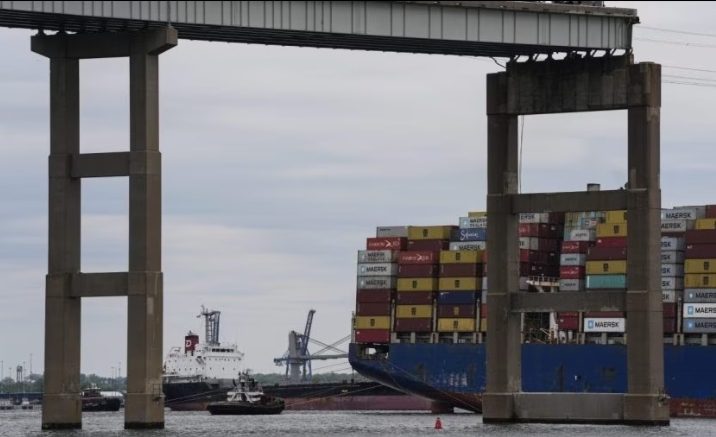
After the Francis Scott Key Bridge collapsed in March, the shipping lane into the Port of Baltimore fully reopened on Monday evening, facilitating full capacity cargo flow into the port.
Six road workers were killed when a huge cargo ship slammed the bridge’s central support pylon, throwing the entire structure into the Patapsco River. Since then, months have passed while the Army Corps of Engineers and other recovery crews have laboured to clear an estimated 50,000 tonnes of debris from the water to allow vital trade to fully resume.
“Yet again, Baltimore was counted down and out,” Baltimore Mayor Brandon Scott (D) told The Washington Post. “And yet again, Baltimore proved the world wrong.”
Workers moved quickly to partially reopen the channel, getting smaller ships in and out of the port just days after the bridge disaster via newly dug shallow channels. The full recovery also came faster than expected, in about three months instead of the anticipated six.
Officials said a total of 56 federal, state and local agencies participated in the salvage operations, including about 500 specialists from around the world who operated a fleet of 18 barges, 22 tugboats, 13 floating cranes, 10 excavators and four survey boats.
“I cannot overstate how proud I am of our team,” said Col. Estee Pinchasin, Baltimore district commander for the Army Corps of Engineers. “It was incredible seeing so many people from different parts of our government, from around our country and all over the world, come together in the Unified Command and accomplish so much in this amount of time.”
The Port of Baltimore was the East Coast’s busiest for automobile shipments before the bridge collapse, as well a crucial coal and farm equipment terminal. With the wreckage removed and the ship that downed the bridge floated to port, effectively no evidence of the disaster remains except for the lack of bridge deck itself.
The bridge collapse was met with broad support for federal and state assistance. President Biden has committed federal funds to rebuilding the bridge, which carries Interstate 495 around the city. Maryland highway officials hope to have the new span open by 2028.



Abebe Selassie to Retire as Director of African Department at IMF -By Kestér Kenn Klomegâh
Concessional financing to counter rising borrowing costs, with Africa paying up to 5 times more in interest than advanced economies...


Singapore’s Leaders Built An Economy; Nigeria’s Keep Building Excuses -By Isaac Asabor
Singapore paired economic growth with social stability. Through the Housing Development Board, the government built large-scale public housing, providing affordable...


Tax Considerations for CFD Traders in South Africa: What Experienced Traders Should Know
What looks like a sweet profit on your platform screen can shrink fast once the tax bill hits. When you're...


Russia–India Dialogue Provides Platform for Strengthening Bilateral Entrepreneurship -By Kestér Kenn Klomegâh
The Dialogue was organized by the Indian Business Alliance, the Business Council for Cooperation with India, the Government of Moscow,...


The Kampala Declaration: How African Youth Can Lead Food System Transformation to Accelerate the Achievement of Zero Hunger by 2030 -By Emeka Christian Umunnakwe
If Africa is serious about achieving Zero Hunger by 2030, these perceptions must be confronted with deliberate action. Young people...