
National Issues
Ambassadors of Shame: When Local Rejects Become Nigeria’s Image Abroad -By Vitus Ozoke, PhD
They conduct their internal investigations. Nations notice who you send to them. They read meaning into it. They adjust expectations accordingly. When you send lightweights, you receive lightweight treatment. When you send seriousness, you are taken seriously. This is how credibility works. Nations do not see Nigeria’s foreign missions as strategic outposts but rather as political consolation prizes.

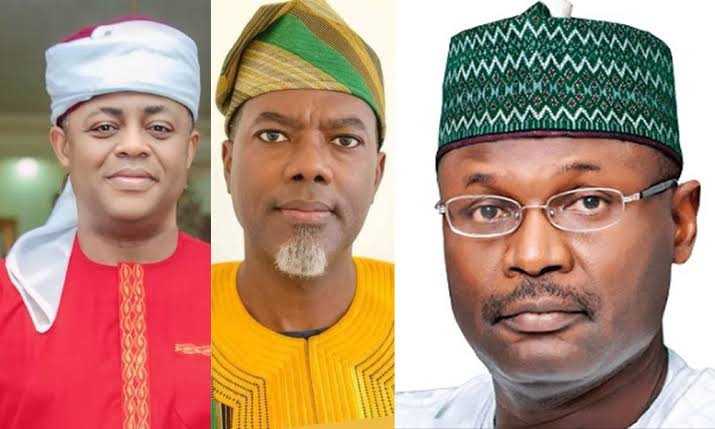
There are many ways a nation can announce its decline. Some do it with coups, some with hyperinflation. Nigeria, ever inventive, does it with ambassadorial lists. Bola Tinubu’s latest nominations, which include former Governors Ifeanyi Ugwuanyi of Enugu State and Okezie Ikpeazu of Abia State, both rejected at the senatorial ballot box by their own people, are not merely appointments. They are indictments. Indictments of judgment, of values, and of a political culture that has perfected the art of punishing excellence and rewarding failure.
An ambassador, in any functioning state, is not a souvenir. He is not excess luggage. He is not a diplomatic exile. He is supposed to be the distilled image of national seriousness – the best face a country can present to the world. Instead, Nigeria sends the political equivalent of expired goods with fresh labels. Men whose people refused them another term now receive national diplomatic passports to represent those same people abroad. If that is not satire, then Jonathan Swift owes Nigeria royalties.
In ancient Athens, leaders who failed catastrophically were ostracized – physically removed from public life to protect the republic. In post-war Germany and Japan, failure in leadership was followed by institutional shame and reform. In modern Nigeria, failure is followed by reward, rebranding, and relocation. We don’t remove bad leaders. We recycle them. And recycling in Nigerian politics is not an environmental virtue – it is a disease.
This pattern did not begin with Bola Tinubu, but his administration has elevated it to ideological status. Where older regimes pretended to care about optics, Bola Tinubu does not bother. He embodies and announces incompetence with confidence and fanfare. He parades rejected politicians before foreign governments as if saying, “If I could not convince my own people to keep them, perhaps I can convince you to receive them.”
But what does that communicate? It says Nigeria does not believe in merit. It says Nigeria does not learn. It says Nigeria does not take diplomacy seriously. It says governance is just a pension system for the politically exhausted. In any sane system, elections are employment interviews. Lose and you leave. In Nigeria, elections are auditions for international posting. Fail upward. Fail abroad. One might almost admire the innovation.
Bola Tinubu’s defenders will argue that these men have “experience.” Yes, experience in corruption. Experience in being rejected by their own people. Experience in public dissatisfaction. Experience in confirming every cynical belief Nigerians hold about their ruling class. Experience alone does not make a surgeon competent. Experience does not make a pilot safe. Experience does not make a leader worthy. If it did, Nigeria would have been Switzerland 30 years ago.
Instead, Nigeria has institutionalized mediocrity. Where other nations send technocrats, scholars, and diplomats fluent in both language and leverage, we send our rejects and crumbs-seeking puppies, who have hung enough under the dining tables of Aso Rock.
Consider the historical absurdity: at a time when Nigeria’s reputation is bruised, when its economy bleeds, when its citizens flee, when its passport shrinks in dignity by the year, Bola Tinubu decides the best people to represent the nation are individuals whose own communities declined to rehire. This isn’t statesmanship. It’s performance art.
There is something deeply offensive about the assumption behind these nominations. It is the idea that Nigerians are so politically docile and domesticated that anything can be done to them. That they will swallow any insult labeled “appointment.” That governance is not stewardship but domination. In medieval times, kings sent disgraced courtiers to distant provinces to remove them from polite company. Bola Tinubu sends them abroad with a diplomatic passport and immunity. We have, in effect, converted Nigeria’s embassies into sanctuaries for political leftovers.
And yet this madness is strategic – just not in a national sense. Poor appointments make one man look better by contrast. When mediocrity surrounds you, you default upward. When the worst parade before the world, the sponsor looks improved by proximity. This is why the list feels less like foreign policy and more like psychological vanity: if everyone below him is terrible, Bola Tinubu looks tolerable. It is a politics of contrast, not competence. But Nigeria cannot afford personal therapy masquerading as public policy.
This country sits on a diplomatic fault line. Global influence is shifting. Strategic alliances matter. Intelligence relationships matter. Trade negotiations matter. Perception matters. Reputation is currency. And Nigeria is busy debasing it. You do not send weak ambassadors into a world of aggressive bargaining. Diplomacy today is not tea and handshakes; it is war conducted politely. Economic war. Information war. Strategic influence war. And we have entered that battlefield with political casualties in suits.
There is, however, a deeper moral rot beneath the embarrassment. When citizens see failure rewarded, they internalize despair. When politicians see rejection followed by reward and promotion, they internalize a sense of impunity. When both happen long enough, a nation forgets what excellence looks like. This is how civilizations die – not with explosions but with corrupt and lousy appointments.
The tragedy is not that Nigerians are unrepresented abroad. It is that they are misrepresented. This list does not define Nigeria. Nigeria is defined by its teachers, traders, doctors, engineers, artists, and entrepreneurs – millions of hardworking men and women and youth navigating chaos with dignity. But the world does not see them. Instead, it sees what Bola Tinubu sends. And what Bola Tinubu has sent is a message loud enough for foreign capitals to decode: We do not believe in consequence. We do not reward merit. We do not fear ridicule.
And that, more than any individual name, is the real diplomatic disaster. But, perhaps, Ifeanyi Ugwuanyi’s failed governing ideology, “Enugu State is in the hands of God”, may just work this time. It may just be that Nigeria is in the hands of God. That will allow Gburugburu to leave his diplomatic post unattended while he goes in search of weddings and funerals to eat his favorite pounded yam and egusi soup in some foreign capital.
But seriously, there comes a moment in the life of a nation when governance stops being merely disappointing and becomes openly contemptuous. Nigeria, under Bola Tinubu, has reached that moment. Bola Tinubu’s list of ambassadorial nominees is not simply a political decision. It is a statement. It is a declaration that in modern Nigeria, failure is not a disqualifier – it is a credential. That rejection at home is not an obstacle to promotion abroad. That political disappointment is now officially a pathway to diplomatic reward.
Voters rejected Ifeanyi Ugwuanyi and Okezie Ikpeazu after their terms in office as governors because they could not convince their own people that they deserved a continued mandate. Their records were vetted and found wanting by the very citizens they led. Yet now, Nigerians are expected to accept that these same individuals are suitable emissaries to foreign nations, carrying the reputation, dignity, and face of over 220 million Nigerians. If you cannot represent your own community, on what moral, political, or logical basis are you qualified to represent your country?
This is not governance. This is recycling. It is the same politics-by-dump-site that has crippled the Nigerian state for decades: when an official fails upward, when incompetence is elevated instead of punished, when governance becomes an elaborate pension scheme for the politically connected. The diplomatic corps becomes a warehouse for political allies when they are no longer electorally useful.
And we had better watch it. We are dumping our political waste on foreign capitals around the world. That’s not diplomatic engagement; that’s an act of war. The world deserves the best of us – not the very worst of us. We are not fixing our foreign policy; we are insulting it. What Bola Tinubu fails to realize is that every nation is not Nigeria. Other societies do their due diligence. They conduct their internal investigations. Nations notice who you send to them. They read meaning into it. They adjust expectations accordingly. When you send lightweights, you receive lightweight treatment. When you send seriousness, you are taken seriously. This is how credibility works. Nations do not see Nigeria’s foreign missions as strategic outposts but rather as political consolation prizes.
At some point, Nigerians must stop accepting that public appointments are beyond moral scrutiny. At some point, citizens must begin speaking not just at polling units but also in public discourse. It is not unpatriotic to criticize this system. It is unpatriotic to normalize it. Nigeria does not suffer from a lack of talent. It suffers from a lack of political will to use it. Our finest professional minds are sidelined while the political faithful are promoted. Our sharpest diplomats are ignored while political survivors are exported.
Bola Tinubu’s ambassador list is not just a document. It is a mirror. And what it reflects to us is not flattering. If this is how Nigeria chooses to present itself to the world, then the world will not misunderstand us. It will understand us perfectly.
And that is the real tragedy, my friends.
Dr. Vitus Ozoke is a lawyer, human rights activist, and public affairs analyst based in the United States. He writes on politics, governance, and the moral costs of leadership failure in Africa.



The Pragmatism of Principle: Redefining Loyalty in an Age of Change -By Florence Ozor
While I do not endorse political nomadism, one must acknowledge that strategic realignment can be expedient. Take Peter Obi: after...


Lessons for Today: MLK for Continental African Leadership – A Psychoafricalytic Mirror for Power, Dignity, and Continental Renewal -By Psychologist John Egbeazien Oshodi
When African leaders abandon indigenous wisdom, they often adopt the colonial logic of control. Citizens become subjects. Protest becomes treason....


The Poverty Crisis: A Global Challenge to Human Dignity and Development -By Jennifer Joab
The poverty crisis is not just an economic problem but a profound human tragedy that affects the social, political, and...

Good Governance as a Tool for National Development -By Blessing Matthew
Good governance prioritizes the interests and welfare of the people above personal or sectional interests. It encourages transparency, accountability, rule...


Role of Youths in Nation Building -By Kusompwa Lazarus Motiyedi
It is true that today’s youth did not experience the horrors of the Nigerian Civil War or the severe economic...