Time and seasons have their indicators. My people have many of such indicators. For instance, when elders gather to feast on the intestines, the entrails of an Òkété, known as the African giant pouched rat, that community is at its autumn. In Christendom, the fig tree and its leaf are denotatively used to represent the end time. In eschatology, that part of theology concerned with death, judgment and the final destiny of the soul and mankind, Jesus Christ’s parable of the end time told to His disciples is usually referenced. It is their own indicator of elders gathering to eat the entrails of Òkété. Using the branch of the fig tree and its fruits, which my people call ‘èso òpòtó’ as illustration, Christ said that when the fig tree becomes tender, falls ‘and puts forth its leaves’, then you know that human existence, the end, “is nigh”. Except for those imbued with inner eyes, end time is seldom seen.
Those who know signs of end time, when they behold a ripening banana, are alarmed. These ones put a line of Irish poet, Oscar Wilde, to shame. In his The Picture of Dorian Gray, Wilde had said that those who find ugly meanings in beautiful things are corrupt without being charming. I disagree. Those who see end time when things posture to be bright and beautiful, are actually charming without being corrupt. What do you see when you behold a ripening banana? It will show where you belong. Do you see engaging beauty or decomposing beauty? For the ones who are blinded from the truth, what they see in a ripening banana is a transition into a beautiful, fair-complexioned beauty of a hitherto green lump of fruit. Elders who can see autumn ahead see otherwise, prompting them to say, in Yoruba, “ògèdè ńbàjé e l’ó ńpón.” It translates to mean that while we should be sad that the banana fruit is gradually entering its rottening process, some people are glad that it has ripened into an edible piece of fruit.
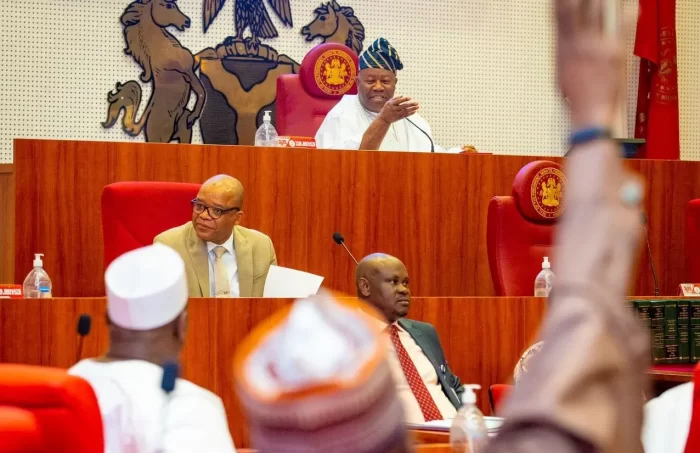
Men and women we thought were wisemen, by the virtue of the position they hold, gathered to eat entrails of the Òkété in the Nigerian senate last week. Venue was the Red Chamber of the National Assembly. For those of us who do not queue behind Wilde, when recently, the Nigerian president belatedly released the names of his nominees for ambassadorial positions, we didn’t see wisdom, we saw the fatal hinges of politics making grating noise.
But we were in for further rude shocks of human beings who got carnal in their pleasures. For once, we began to agree with another of Wilde’s submissions that behind everything exquisite, beautiful and charming things, there exists something tragic. The president’s ambassadorial appointment list appeared charming but it was tragic. It immediately reminded me of how we inverted a line of the Christian hymnal, “All things bright and beautiful, all creatures great and small, all things bright and wonderful, the Lord God made them all”.
The hymn was from the famous opening of a beloved Christian hymnal written by Cecil Frances Alexander, in 1848. Alexander used the hymn to celebrate God’s marvelous creation, divine aesthetic artistry and order. These range from tiny flowers and birds, to majestic mountains, the binary of the rich and poor, and natural creations like sun and wind. Odolaye Aremu, the late Ilorin bard, also broke this God’s artistry down into some tiny granules in his poetic rendition when he lauded God as one who created the rain, famine, winter and hot weather. He did this as he sang, “as’òjò, as’òdá, asè’kàn bí orururu, asè’kàn a dàbíi oyé…”
Pardon my insolent digression. I will digress again presently. So, I have taken liberty to inflect Alexander’s hymnal to read, in present day reality of Nigeria, “All things bright and beautiful, all creatures great and small, all things wise and wonderful, Bola Tinubu made them worse.” The ambassadorial list was an example. It consists of many of the very worst of Nigerians. But, do we know that this Nigeria that has become almost a mess of pottage in the hands of Tinubu used to be a great country?
A famous Learned Silk put a call to me last week. He took me on a fascinating but difficult-to-believe journey of Nigeria’s past greatness. Did I know how great Nigeria used to be? He enumerated them all. From Nigeria’s Anglo-Defence pact, the nationalization of the British Petroleum and other foreign companies and corporations in Nigeria under the Indigenization Decree. Under such greatness that Nigeria was enveloped, a Donald Trump would not dare talk down on Nigeria as he did recently. He dared not dare. Nigeria would square up to him. Great Pat Utomi, on a television programme last week, spoke brilliantly on how Nigeria has become strategically irrelevant in Nigeria and the world. I paraphrase him: If any country of the world wanted to take any decision against any country in Africa, Nigeria was so consequential, was such an octopodal behemoth, that they would pause to think what Nigeria would feel of such action. Today, Nigeria is rated less than a tissue paper in the eyes of even countries of Africa due to its strategic irrelevance.
Last week, Captain Ibrahim Traore of tiny landlocked Burkina Faso sent Nigeria an ‘àrokò’ of our irrelevance in Africa and even the world. In his estimation, Nigeria is all brown but brawns. In those days when there was no modern means of communication, our forefathers used àrokò, semiotic objects, to communicate.
When my people are thoroughly ashamed about a thing, or unable to fathom a turn of things for the worse, they would simply say, “ojú gbà mí tì fún e’. Literally, it reads, I am unspeakably ashamed of and for you. Last week, I was unspeakably ashamed for the figurine figure Almighty Nigeria had become today when Yusuff Tugar, Nigeria’s Foreign Minister, at a press conference with his Benin counterpart, admitted that eleven Nigerian soldiers and Air Force jet are still under the audacious military jackboots of the Burkinabe junta head. How lower can an Òmìnrán – a giant – sink? In seizing Nigeria’s jet and detaining eleven of its soldiers, Burkina Faso’s àrokò was clear and unambiguous. Nigeria is in the hands of a man whose life is all about politics of election and conquest of opposition figures and parties by stealth but zero in strategic military prowess.
To buttress Utomi and to counterpoise the little jelly power we have become, let me tell you the story of the Olusegun Obasanjo who some regime fawners and data-boy cretins of history take turns to disparage today. In July 2003, an insolent military junta had the temerity to seize power in São Tomé and Príncipe. The democratically elected president, Fradique de Menezes, was yet in Nigeria to attend an economic summit while the cretins, parodying Adewale Ademoyega, struck. Obasanjo didn’t bother to know why they struck. Not only did he condemn the coup, Obasanjo put a call to the leader of the coup plotters and gave them an ultimatum to surrender and hand power back to de Menezes. The plotters complied immediately, eventually signing an agreement to reinstate President Menezes. It was a proud Nigeria which beheld Obasanjo personally accompanying Menezes back to São Tomé and Príncipe.
Where are my manners! I have digressed incredibly, but I am back. When a man has phallic greed and parades a confetti of harem, my people say under his roof are the mentally deranged, the schizophrenic, the mad, witches, the malevolent, the benevolent and all sorts. That description fits President Tinubu’s ambassadorial list. All things bright and beautiful, Tinubu made them ugly. The list Tinubu sent to the parliament is that ugliness. To truly appreciate what befell Nigeria in that ambassadorial list, try and internalize a Yoruba proverb which says that when a calamity of monstrous dimension befalls a man, lesser indignities begin to clamber him. A list that contains Reno Omokri, Mahmood Yakubu, ex-electoral umpire and some other floating leaves without character shares synonym with the man I referenced above whose harem is populated by a rainbow of afflictions. It is a combination of asymmetric persons, what Yoruba will call an admixture of ‘lúrú’ and ‘sàpà’ as soup ingredients, the result of which is a culinary disaster.
When the list got to the senate, it mutated from a monstrous calamity into frightening indignities that clambered our country. Not that Nigerians expected anything different from the senators. As if Odolaye Aremu read that Wilde’s classic, in an elegy he did for the assassinated Premier of Nigeria’s Western Region, S. L. Akintola, Odolaye sang that when a matter is more grisly in stature than what can be countenanced, so much that even a bitter cry cannot capture the pain felt, we must burst into laughter. “Òrò t’ó bá ju ekún lo, èrín l’a fií rín,” he sang. To demonstrate this, Odolaye burst into laughter himself. Can’t we see, Odolaye asked, how dried lumps of yam called ìpáńkóró, while pounding them with pestle and mortar, have turned this routine kitchen exercise into an onomatopoeia, as the duo make the strange sound of “gba-han-ran, gba-han-ran”?
To be fair to Godswill Akpabio, his tenth senate did not pioneer the groveling groove that the Nigerian parliament, which we euphemistically call the senate, has become today. Nigeria’s National Asssembly has always been a throb in the people’s veins. In its poetry of self, our parliament is the most unpoetic of all. Yet, we expected some redemptive move from it which, like a flash in the pan, we sometimes get. Take for instance a couple of weeks ago. Nominee for the Minister of Defence portfolio, Christopher Musa, stood before the senate. A Niger State senator, consumed by the obsequious culture which Nigeria’s parliament wears as a lapel, had asked Musa to take a bow. As they say that it is a violent pedigree that will make a man seek a bullet-evading charm called Òkígbé, and that it is only he who is gifted with the metaphysical ability to see the unseen who is afraid all the time, Akpabio was livid. He must be aware that the pot of soup which all of them made ring round, tossing its pound of roasted meats inside their rapacious oesophagus at will, was under serious threat by the rascally Donald Trump. For the very first time, Akpabio was recorded to be on his feet. Venom danced round his lips like a threatened viper. How dare you! He seemed to be telling Musa, the senator. Trump is on our neck and you are asking a nominee for defence portfolio to bow and go!
But not to worry. The vulture seemed to have been sufficiently chased away from the huge gourmet meal that is Nigeria. The senate’s personal meal not looking threatened, it was time for the parliamentarians to return to their vomit. And, man, did the senators gobble this mountainous vomit! At the screening of Tinubu’s 65 career and non-career ambassadorial nominees last week, we expected the men we purportedly elected to humour us. To at least make a pretence to nationhood, that the love of Nigeria was their most prized possession. No, it was not time for base humour. So it was that, from start to finish, it was as if a huge billowing wind gushed from nowhere and exposed the rump of their hen. We saw their narcissim in its nakedness. I pray I don’t kill Oscar Wilde a second time in this piece. In his The decay of Lying, Wilde said while one recognises the poet by his fine lines, a liar can be recognised by his rich rhythmic utterance. Immediately ex-Governor Adams Oshiomhole stood up to speak, Wilde’s was what I saw. I searched Oshiomhole’s mouth meticulously. I couldn’t find a single dot of blood. You can find everything but a sprinkle of lie in the mouth of a liar, so say my people.
Senators know Nigerians love theatre, so at that screening point, they gave our people more than their fill. Between Oshiomhole and Ali Ndume, Nigerians had a mouthful. It was at the point of screening of itinerant Janus, Reno Omokri. Oshiomhole, regarded more for the lyricism in his utterances than the senses therein, first began the outburst. He said he wanted to speak on Omokri “in the public interest”. Then he threw the whole issue to the dogs and the dogs, unable to fathom it, threw it to the swines, and the swines, seeing how filthy and smelly it was, threw it into the sewage. “When I talk, those who have not been governors should listen.” Then Ndume, visibly irritated by such cant, hit back, “You have never dreamed of being a senator when I became one.” I had never seen immodesty advertized as public character as this.
Then the former governor espoused the theory of pragmatism as justification for Omokri’s reversibility. The brainchild of key figures like Charles Sanders Peirce, William James, and John Dewey, pragmatism is a philosophy which has its roots in 19th century USA. Its thrust is that the meaning, truth and value of ideas can be found in their practical consequences. I would like to look Oshiomhole in the face and ask him how he could have taken self-service to this absurdly shameless height that he did the memory of a pragmatist like John Dewey such a violent injustice. It was so bad that his bones turned in throbbing pain. Comparing his pragmatist school with the oesophagus pursuits of Omokri was verbal diarrhoea.
The day our legislature started the “bow and go” syndrome, Nigerian parliament began to atrophy. This perfunctory parliamentary approval process has highlighted severe institutional and procedural weaknesses which are now dominant in Nigeria’s legislative and democratic practice. Nigeria’s screening is so bland that it sickens. There have been allegations that huge money is tethered by the feet of the parliament’s mace before screening.
Yet screening of nominees is at the core of legislative duties. It increases openness and accountability and nourishes democracy. Inappropriate political patronage and kow-towing, the like we saw last Thursday, undermine us. How do Nigerians have a window into the minds of their ambassadors? Why not build scenario questions of contemporary bilateral situations for the nominees to answer, so that we could have a peep into their acuity? Screening also allows nominees to wittingly or unwittingly reveal certain information about themselves. For instance, in 1999, while being grilled by the South African Judicial Commission at the Constitutional Court, Justice Edwin Cameron, a respected judge who was a gay member of the South African high court, self-confessed. The grilling buoyed the commission’s reputation for making non-discriminatory appointments. In the Nigerian senate last week, most of the nominees were simply asked to take a bow and go after introducing themselves. The whole charade was highly pro-forma, perfunctory, and largely a ceremonial pumping of hands.
Senate Leader, Opeyemi Bamidele’s defence of the cancerous Bow and Go syndrome continued on the trajectory of sophistry that the Nigerian parliament is notorious for. While Akpabio, the week before, threw Bow and Go to the wolves to maul, Opeyemi resurrected it from the jaws of the carnivores and polished it for public amusement. Bamidele said the tradition is reserved for “individuals with established and verifiable records of public service.” Which is absolute bunkum. Why would the senate of Nigeria not be interested in asking Omokri questions, especially as regards Mike Arnold, an American former Mayor’s allegation against him of being a “pathological liar”?
In a letter addressed to the parliament, Arnold told the parliament that Reno was a “shape-shifting mercenary” who says whatever he is paid to say, which makes him unfit for a diplomatic role. Not done, he also claimed that Omokri’s nomination “plays into the negative international stereotype of a ‘slick scammer,’ which would de-market Nigeria on the world stage. That is Opeyemi’s “verifiable record of public service”?
What about the optics of reward-for-a-good-job embedded in a president appointing a man who superintended over his election? That appointment was immoral, adulterous and incestuous. It can be likened to a referee in a UEFA championship being engaged the following season by the winning team as coach. If the appointor was shameless to offer, the appointee must be man enough to say no. To ask Yakubu directly, when is enough really enough for him? This was a man who was executive secretary of TETFUND since 2007, assistant secretary of finance and administration at the 2014 National Conference and who spent ten years as INEC chairman. Must the straw in the feeding bottle of Nigeria be eternally in Mamood Yakubu’s mouth?
We will be dignifying the word ‘circus’ if we say what we saw in the senate last Thursday was one. What we had was people we thought were wisemen gathering to feast on the worthless intestines of an Òkété. An elderly man who eats the intestines of an Òkété is disreputable. Eating it indicates that summertime “is nigh” and it is time to close shop.