
Breaking News
BREAKING: Crisis-hit Peru expands state of emergency
The demonstrations are driven by poor southern, Indigenous Peruvians who perceive Castillo, who is also from humble origins and has Indigenous roots, as an ally in their fight against poverty, racism and inequality.

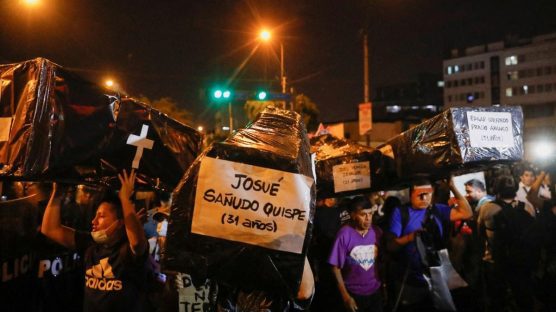
The government of Peru on Sunday expanded and prolonged a state of emergency to deal with a two-month-old revolt against President Dina Boluarte that has claimed 48 lives in clashes between protesters and security forces.
Seven southern Peruvian regions – Madre de Dios, Cusco, Puno, Apurimac, Arequipa, Moquegua and Tacna – will fall under the measure, which will remain in place for 60 days, according to a notice in the government gazette.
On January 13, the government extended by 30 days a state of emergency for Lima, El Callao, Cusco and Puno.
With the new extension not covering the capital Lima, nor El Callao – which hosts the country’s main airport and maritime terminals – the state of emergency there will expire in mid-February.
The measure authorizes the military to back up police actions to restore public order. It also suspends constitutional rights such as freedom of movement and assembly.
The decree provides for an 8:00 pm to 4:00 am curfew for 10 days in the department of Puno, the epicenter of the anti-government demonstrations, where 18 civilians and a policeman died in clashes on January 9.
Peru has been embroiled in a political crisis with near-daily demonstrations since December 7, when then-president Pedro Castillo was arrested after attempting to dissolve Congress and rule by decree.
Roadblocks erected by protesters have caused shortages of food, fuel and other basic commodities in several regions of the Andean nation.
Demonstrators are demanding the dissolution of Congress, a new constitution, and the resignation of Boluarte, who as vice president took over with Castillo gone.
Several attempts to pass a bill through Peru’s legislature to allow early elections have failed, the latest on Friday, which blocked any further debate on the topic until August.
This was followed on Saturday by violent street protests in central Lima.
The demonstrations are driven by poor southern, Indigenous Peruvians who perceive Castillo, who is also from humble origins and has Indigenous roots, as an ally in their fight against poverty, racism and inequality.
AFP



China Finances New ECOWAS Headquarters -By Kestér Kenn Klomegâh
In accordance with the agreement concluded between the ECOWAS and the Government of China, the building by the Shanghai Construction...


The Arrest Of Nicholas Maduro By The US And Other Matters -By Hajia Hadiza Mohammed
Since the advent of the current administration, the country has been weaken internally with self-serving leaders insensitive to the yearnings...


When Nations Break Their Reformers: Why EFCC Cannot Carry Nigeria’s Burden Alone — And Why Power Must Fear God -By Prof. John Egbeazien Oshodi
Public frustration with the EFCC over perceived selective enforcement is understandable. Nigerians see some arrests carried out suddenly and forcefully,...

Poor, Poor, Maduro -By IfeanyiChukwu Afuba
Little wonder his ouster elicited celebrations. The ease of his capture is telling. There is only one explanation for the...


Why African Leaders Must Fix Governance Before Crying Sovereignty -By Isaac Asabor
One of the great contradictions of African leadership today is selective morality. Leaders speak passionately about international law while violating...