
Breaking News
Court Sets Dec. 8 to Hear Nnamdi Kanu’s Motion Seeking Transfer From Sokoto Prison
The Federal High Court has set Dec. 8 to hear Nnamdi Kanu’s motion seeking transfer from Sokoto prison as he argues it hinders his right to appeal.

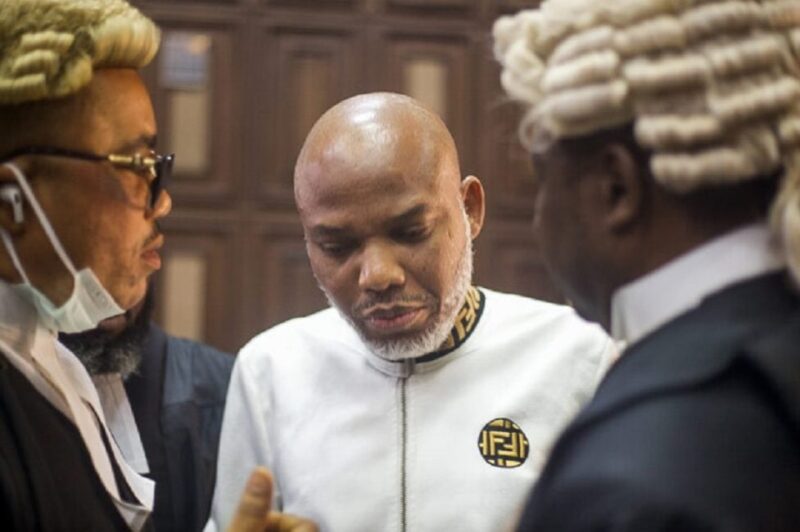
The Federal High Court in Abuja has scheduled December 8 for the hearing of an ex parte motion filed by Nnamdi Kanu, leader of the proscribed Indigenous People of Biafra (IPOB), who is seeking to be moved from the Sokoto Correctional Facility to a custodial centre closer to Abuja.
Justice James Omotosho fixed the date on Thursday after declining to hear the application when Kanu’s younger brother, Prince Emmanuel, attempted to appear on his behalf despite not being a lawyer.
In the motion ex parte, personally signed by him, Kanu asked the court to deem the motion moved in absentia since it was “impossible” for him to be present in court or chambers to argue it himself.
He is requesting an order directing the Federal Government and the Nigerian Correctional Service (NCoS) to immediately transfer him to a facility within the court’s jurisdiction. In the alternative, he seeks relocation to the Suleja or Keffi Custodial Centre to enable him pursue his constitutionally guaranteed right of appeal.
According to the News Agency of Nigeria (NAN), Kanu—convicted of terrorism offences on November 20 and currently serving a life sentence—was moved to the Sokoto Correctional Centre on November 21 after sacking his legal team and opting to represent himself.
When the matter was called, Justice Omotosho insisted that only a qualified lawyer could move the application. Emmanuel, who is not a legal practitioner, announced appearance for his brother, prompting the judge’s refusal.
“This ex parte motion cannot be moved on the convict’s behalf because you are not a legal practitioner,” the judge ruled. He advised Emmanuel to engage counsel or approach the Legal Aid Council. “When I said representation, it is not his father, brother, sister or relations I meant. I mean his counsel.”
Justice Omotosho stressed that no individual can represent another person in court without being a solicitor or advocate of the Supreme Court of Nigeria. “For you to be qualified as a lawyer, it will take you another six years or thereabout. So get a counsel to move the application,” he added.
Although noting court engagements on Monday, the judge assured that Kanu’s case would be accommodated and warned against misinforming the public about appeal procedures. He specifically described comments attributed to Aloy Ejimakor, a former counsel turned consultant, as “erroneous.”
“The defendant may not be in court to compile a record. His attendance is not required… The rights of a defendant are different from the rights of a convict,” the judge clarified, eliciting agreement from other lawyers present.
He further cautioned that any lawyer lacking proper knowledge of appellate procedure “should stop misleading the public.”
Justice Omotosho then adjourned the case to December 8 for hearing.
In his motion, filed under FHC/ABJ/CR/383/2015, Kanu listed eight grounds, including the hardship associated with his detention more than 700 kilometres from Abuja. He argued that he intends to personally file his appeal, which requires direct access to the Abuja-based Court of Appeal and court registry staff.
He maintained that his relatives, associates and legal consultants are all in Abuja, and that remaining in Sokoto makes the preparation of his appeal “impracticable,” potentially violating Section 36 of the Constitution on fair hearing.
Kanu concluded that being moved to a facility near Abuja is necessary “to effectively prosecute his appeal in the interest of justice.”
Opinion Nigeria News



The Pragmatism of Principle: Redefining Loyalty in an Age of Change -By Florence Ozor
While I do not endorse political nomadism, one must acknowledge that strategic realignment can be expedient. Take Peter Obi: after...


Lessons for Today: MLK for Continental African Leadership – A Psychoafricalytic Mirror for Power, Dignity, and Continental Renewal -By Psychologist John Egbeazien Oshodi
When African leaders abandon indigenous wisdom, they often adopt the colonial logic of control. Citizens become subjects. Protest becomes treason....


The Poverty Crisis: A Global Challenge to Human Dignity and Development -By Jennifer Joab
The poverty crisis is not just an economic problem but a profound human tragedy that affects the social, political, and...


Good Governance as a Tool for National Development -By Blessing Matthew
Good governance prioritizes the interests and welfare of the people above personal or sectional interests. It encourages transparency, accountability, rule...


Role of Youths in Nation Building -By Kusompwa Lazarus Motiyedi
It is true that today’s youth did not experience the horrors of the Nigerian Civil War or the severe economic...