
Breaking News
Emergency Rule: Supreme Court Affirms President’s Power to Suspend Elected Officials
Nigeria’s Supreme Court has affirmed the President’s constitutional authority to declare emergency rule and suspend elected officials, ruling in a split decision while stressing such actions must be temporary and limited in duration.

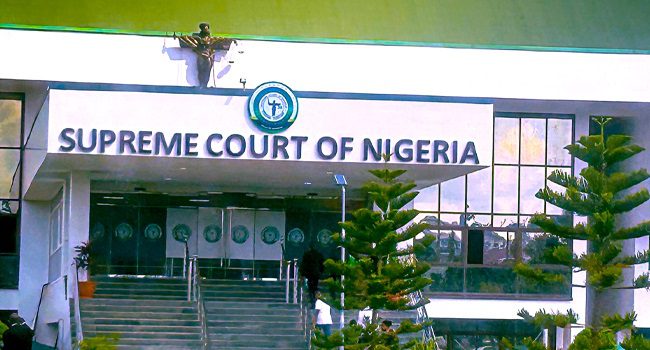
The Supreme Court on Monday upheld the constitutional authority of the President to declare a state of emergency in any part of the country to prevent a breakdown of law and order, affirming that such powers may include the suspension of elected officials.
In a split decision of six to one, a seven-member panel of the apex court declined to fault the suspension of governors, deputy governors and state lawmakers during emergency rule, but emphasised that such action must be temporary and limited in duration.
The ruling followed the dismissal of a suit filed by 11 states, all governed by the opposition Peoples Democratic Party (PDP), challenging President Bola Tinubu’s actions in Rivers State after he proclaimed emergency rule.
The states, through their Attorneys-General, questioned the President’s powers to suspend a sitting governor, deputy governor and members of a State House of Assembly following the declaration of emergency rule. They urged the court to rule that, under Sections 1(2), 5(2) and 305 of the 1999 Constitution (as amended), the President “has no powers whatsoever or vires to suspend a democratically elected governor and deputy governor of a state in the federation of Nigeria under the guise of or pursuant to the proclamation of a state of emergency.”
They also sought a declaration that the President lacked authority to suspend a democratically elected House of Assembly under Sections 192(4), 192(6) and 305 of the Constitution, and argued that the suspension of Rivers State Governor Siminalayi Fubara, his deputy and state lawmakers was unconstitutional and unlawful.
The Attorney-General of the Federation and the National Assembly were listed as first and second defendants in the suit marked SC/CV/329/2025.
Delivering the majority judgment, Justice Mohammed Idris held that Section 305 of the Constitution empowers the President to adopt “extraordinary measures” to restore order once a state of emergency is declared. The court noted that the provision does not clearly define the scope of such measures, thereby granting the President discretion on how to manage emergency situations.
The court also upheld preliminary objections raised by the defendants, ruling that the plaintiffs failed to establish a cause of action or justify the invocation of the Supreme Court’s original jurisdiction. It held that the case did not amount to a dispute between the federation and the states, as required for the apex court to act as a court of first instance.
Consequently, the suit was dismissed for want of jurisdiction.
However, Justice Obande Ogbuinya dissented, ruling that while the President has the power to declare a state of emergency, such authority does not extend to suspending elected officials, including governors, deputy governors and state lawmakers.
Other members of the panel who aligned with the majority judgment included Justices Inyang Okoro, Chioma Nwosu-Iheme, Haruna Tsammani, Stephen Adah and Habeeb Abiru.
President Tinubu had on March 18 declared a state of emergency in Rivers State, suspending Governor Fubara, his deputy and members of the State House of Assembly for six months. He appointed Vice Admiral Ibok-Ete Ibas as Sole Administrator to oversee the state during the period, a decision later endorsed by both chambers of the National Assembly.
The PDP-controlled states subsequently filed the suit, which was struck out by the Supreme Court on Monday.
Opinion Nigeria News

Cease The Unchecked Looting -By Abba Dukawa
To address this, the Independent Corrupt Practices and Other Related Offences Commission (ICPC) and the Economic and Financial Crimes Commission...


Moscow University Museum Presents Insights into African Artistic Culture -By Kestér Kenn Klomegâh
In his contribution, Louis Gouend, Chairman of the Commission for Work with African Diasporas at Moscow State University's Russian-African Club,...


Justice, Peace And Integrity Of Creation Prerequisite To Good Living -By Melissa Thomas
There are many ways to promote peace in our world of today but perhaps the best way is to promote...

Africa Squeezed Between Import Substitution and Dependency Syndrome -By Kestér Kenn Klomegâh
The key buyers of Russian grain on the continent are Egypt, Algeria, Kenya, Libya, Tunisia, Nigeria, Morocco, South Africa, Tanzania...

Accelerating Intra-Africa Trade and Sustainable Development -By Kestér Kenn Klomegâh
The AU Private Sector Forum has held several forums, with key recommendations. These recommendations provide valuable insights into the challenges...