
National Issues
Farukgate: Is the Rift Fueled by Genuine Corruption Concerns or a Battle for Survival? -By Abba Dukawa
The fact that former NMDPRA resigned from his position shows that he did not leave of his own free will; he was compelled to do so after meeting with the President. In an ideal system, the former Farouk Ahmad would have stepped aside once the allegation was made, pending the outcome of the ICPC investigation. Instead, he chose to disown the earlier statement attributed to him and act as if nothing had happened.


The impasse between Aliko Dangote President and former Chief Executive Officer of Dangote Industries Limited—and Farouk Ahmed, former Managing Director of the Nigerian Midstream and Downstream Petroleum Regulatory Authority (NMDPRA), raises a critical question: does the rift stem from genuine concerns over regulatory impunity and the alleged diversion of national resources for personal gain, or is it a strategic battle by both sides to protect entrenched interests?
The dispute dates back to July 2024, when the NMDPRA alleged that locally refined petroleum products—including those produced by the Dangote Refinery were inferior to imported fuel. Dangote swiftly countered by arranging independent testing of his diesel in full public view, directly challenging the regulator’s claims. Although the disagreement initially appeared subdued, the rift has quietly persisted.
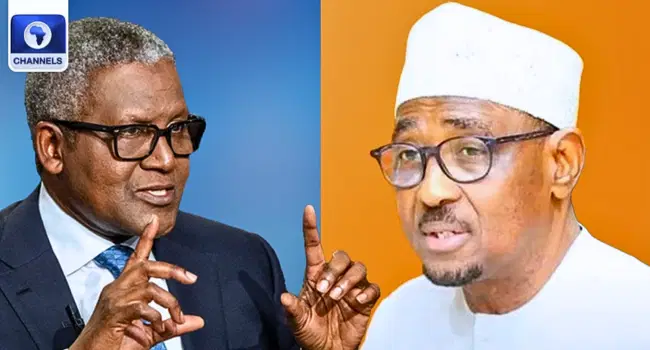
Meanwhile, the Dangote Refinery has continued to advance aggressively within Nigeria’s petroleum sector. The refinery plans to supply 1.5 billion litres of Premium Motor Spirit (PMS) monthly approximately 50 million litres per day beginning in December 2025. In a bid to promote transparency, Dangote has invited the NMDPRA to verify its daily production as output increases.
Amid this strained relationship, tensions have escalated. Dangote has accused the NMDPRA leadership of colluding with international traders and fuel importers to undermine local refining by issuing import licences that allow cheap imported fuel to flood the market, thereby disadvantaging domestic producers.
In November, the authority issued licences permitting the importation of up to 52 million litres of petrol per day, citing inadequate domestic supply and broader market considerations. In addition The former NMDPRA chief executive officer has firmly denied these accusations, arguing that Dangote seeks to monopolise petroleum‑product sales in Nigeria
The conflict intensified when Dangote publicly alleged corruption against the NMDPRA’s managing director. He accused Ahmed of approving excessive fuel imports that threaten Nigeria’s refining capacity and energy security, while also claiming that Ahmed is living far beyond his legitimate means. These allegations have reignited long‑standing concerns about corruption in Nigeria’s energy sector and its damaging consequences for the national economy.
In a dramatic escalation, Dangote formally petitioned the Independent Corrupt Practices and Other Related Offences Commission (ICPC), accusing Farouk Ahmed of corruption, abuse of office, and illicit enrichment. According to the petition, Ahmed allegedly spent over $7 million on the education of his four children in Switzerland, reportedly paying six years’ tuition upfront—an expenditure Dangote claims cannot be justified by Ahmed’s lawful income. Dangote has stated that he is prepared to appear before investigators and present documentary evidence to substantiate his claims.
In response, the NMDPRA chief distanced himself from a statement circulating in his name, asserting that it did not originate from him. While acknowledging awareness of what he described as “wild and spurious allegations” against him and his family, Ahmed said he deliberately chose not to engage in public exchanges. “Thankfully, the person behind the allegations has taken the matter to a formal investigative institution. This will provide an opportunity to dispassionately examine the issues and clear my name,” he said.
Corruption has eroded public trust and deprived citizens of essential services and opportunities in the country. Its effects are evident in the nation’s stunted economic growth and deteriorating infrastructure. As a private investor, Dangote has delivered the long‑missing infrastructure, but he now bumps into regulatory obstacles from an authority whose very mandate is to promote efficiency, investment and growth in the downstream sector. The standoff between Aliko Dangote and the NMDPRA lays bare deeper contradictions in Nigeria’s petroleum‑governance framework.
Consequently, the ongoing dispute between the Dangote Group and Farouk Ahmed has become a litmus test for President Bola Tinubu’s administration in demonstrating genuine commitment to the fight against corruption. In the interest of public accountability, Nigeria’s anti‑corruption agencies must conduct a thorough investigation into the allegations raised by Dangote—particularly the claim that a civil servant could afford to spend $7 million on his children’s education. The alleged $7 million in children’s school fees equivalent to about ₦10.19 billion at today’s mid‑market rate of roughly ₦1,455 per dollar. Even the country’s richest individuals would likely find such spending excessive; it is simply a waste of resources.
Despite the heinous breach of public trust, Farouk Ahmed appears unashamed of his actions. I know he is still innocent in the eyes of the law, but how can a civil servant in Nigeria afford such a huge sum if he is honest? This level of impunity must no longer be accepted in the public interest.
The fact that former NMDPRA resigned from his position shows that he did not leave of his own free will; he was compelled to do so after meeting with the President. In an ideal system, the former Farouk Ahmad would have stepped aside once the allegation was made, pending the outcome of the ICPC investigation. Instead, he chose to disown the earlier statement attributed to him and act as if nothing had happened.
Therefore, President Tinubu demonstrate his commitment in fighting corruption and breaches of public office by ensuring that the former chief executive officer of the NMDPRA resigned. What is important now is that the matter not be allowed to pass without determining who is truly at fault between them.
The challenge before the Independent Corrupt Practices and Other Related Offences Commission (ICPC) is to proceed with the petition that has been forwarded to the agency. Although the NMDPRA chief has resigned, the ICPC should still carry out a comprehensive, transparent investigation. The investigation should involve both the accuser and the accused, even though the accuser has offered to appear before investigators and present documentary evidence. Only through a comprehensive investigation can it be determined whether the rift between Aliko Dangote and Engr. Farouk Ahmed is a genuine concern over corruption or a high‑stakes battle for survival and market control.
Dukawa is a journalist, public‑affairs analyst, and political commentator. He can be reached at abbahydukawa@gmail.com.


Second Ministerial Conference: Shaping Russian-African Strategic Partnerships -By Kestér Kenn Klomegâh
As indicated from above, the most important issues of multifaceted development are included on the Russian-African agenda, with a focus...


When Matrimony Is Dead On Arrival, The Wedding Was Only A Ceremony -By Isaac Asabor
Marriage is not for everyone, and that truth needs to be said plainly. It requires emotional intelligence, self-control, humility, and...


Awards Without Impact: Rethinking ‘Good Governance’ In Bauchi State -By Yasir Shehu Adam
True good governance is not proven in Abuja halls or award plaques. It is proven in functional classrooms, well-equipped hospitals,...


When “Happily Ever After” Starts Expiring: A Deep Dive into the Alarming Rise of Failed Marriages -By Peace Adams Bitrus
Weddings have become theatrical performances. Months of planning, millions spent, lights, cameras, choreographed dances… but very little attention is given...
Cease The Unchecked Looting -By Abba Dukawa
To address this, the Independent Corrupt Practices and Other Related Offences Commission (ICPC) and the Economic and Financial Crimes Commission...