
Breaking News
Federal Highways of Horror: Collapsed Roads Turning Travel into Nightmare Across Nigeria – REPORT
An investigation reveals that Nigeria’s collapsing federal highways have turned deadly, with over 80% of road accidents linked to poor maintenance and neglect. From Lagos to Cross River, commuters face daily risks on impassable, crumbling roads.

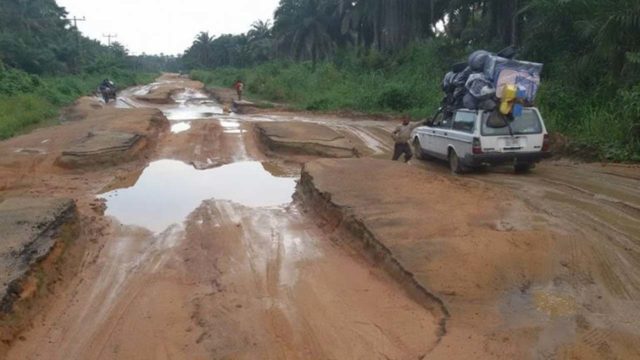
Federal Highways of Horror: Collapsed Roads Turning Travel into Nightmare Across Nigeria
An investigation has revealed that Nigeria’s collapsing federal highways have become death traps for commuters, with fatal accidents surging nationwide due to deteriorating infrastructure and poor maintenance.
Findings by Opinion Nigeria show that over 80% of reported road accidents are linked to the deplorable condition of major highways and the inefficiency of road management authorities. Once lifelines of commerce and connection, these roads have degenerated into perilous routes scarred by craters, potholes, and erosion.
Travelling on these roads has become not just uncomfortable but dangerous, as motorists frequently lose control while navigating treacherous sections, resulting in deadly crashes.
Despite Nigeria boasting the largest road network in West Africa — with over 108,000 kilometres of surfaced roads — neglect and lack of maintenance have turned the country’s highways into hazards.
Lagos and the South-West: Gridlocks and Gaping Craters
In Lagos and neighbouring South-West states, road users endure daily ordeals navigating failed sections of key federal highways, including the Lagos-Ota Road, Lagos-Sagamu-Ibadan Expressway, Apapa/Tin Can Port Road, and Lagos-Badagry Expressway.
Commuters lament that many of these projects, though awarded for rehabilitation, were abandoned mid-way. At Mushin, Olosha, and Dorman Long on the Agege Motor Road, failed portions filled with gravel have worsened, causing gridlocks and vehicle damage.
“The road is not good. I’ve spent over N150,000 repairing my Korope in the last few months,” said motorist Damola Oloyede. “It’s been neglected for over five years.”
Residents also complain that hoodlums exploit the poor road conditions to rob motorists at night, while dust pollution poses health risks.
Ondo and Ekiti: Roads of Economic Despair
In Ondo State, travellers now spend over an hour and a half commuting between Akure and Ado-Ekiti — a journey that once took 30 minutes. Deep gullies and failed portions have forced motorists to take longer, costlier routes.
“This road is vital for business between Ondo and Ekiti states. We are really suffering due to the delay in completion,” lamented driver Kunle Ajiroba.
Governor Lucky Aiyedatiwa said the state government may assume responsibility for key federal roads to ease the suffering of residents.
In Ekiti, highways such as the Ado–Akure and Ifaki–Oye–Ikole–Omuo–Abuja roads are riddled with craters and collapsed drainages. Drivers say navigating them has become a matter of survival.
“You dodge one hole and face oncoming traffic,” said driver Banjo Olajide. “At night, it’s even worse.”
South-South: Death Traps and Endless Delays
Across the South-South, particularly in Rivers, Delta, Edo, Akwa Ibom, and Cross River states, many federal roads are virtually impassable. The East–West Road remains a recurring nightmare despite repeated government promises.
In Edo, the Benin–Auchi–Lokoja and Benin–Warri highways are collapsing, leading to frequent accidents and kidnappings. Residents say construction has dragged on for years, with sections still awaiting rehabilitation.
Delta monarchs, including the Asagba of Asaba and the Ovie of Idjerhe, have condemned the state of highways in the region.
“We no longer have roads in the South-South — what we have now are death traps,” lamented King Obukowho Monday Whiskey.
In Cross River, members of the National Assembly Committee on Works recently called for a national emergency on road infrastructure after inspecting the Calabar–Itu highway.
“This is the worst I have ever seen,” said Committee Chairman Akinola Alabi. “Something must be done urgently.”
Ministry of Works: “We Are Overwhelmed”
A senior official of the Federal Ministry of Works, who spoke anonymously, acknowledged the severity of the crisis, citing poor funding, outdated contracts, and contractor inefficiency as major obstacles.
“We are stretched thin by many factors, including poor funding and messy contract arrangements. Some contractors have multiple jobs but no capacity to deliver. The situation is overwhelming,” the source said.
Minister of Works, David Umahi, recently secured presidential approval to revoke several stalled road contracts, including portions of the Abuja–Kaduna–Kano highway, as part of efforts to fast-track ongoing rehabilitation.
Despite government assurances, millions of Nigerians continue to endure unbearable road conditions that have crippled mobility, increased insecurity, and cost countless lives across the nation.
Opinion Nigeria News


Africa’s Crisis of Military Coups and Insecurity -By Safiya Zakari Muhammad
The erosion of democracy has also weakened regional and international security cooperation. In some cases, juntas have expelled traditional partners...


Governor Uba Sani’s Resolute Commitment On Rural Development -By Abdulrashid Sani Gimi
In the long run, the 2026 fiscal strategy transcends conventional budgetary practice. With a total outlay of ₦985.9 billion, a...


Lack of Financial Support Holding Back Russia’s Economic Influence in Africa: A Case Study of Missed Opportunities in Nigeria -By Kestér Kenn Klomegâh
As Africa's largest economy, Nigeria cannot afford another decade of promises without projects. The future of its development lies with...


The Impact Of Social Media On Youth Mental Health -By Jemimah Hezekiah
Governments and tech companies also have a role to play. Enforcing anti-cyberbullying policies, offering digital literacy programs, and providing mental...

Every Night We Pray to Survive: Voices from Insecure Communities -By Rinret istifanus
As the nation debates policies and strategies, these voices remind us that insecurity is not just a headline it is...