
National Issues
Hijab not a scarf -By Abdulkadir Jimoh
It is recommended that women wear clothing that is not form fitting to the body, such as modest forms of Western clothing (long shirts and skirts), or the more traditional jilbāb, a high-necked, loose robe that covers the arms and legs. A khimār or shaylah , a scarf or cowl that covers all but the face, is also worn in many different styles.

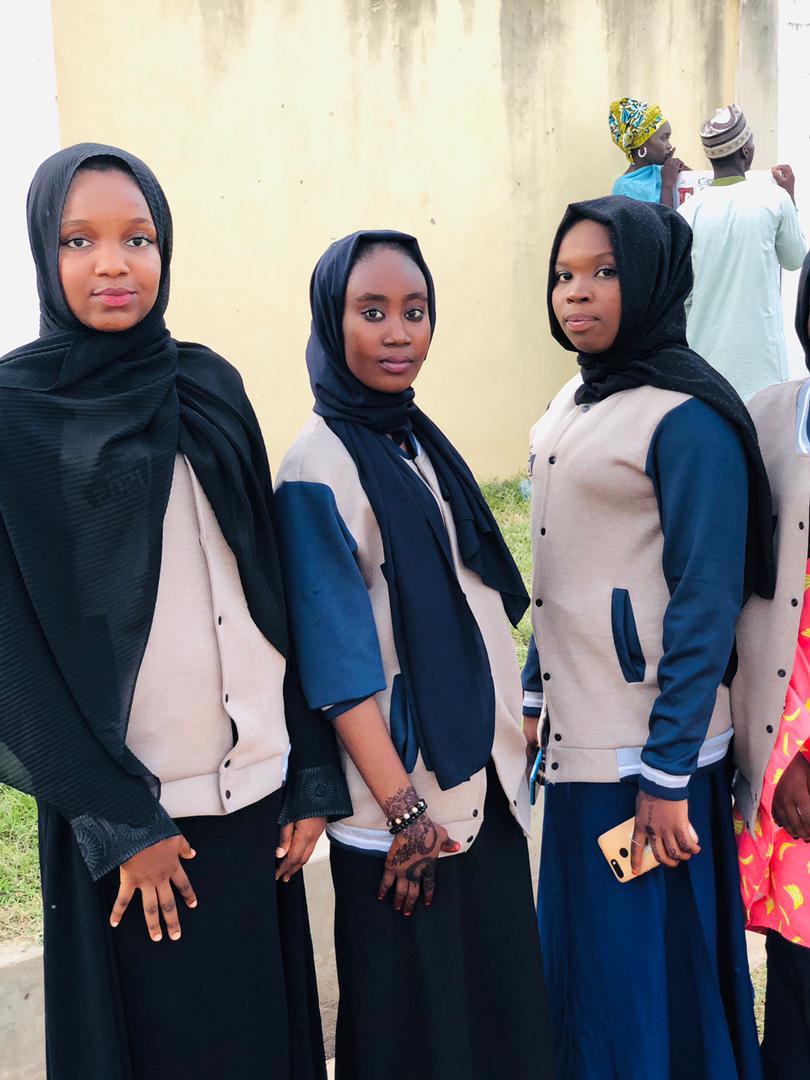
The Qur’an instructs Muslim women and men to dress modestly . Some Islamic legal systems define this type of modest clothing as covering everything except the face and hands up to the wrists. Check Qur’an 33 vs 59
Hijab in common English usage is a religious veil worn by many Muslim women in the presence of any male outside of their immediate family, which usually covers the hair, head and chest. The term can refer to any hair, head, face, or body covering worn by Muslim women that conforms to Islamic standards of modesty . Another interpretation can also refer to the seclusion of women from men in the public sphere, whereas a metaphysical dimension, may refer to “the veil which separates man, or the world, from God”.
For some believers of the Quran, Hadith and other classical Arabic texts, the term khimār ( Arabic : ﺧِﻤﺎﺭ ) was used to denote a headscarf, and ḥijāb was used to denote a partition, a curtain, or was used generally for the Islamic rules of modesty and dress for females.
In its traditionalist form, the hijab is worn by Muslim women to maintain modesty and privacy from unrelated males. According to the Encyclopedia of Islam and Muslim World , modesty concerns both men’s and women’s “gaze, gait, garments, and genitalia”. The Qur’an instructs Muslim women and men to dress modestly. Some Islamic legal systems define this type of modest clothing as covering everything except the face and hands up to the wrists. These guidelines are found in texts of hadith and fiqh developed after the revelation of the Qur’an but, according to some, are derived from the verses ( ayahs ) referencing hijab in the Qur’an. Some believe that the Qur’an itself does not mandate that women need to wear a hijab.
In the verses of the Qur’an, the term hijab refers to a curtain separating visitors to Muhammad’s main house from his wives’ residential lodgings. This interpretation has led some to claim that the mandate of the Qur’an to wear hijab applied only to the wives of Muhammad, and not to entirety of women.
Wearing Hijab in public is not required by law in Saudi Arabia. It is required by law in Afghanistan , Iran and the Indonesian province of Aceh . Other countries, both in Europe and in the Muslim world , have passed laws banning some or all types of hijab in public or in certain types of locales. Women in different parts of the world have also experienced unofficial pressure to wear or not wear a hijab.
QUR’AN
The Quran instructs both Muslim men and women to dress in a modest way, but there is disagreement on how these instructions should be interpreted. The verses relating to dress use the terms khimār (veil) and jilbāb (a dress or cloak) rather than ḥijāb . Of the more than 6,000 verses in the Quran, about half a dozen refer specifically to the way a woman should dress or walk in public.
The clearest verse on the requirement of modest dress is Suratul Noor 24 :31, telling women to guard their private parts and draw their khimār over their bosoms.
And say to the believing women that they should lower their gaze and guard their private parts; that they should not display their beauty and ornaments except what (must ordinarily) appear thereof; that they should draw their khimār over their breasts and not display their beauty except to their husband, their fathers, their husband’s fathers, their sons, their husbands’ sons, their brothers or their brothers’ sons, or their sisters’ sons, or their women, or the slaves whom their right hands possess, or male servants free of physical needs, or small children who have no sense of the shame of sex; and that they should not strike their feet in order to draw attention to their hidden ornaments. Quran 24:31
In Suratul Ahzab 33 :59 Muhammad Peace be upon him is commanded to ask his family members and other Muslim women to wear outer garments when they go out, so that they are not harassed:
O Prophet! Enjoin your wives, your daughters, and the wives of true believers that they should cast their outer garments over their persons (when abroad): That is most convenient, that they may be distinguished and not be harassed. Quran 33:59
The Islamic commentators generally agree this verse refers to sexual harassment of women of Medina . It is also seen to refer to a free woman, for which Tabari cites Ibn Abbas . Ibn Kathir states that the jilbab distinguishes free Muslim women from those of Jahiliyyah, so other men know they are free women and not slaves or prostitutes, indicating covering oneself does not apply to non-Muslims. He cites
Sufyan al-Thawri as commenting that while it may be seen as permitting to look upon non-Muslim women who adorn themselves, it is not allowed in order to avoid lust. Al-Qurtubi concurs with Tabari about this ayah being for those who are free. He reports that the correct view is that a jilbab covers the whole body. He also cites the Sahabah as saying it is no longer than a rida (a shawl or a wrapper that covers the upper body). He also reports a minority view which considers the niqab or head-covering as jilbab. Ibn Arabi considered that excessive covering would make it impossible for a woman to be recognised which the verse mentions, though both Qurtubi and Tabari agree that the word recognition is about distinguishing free women.
Some scholars like Ibn Hayyan , Ibn Hazm and Muhammad Nasiruddin al-Albani questioned the ayah’s common explanation. Hayyan believed that “believing women” referred to both free women and slaves as the latter are bound to more easily entice lust and their exclusion is not clearly indicated. Hazm too believed that it covered Muslim slaves as it would violate the law of not molesting a slave or fornication with her like that with a free woman. He stated that anything not attributed to Muhammad should be disregarded.
The word ḥijāb in the Quran refers not to women’s clothing, but rather a spatial partition or curtain. Sometimes its use is literal, as in the verse which refers to the screen that separated Muhammad’s wives from the visitors to his house (33:53), while in other cases the word denotes separation between deity and mortals (42:51), wrongdoers and righteous (7:46, 41:5), believers and unbelievers (17:45), and light from darkness (38:32).
The interpretations of the ḥijāb as separation can be classified into three types:
i. as visual barrier,
ii. physical barrier,
iii. and ethical barrier.
I. A visual barrier (for example, between Muhammad’s family and the surrounding community) serves to hide from sight something, which places emphasis on a symbolic boundary.
II. A physical barrier is used to create a space that provides comfort and privacy for individuals, such as elite women.
III. An ethical barrier, such as the expression purity of hearts in reference to Muhammad’s wives and the Muslim men who visit them, makes some thing forbidden.
HADEETH
Narrated Umm Salama Hind bint Abi Umayya, Ummul Mu’minin: “When the verse ‘That they should cast their outer garments over their breasts’ was revealed, the women of Ansar came out as if they had crows hanging down over their heads by wearing outer garments.” 32:4090 . Abū Dawud classed this hadith as authentic.
Narrated Safiya bint Shaiba : “Aisha used to say: ‘When (the Verse): “They should draw their veils (khimaar) over their breasts (juyyub) ,” was revealed, (the ladies) cut their waist sheets at the edges and veiled themselves (Arabic: ﻓَﺎﺧْﺘَﻤَﺮْﻥَ , lit. ’to put on a hijab’) with the cut pieces.’” Sahih al-Bukhari , 6:60:282 , 32:4091 . This hadith is often translated as “…and covered their heads and faces with the cut pieces of cloth,” as the Arabic word used in the text (Arabic: ﻓَﺎﺧْﺘَﻤَﺮْﻥَ ) could include or exclude the face and there was ikhtilaf on whether covering the face is farḍ , or obligatory. The most prominent sharh , or explanation, of Sahih Bukhari is Fatḥ al-Bārī which states this included the face.
Yahya related to me from Malik from Muhammad ibn Zayd ibn Qunfudh that his mother asked Umm Salama, the wife of the Prophet, may Allah bless him and grant him peace, “What clothes can a woman wear in prayer?” She said, “She can pray in the khimār (headscarf) and the diri’ (Arabic: ﺍﻟﺪِّﺭْﻉِ, lit. ’shield, armature’, transl. ’a woman’s garment’) that reaches down and covers the top of her feet.” Muwatta Imam Malik book 8 hadith 37.
Aishah narrated that Allah’s Messenger said: “The Salat (prayer) of a woman who has reached the age of menstruation is not accepted without a khimār.” Jami` at-Tirmidhi 377.
Traditionally, the four major Sunni schools of thought ( Hanafi , Shafi’i , Maliki and Hanbali ) hold by consensus that it is obligatory for the entire body of the woman, except her hands and face (and feet according to Hanafis) to be covered during prayer and in the presence of people of the opposite sex other than close family members (whom one is forbidden to marry.
According to Hanafis and other scholars, these requirements extend to being around non-Muslim women as well, for fear that they may describe her physical features to unrelated men.
Men must cover from their belly buttons to their knees, though the schools differ on whether this includes covering the navel and knees or only what is between them.
It is recommended that women wear clothing that is not form fitting to the body, such as modest forms of Western clothing (long shirts and skirts), or the more traditional jilbāb, a high-necked, loose robe that covers the arms and legs. A khimār or shaylah , a scarf or cowl that covers all but the face, is also worn in many different styles.
Some Salafi scholars such as Muhammad ibn al Uthaymeen believe that covering the hands and face for all adult women is obligatory.
Am using this medium to call on Parents/Guardians to take care of their female children most especially the secondary students before given the admission into the tertiary institution.
Narrated Ibn ‘Umar:
… ﺃَﻻَ ﻛُﻠُّﻜُﻢْ ﺭَﺍﻉٍ ﻭَﻛُﻠُّﻜُﻢْ ﻣَﺴْﺌُﻮﻝٌﻋَﻦْ ﺭَﻋِﻴَّﺘِﻪِ
That the Prophet ( ﷺ ) said: “Indeed each of you is a shepherd and all of you will be questioned regarding your flock. The commander who is in authority over the Muslims is responsible and he will be questioned regarding his responsibility. The man is responsible over the inhabitants of his house and he is the one who will be questioned about them. The wife is responsible in her husband’s house and she will be questioned about it. The slave is responsible regarding his master’s property, and he will be questioned about it. Indeed each of you is a shepherd and each of you will be questioned about his flock.”
[Abu ‘Eisa said:] There are narrations on this topic from Abu Hurairah, Anas, and Abu Musa. The Hadith of Abu Musa is not preserved, and the Hadith of Anas is not preserved. And the Hadith of Ibn ‘Umar is Hasan Sahih Hadith.
Jazaakumullah Khaira



Second Ministerial Conference: Shaping Russian-African Strategic Partnerships -By Kestér Kenn Klomegâh
As indicated from above, the most important issues of multifaceted development are included on the Russian-African agenda, with a focus...


When Matrimony Is Dead On Arrival, The Wedding Was Only A Ceremony -By Isaac Asabor
Marriage is not for everyone, and that truth needs to be said plainly. It requires emotional intelligence, self-control, humility, and...


Awards Without Impact: Rethinking ‘Good Governance’ In Bauchi State -By Yasir Shehu Adam
True good governance is not proven in Abuja halls or award plaques. It is proven in functional classrooms, well-equipped hospitals,...


When “Happily Ever After” Starts Expiring: A Deep Dive into the Alarming Rise of Failed Marriages -By Peace Adams Bitrus
Weddings have become theatrical performances. Months of planning, millions spent, lights, cameras, choreographed dances… but very little attention is given...

Cease The Unchecked Looting -By Abba Dukawa
To address this, the Independent Corrupt Practices and Other Related Offences Commission (ICPC) and the Economic and Financial Crimes Commission...