
Political Issues
Is Amewhule Plotting A Democratic Coup? Questions Rivers State Can No Longer Ignore -By Isaac Asabor
So far, Nigerians have heard plenty of noise over the move to impeach Fubara and his deputy, but very little substance. Allegations have been vague. Accusations have been recycled. The moral weight required to justify such a drastic step is glaringly absent. This is why many Nigerians, across party lines, have described the move as baseless, reckless, and politically motivated.

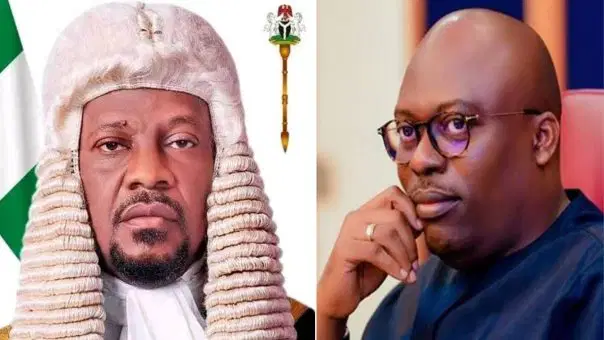
There comes a point in every political crisis when silence becomes complicity and pretense turns into insult. Rivers State has reached that point. What is unfolding around the Speaker of the Rivers State House of Assembly, Martin Amaewhule, is no longer just a disagreement between arms of government. It has mutated into a troubling spectacle that raises a fundamental question Nigerians are increasingly asking in private and now aloud: “Is Amaewhule fighting Governor Siminalayi Fubara and his deputy so that he can become governor by the backdoor?”
If the answer is no, and Amaewhule insists it is, then the burden of explanation rests squarely on him. Because nothing about the current legislative onslaught makes political, moral, or democratic sense.
Why target the governor and his deputy at the same time? Why the desperation? Why the forcefulness? Why the refusal to read the public mood? Why the haste to pull down an entire executive structure without any convincing justification? Above all, why does the Speaker’s body language scream ambition, even when his words try to deny it? These are not idle questions. They go to the heart of democratic governance in Rivers State.
Without a doubt, the move to simultaneously remove both the governor and his deputy defies logic. In constitutional democracies, impeachment is not a toy. It is not a political cudgel to be swung in moments of anger or loyalty. It is an extreme measure reserved for extreme circumstances, gross misconduct clearly defined, credibly established, and transparently proven. Yet, what Rivers people are witnessing is an attempt to remove both the governor and his deputy in one sweep, as if the state were clearing debris rather than dealing with elected leaders.
Even though a deputy governor is constitutionally expected to step in for the governor whenever the latter is absent, Nigeria’s political reality tells a far less cooperative story. Since the return to democracy in 1999, the record is clear and well documented: governors and their deputies more often than not operate at cross-purposes, locked in rivalry, suspicion, or outright hostility rather than harmony. Against this backdrop, the decision to target both offices simultaneously should unsettle any serious observer. Governors and deputies are not political twins; they can disagree, one can falter while the other objects. Their duties, powers, and personal conduct are separate. That being the case, what exactly is the common sin, so extraordinary and so indivisible, that warrants the unprecedented move to simultaneously remove both?
The actions of Amaewhule and his cohorts are truly unprecedented. Never in Nigeria’s political history have a sitting governor and deputy been impeached together as part of a coordinated legislative move.
Repeatedly, the impeachment of a governor, frequently amidst controversy, has resulted in the automatic elevation of the deputy governor, in line with constitutional provisions. Examples include Jonathan succeeding Alamieyeseigha in Bayelsa, as well as the cases of Ladoja in Oyo, Fayose in Ekiti, and Dariye in Plateau. In all such instances, the deputy was not removed alongside the governor
What has happened repeatedly is this: a governor is impeached (sometimes controversially), and the deputy automatically steps in as governor, in line with constitutional succession. In Bayelsa, Jonathan took over from Alamieyeseigha, In Oyo Ladoja’s governorship, in Ekiti under Fayose’s governorship, in Plateau under Dariye, and others all followed this pattern. In none of these cases was the deputy removed alongside the governor.
There have also been situations where deputies were impeached alone; governors were removed by court judgments rather than impeachment, governors were incapacitated or died, with deputies taking over, .and deputies resigned or defected. But dual impeachment has never happened. Not once.
That is not a coincidence. The 1999 Constitution deliberately structures impeachment and succession to avoid a power vacuum. Removing both offices at the same time would undermine stability and invite manipulation, something the framers clearly sought to prevent.
Therefore, when a political process appears designed, directly or indirectly, to take out both the governor and the deputy, it is not just unusual. It is historically unprecedented and constitutionally suspect, and it inevitably raises the question that refuses to go away: if both are removed, who exactly is waiting in the wings?
So far, Nigerians have heard plenty of noise over the move to impeach Fubara and his deputy, but very little substance. Allegations have been vague. Accusations have been recycled. The moral weight required to justify such a drastic step is glaringly absent. This is why many Nigerians, across party lines, have described the move as baseless, reckless, and politically motivated.
Not a few readers of this piece may have wondered why this writer is so obsessed with the happenings surrounding the plot to impeach both Fubara and his deputy. The reason for his obsession or worry cannot be farfetched as no democratic-minded person would be comfortable seeing democracy been treated so casually. In fact, with the plot, democracy itself is weakened, and questions about motive become unavoidable. Politics abhors a vacuum. If both the governor and the deputy are removed, power does not disappear; it simply relocates. Given the backdrop of the foregoing, not a few Nigerians are asking if the impeachment process sails through, God forbid, who benefits?
To answer the foregoing question, there is no denying the fact that in the line of succession, the Speaker does. This is not speculation; it is constitutional reality. In addition, it is precisely this reality that makes Amaewhule’s aggressive posture deeply suspicious. If he were merely defending legislative independence or enforcing constitutional order, restraint would have been his ally. Process would have been his shield. Public persuasion would have been his strategy.
Instead, what Rivers people see is force. What they hear is threat. What they sense is impatience. That is not the body language of a neutral umpire. It is the posture of a man who believes time is against him and power must be seized quickly or not at all.
In fact, body language does not lie. In politics, words are cheap. Body language is expensive, it reveals intent. Amaewhule’s body language throughout this crisis has been confrontational, dismissive of public concern, and deaf to calls for moderation. He has acted less like a presiding officer holding a fragile democracy together and more like a general leading a siege.
A Speaker confident in the righteousness of his cause does not need to bulldoze institutions. He does not need to appear perpetually angry. He does not need to treat dissent as treason or caution as weakness. Yet, Amaewhule has done all these.
His insistence, even when the national mood is clearly hostile to the idea, suggests more than legislative duty. It suggests a personal stake in the outcome, one too large to ignore. Ambition is not a crime, but the path matters.
Let it be said clearly: there is nothing immoral about wanting to be governor of Rivers State. After all, ambition is the oxygen of politics. Without it, leadership stagnates. Odd enough, what is immoral is attempting to achieve that ambition through subversion. If Amaewhule believes he has what it takes to lead Rivers State, the path is well known and clearly marked. Build a political base. Convince the people. Win a party ticket. Face the electorate. Earn the mandate. That is the democratic route.
What he must not do, what he should not even contemplate is using the legislature as a battering ram to collapse the executive so he can walk into power without the people’s consent. That is not leadership. That is opportunism dressed in constitutional language. Call it what it is: a democratic coup. No tanks on the streets. No soldiers on television. Just procedural gymnastics designed to produce the same anti-democratic outcome, power without mandate. Rivers state is not a political chessboard. Rivers State is not a laboratory for constitutional experiments. It is home to millions of Nigerians whose daily struggles do not pause because politicians are fighting ego wars.
Every day spent on this manufactured crisis is a day governance suffers. Development stalls. Investor confidence shrinks. Public trust erodes. Amaewhule, as Speaker, should be acutely aware of this. His role demands sobriety, not theatrics; wisdom, not warfare.
The refusal to de-escalate, even when elders, civil society, and ordinary citizens are clearly uneasy, paints a picture of a man consumed by political tunnel vision. That is dangerous.
Without a doubt, history is unkind to political shortcuts. Nigerian political history is littered with men who thought they could outsmart the system, only to be crushed by it. Shortcuts often end in dead ends. Backdoors frequently lead to political exile.
In fact, power acquired without legitimacy rarely lasts. In addition, when it collapses, it takes reputations down with it. Amaewhule still has a choice. He can step back from the brink, restore legislative dignity, and allow Rivers State to breathe. Alternatively, he can continue down a path that increasingly looks less like constitutionalism and more like ambition run amok.
As a final word, Amaewhule and his acolytes should be reminded that Rivers People nay Nigerians at large are watching. This crisis has moved beyond legal technicalities. It is now a moral test.
Repetitively put, Rivers people are watching. Nigerians are watching. History is taking notes. If Amaewhule’s intention is not to become governor through the collapse of the executive, then he must act like it, immediately and convincingly. That means abandoning this reckless push, respecting democratic stability, and allowing governance to function.
If, however, he believes power is best seized through legislative muscle and procedural manipulation, then he should be honest enough to admit it, and prepared to face the judgment of a people who have seen this movie before and know how it ends.
Democracy is not perfect, but it has rules. Break them, and what follows is not leadership, it is legacy loss.


The Poverty Crisis: A Global Challenge to Human Dignity and Development -By Jennifer Joab
The poverty crisis is not just an economic problem but a profound human tragedy that affects the social, political, and...

Good Governance as a Tool for National Development -By Blessing Matthew
Good governance prioritizes the interests and welfare of the people above personal or sectional interests. It encourages transparency, accountability, rule...


Role of Youths in Nation Building -By Kusompwa Lazarus Motiyedi
It is true that today’s youth did not experience the horrors of the Nigerian Civil War or the severe economic...

Putin Receives Newly Appointed Foreign Ambassadors in Bolshoi Kremlin Palace -By Kestér Kenn Klomegâh
According to him, the foundations of these relationships were laid back during the struggle of African peoples for freedom and...


Why Obi Cubana Shouldn’t Have Given His Life to Jesus (Part 1) -By Ugochukwu Ugwuanyi
But then, why the fuss about Obi Cubana's repentance, what with the American Rap King, Snoop Dog, repenting from gangsterism...