
Breaking News
Junta Leader Doumbouya Elected Guinea President
Guinea’s military ruler Mamady Doumbouya has been elected president with 86.72% of the vote, despite earlier pledges not to run and amid opposition boycotts and fraud allegations.

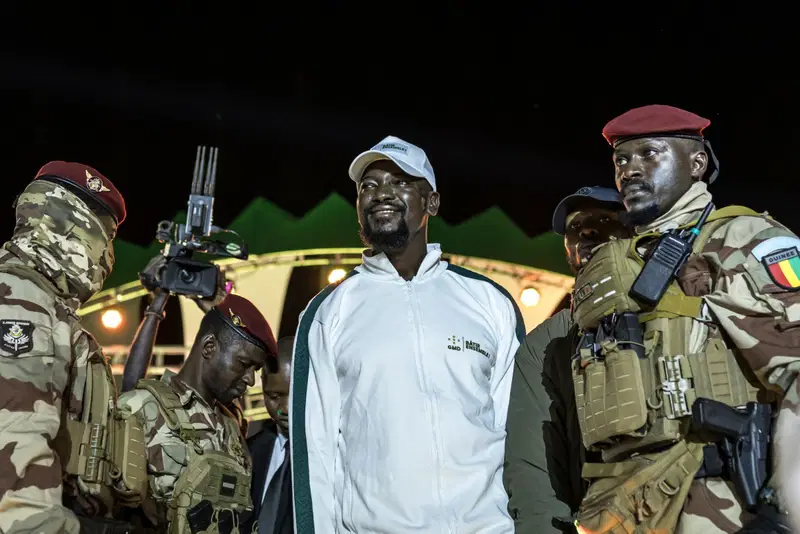
Guinea’s military leader, Mamady Doumbouya, has been elected president after winning an overwhelming majority of votes, according to provisional results released Tuesday by the country’s election commission.
Doumbouya, 41, who seized power in a coup four years ago and initially pledged not to seek elected office, contested the poll against eight other candidates. Major opposition figures were barred from running and had called for a boycott of the weekend election.
The junta chief secured 86.72 percent of the first-round vote, according to figures announced by the General Directorate of Elections, comfortably surpassing the threshold required to avoid a runoff.
Voter turnout was put at 80.95 percent, according to Djenabou Toure, head of the General Directorate of Elections.
Doumbouya recorded strong performances across the country, particularly in the capital, Conakry, where he reportedly won more than 80 percent of the vote in many districts. He also led decisively in other areas, including Coyah near Conakry, as well as Boffa and Fria in western Guinea, Gaoual in the northwest, Koundara and Labe in the north, and Nzerekore in the southeast, based on official partial results earlier read out on state broadcaster RTG.
The general had earlier pledged to hand over power to civilian rule by the end of 2024 but later reversed that position after a new constitution allowed junta members to contest elections.
However, the results were disputed by pro-democracy groups. The National Front for the Defence of the Constitution questioned the turnout and outcome, saying in a statement on Monday: “A huge majority of Guineans chose to boycott the electoral charade.”
Doumbouya came to power in September 2021 after leading a coup that ousted Guinea’s first democratically elected president, Alpha Conde. Since then, his administration has been accused of restricting civil liberties, banning protests, and arresting or forcing political opponents into exile.
Allegations of Irregularities
One of the presidential candidates, Abdoulaye Yero Balde, alleged “serious irregularities” in the electoral process. In a statement issued late Monday, he cited the refusal to allow his representatives access to vote-counting centres and alleged cases of “ballot stuffing” in some areas.
Another contender, Faya Millimono, also raised concerns, accusing authorities of “electoral banditry” and claiming that voters were improperly influenced.
In late September, Guineans approved a new constitution via referendum that cleared the way for junta leaders to run for office. The constitution also extended presidential terms from five to seven years, renewable once.
Opposition leader and former prime minister Cellou Dalein Diallo was among three key opposition figures barred from contesting the election under the new constitution. Diallo was excluded because he resides in exile and maintains his primary residence outside Guinea.
Former president Alpha Conde, deposed in the 2021 coup, and ex-prime minister Sidya Toure were also disqualified, as both are over the maximum age limit of 80 and live in exile.
Opinion Nigeria News


Africa’s Crisis of Military Coups and Insecurity -By Safiya Zakari Muhammad
The erosion of democracy has also weakened regional and international security cooperation. In some cases, juntas have expelled traditional partners...

Governor Uba Sani’s Resolute Commitment On Rural Development -By Abdulrashid Sani Gimi
In the long run, the 2026 fiscal strategy transcends conventional budgetary practice. With a total outlay of ₦985.9 billion, a...

Lack of Financial Support Holding Back Russia’s Economic Influence in Africa: A Case Study of Missed Opportunities in Nigeria -By Kestér Kenn Klomegâh
As Africa's largest economy, Nigeria cannot afford another decade of promises without projects. The future of its development lies with...


The Impact Of Social Media On Youth Mental Health -By Jemimah Hezekiah
Governments and tech companies also have a role to play. Enforcing anti-cyberbullying policies, offering digital literacy programs, and providing mental...

Every Night We Pray to Survive: Voices from Insecure Communities -By Rinret istifanus
As the nation debates policies and strategies, these voices remind us that insecurity is not just a headline it is...