
Forgotten Dairies
Manduro: How nations lose territories in peacetime – Lessons for Nigeria -By Ebuka Ukoh
Manduro reflects the same logic. Developing countries do not lose territory because their citizens suddenly change. They lose it because neglect accumulates. Because governance withdraws. Because performance replaces presence. Ungoverned spaces attract alternative authorities. Where the state is absent, someone else will step in with structure, income, fear, and identity.


Manduro is not a city. It is a warning. It is the visible outcome of a long, quiet process in which institutions weakened, public trust thinned, and leadership drifted from presence to performance. Territories do not fall suddenly. They rot first.
Manduro did not disappear all of a sudden; it faded through years of neglected roads, unpaid security personnel, empty clinics, unlit streets, porous borders, and abandoned schools. It fell when the state stopped showing up consistently. When ceremonies grew louder than patrols. When branding became more important than governance.
This pattern is not new. It has names.
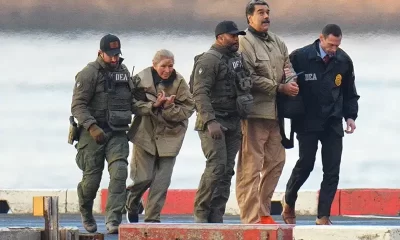
In Venezuela, Nicolás Maduro ruled with an iron grip while preaching democratic legitimacy. Elections were disputed. Protests were crushed. According to Reuters, his rule became defined by alleged electoral manipulation, food shortages, and rights abuses, driving millions of Venezuelans into exile. On his watch, poverty became a feature of governance. Citizenship lost meaning. Power was preserved through control rather than consent.
Maduro assumed he understood his people well enough to keep them permanently powerless. But the more anti-people his rule became, the more isolated he grew. And the more isolated he became, the more exposed he was. He failed to recognise the oldest political truth: the greatest power in any nation is the power of its people. That is the power now celebrating his fall across the world.History records this lesson even earlier.
Rehoboam, the son of Solomon in the Bible’s Old Testament, ascended the throne and mistook harshness for strength. When the people pleaded for relief, he chose arrogance over wisdom and promised heavier burdens. The kingdom fractured. Then came the external consequence. Egypt’s King Shishak invaded and stripped Jerusalem of its treasures. Internal alienation weakened the nation. External humiliation followed.
The sequence is consistent across time. Estrange the people. Weaken the nation from within. Invite affliction from without.
Manduro reflects the same logic. Developing countries do not lose territory because their citizens suddenly change. They lose it because neglect accumulates. Because governance withdraws. Because performance replaces presence. Ungoverned spaces attract alternative authorities. Where the state is absent, someone else will step in with structure, income, fear, and identity.
Neglect is not neutral. It compounds. Every abandoned rural road becomes a supply route. Every closed school becomes a recruitment pool. Every underfunded clinic becomes a grievance factory. Every unpaid officer becomes a risk multiplier. These are not social issues alone. They are security architecture. This is why the price of neglect is always paid in territory. Performance politics accelerates this decay. It is the politics of announcements without implementation. Of summits without systems. Of speeches without delivery. It produces ribbon cuttings while border towns are empty. It makes headlines while patrol routes disappear. It creates visibility while vulnerability deepens.
Nigeria must read Manduro carefully. Nigeria carries familiar warning signs. Border communities that see more criminals than Customs officers. Rural areas that see more bandits than teachers. Police formations stretched thin. Clinics without supplies. Young people are searching for structure, dignity, and opportunity. These are not development gaps. They are fault lines.
Security does not begin with checkpoints. It begins with legitimacy. Legitimacy is built through presence. Through schools that function. Clinics that serve. Roads that connect. The Police who are paid. Courts that are trusted. Borders that are managed. Leadership that shows up where cameras do not go. When leadership alienates its people, it also weakens its shield against the outside world. Nations that lose internal legitimacy find themselves labelled, sanctioned, restricted, and treated as pariahs. Passports grow heavier. Mobility shrinks. Futures are narrow. These outcomes are not conspiracies. There are consequences.
We may condemn foreign intervention all we want. But history is blunt. If the wall has no opening, the lizard cannot enter. External intrusion is often enabled by internal failure. Manduro is not about war. It is about presence. Presence builds trust. Trust builds cooperation. Cooperation builds intelligence. Intelligence prevents collapse. You cannot govern through fear indefinitely. And you cannot perform your way into stability. Every developing nation lives one Manduro away from crisis.
Nigeria still has time. But time does not protect nations. Systems do. And systems only grow where leadership chooses responsibility over performance, humility over arrogance, and the people over applause. Manduro is the cost of performance politics. Nigeria must decide whether it wants to pay it.
• Mr Ukoh, an alumnus of the American University of Nigeria, Yola, and PhD student at Columbia University, wrote from New York.


Manduro: How nations lose territories in peacetime – Lessons for Nigeria -By Ebuka Ukoh
Manduro reflects the same logic. Developing countries do not lose territory because their citizens suddenly change. They lose it because...

Abebe Selassie to Retire as Director of African Department at IMF -By Kestér Kenn Klomegâh
Concessional financing to counter rising borrowing costs, with Africa paying up to 5 times more in interest than advanced economies...


Singapore’s Leaders Built An Economy; Nigeria’s Keep Building Excuses -By Isaac Asabor
Singapore paired economic growth with social stability. Through the Housing Development Board, the government built large-scale public housing, providing affordable...


Tax Considerations for CFD Traders in South Africa: What Experienced Traders Should Know
What looks like a sweet profit on your platform screen can shrink fast once the tax bill hits. When you're...


Russia–India Dialogue Provides Platform for Strengthening Bilateral Entrepreneurship -By Kestér Kenn Klomegâh
The Dialogue was organized by the Indian Business Alliance, the Business Council for Cooperation with India, the Government of Moscow,...