
National Issues
Nigeria: Country Without Nation -By Abdu Abdullahi
I still recall in anger the foiled prophesy proffered by analysts at the peak of the ‘oil boom.’ Nigeria, India and Brazil then were captured as becoming potentially big nations within a short time because the development requirements were at our disposal to tap and dispense. But where are we now in comparison to India and Brazil? What went wrong from our side? Unfortunately, we let adversities to be our defining moments for all these turbulent years.

It is now 62 years into post independence yet, Nigeria is still battling to survive as a country while its hope of achieving nationhood is largely a mirage. The history of Nigeria is that of a country bedeviled by high disappointments and other anomalies that are getting out of hand. Conspicuously, the country is passing through its most darkest days as it is wearing a bleak future that is seemingly becoming worrisome.
Passing through the era of multi-dimensional conflicts, tensions and violence, Nigeria has been caught between the devil and the deep blue sea. To rescue and put it on the right track, all hands must be on deck to facilitate the evolution of a nation, a true nation of equality, justice and achievable vision. It is only a national will that will successfully take us there. We will know if we are there when our cardinal principle of electing our leaders is purely dictated by competence and relegating mundane sentiments and other needless affairs to the background. We will know how to build our nation only when Nigeria’s wealth and resources are duly concentrated in the hands of the majority, thereby ensuring an egalitarian society. Of course, we shall know we are a nation when, according to Malam Aminu Kano of blessed memory,’ leaders ‘must’ justify their leadership rather than followers justifying their followership’.
The late Chief Obafemi Awolowo did tell us that ‘ Nigeria was just a mere geographical representation’. To paraphrase that controversial statement, he viewed our country as a dysfunctional sovereign entity and its citizens were not working faithfully in harmonious collaboration with one another to bring about the desired unity for development. Perhaps, he saw in us the entrenchment of neo- colonialism despite the fact that our flag was no more the ‘Union Jack’. Indeed, the basic characteristic of a nation is binding and blending the people to work in commonality to strive and function for human development.
But in spite of Nigeria’s potentialities of achieving nationhood and leading the black race to unprecedented achievements, the country has been reduced to a mere ‘geographical representation’ for the sake of identification and what have you. At the central stage of its lingering crises is the increased level of insecurity that has consumed lives and properties and threatening the sovereignty of the country. Indeed, Nigeria is at a war in which Nigerians are killing one another. Our great population is nothing to write home about if unemployment, poverty, falling standard of education, perpetuating corruption, etc will continue to be our indices in describing Nigeria!
I still recall in anger the foiled prophesy proffered by analysts at the peak of the ‘oil boom.’ Nigeria, India and Brazil then were captured as becoming potentially big nations within a short time because the development requirements were at our disposal to tap and dispense. But where are we now in comparison to India and Brazil? What went wrong from our side? Unfortunately, we let adversities to be our defining moments for all these turbulent years.
Years after those reflective remarks, Nigeria’s awful and current situation is triggered by continuous decadence in all ramifications. The Nigerian society hails and idolizes the corrupt people to our bewilderment. Crisis of confidence has infiltrated the camp of the power brokers and elites. Their socioeconomic and political philosophy is tilted in terms of who gets what, when and how, whereas the citizens are perpetually frustrated and wallowing in abject poverty. To crown it all, the scenario in Nigeria is aptly captured by a title of World Bank Report on Nigeria ” Poverty in the midst of plenty”.
Preaching unity and love at public functions by prominent Nigerians speaks volume, but during private engagements, we holistically align to all divisive tendencies and other idiosyncrasies that are taking us backwards. This could have been the reason why the late Julius Nyerere asserted that the people of the world were and are more divided now and very conscious of their divisions. There are also sharp divisions between the exploiters and the exploited, between the oppressors and the oppressed. To juxtapose this alongside our prevailing predicament, we are now witnessing the rise of ethnic nationalists and activists as manifested in the Biafra, Oduduwa, Middle belt agitations among others. But then, the question is: Will there be no internal frictions amongst ethnic nationalists even when they are on their own?
These uprisings must have been influenced by the crisis of confidence that has occupied our political domain. On the other hand, our vital institutions have been rendered useless and harmful by our powerful individuals. Those who still ascribe to the view that Nigeria is still just a country cannot be faulted because they are making a genuine point that a nation is more desirable than a country, a nation is more united than a country, a nation is more inclusive in terms of opportunities than a country. Therefore, their exalted penchant for a nation convincingly proves that Nigeria is breeding more Nigerians and very few nationalists. Indeed, the system that aims at wiping out nationalists is very ruinious and must be crushed against all odds.
To attain nationhood is an uphill task that has defied all possibilities because of our own collective handiwork. Achieving nationhood is a desirable undertaking that ought to be actualised to move fast and be prosperous. Contextually therefore, the people of Nigeria are larger than a tribe or community despite our differences. In fact, our differences should be a blessing in disguise but many are seeing them as a curse. We need a national culture that encompasses our diversities and transform them towards human progress and eventually weather the storm.
Will Nigeria continue to remain a country in which state identification, regional and tribal affiliations will continue to determine our divisions and future? Can we forge a nation in which we see ourselves as one, having passion for one another towards a common goal for human development?



When Nations Break Their Reformers: Why EFCC Cannot Carry Nigeria’s Burden Alone — And Why Power Must Fear God -By Prof. John Egbeazien Oshodi
Public frustration with the EFCC over perceived selective enforcement is understandable. Nigerians see some arrests carried out suddenly and forcefully,...
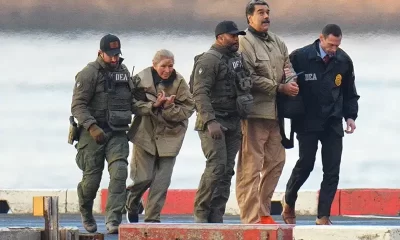

Poor, Poor, Maduro -By IfeanyiChukwu Afuba
Little wonder his ouster elicited celebrations. The ease of his capture is telling. There is only one explanation for the...


Why African Leaders Must Fix Governance Before Crying Sovereignty -By Isaac Asabor
One of the great contradictions of African leadership today is selective morality. Leaders speak passionately about international law while violating...

Baba Has Entered The Classroom -By Isaac Asabor
If what Trump is doing is walking into a noisy global classroom and insisting on discipline, then let us be...

As Trump Exposes Why Tinubu Must Go Sooner -By SKC Ogbonnia
The Nigerian president is not only culpable of heinous crimes, but he is also weakened beyond redemption. His continued stay...