
National Issues
Nigeria: Might, Right and Hindsight -By Chris Ngwodo


Two events before Christmas offered stark reminders of the plague of violence assailing Nigeria. In Zaria, an altercation between a convoy bearing the Chief of Army Staff (COAS) and a group of Shiite Muslims that denied him passage, led to an army operation that claimed hundreds of lives. Both sides dispute what happened, with the army calling it an attempted assassination of its chief and the Shiites claiming that it was an unprovoked massacre.
Let us for the sake of argument accept that the soldiers were placed in an impossible situation. By obstructing the convoy and refusing to give way, even after military officers had entreated them to do so, the mob demonstrated hostile intent and the army chief was at risk of being held hostage or harmed. The troops were left with no option but to use whatever force they deemed appropriate to extricate themselves from a threatening situation. However, there is no justification that can be summoned for what happened hours later – the army’s invasion of the Shiite sect’s premises and the residence of its leader, Sheikh Ibraheem El Zakzaky – an operation which resulted in hundreds of civilian deaths.
Two species of impunity collided in Zaria. The Shiites demonstrated a heedless intransigence by seizing control of a public road, denying the army chief and other motorists rightful passage, and antagonising soldiers on a lawful assignment. But the army’s subsequent use of disproportionate and deadly force that resulted in civilian casualties is equally condemnable.
On hindsight, the matter could have been handled differently. Once the COAS’ convoy had broken through the barricade and the initial situation had been resolved, the proper course of action should have been to lodge a report with the police who would then have investigated and pressed criminal charges accordingly against the sect. Instead, brute force was brought to bear upon a situation crying out to be defused, with an ultimate body count that does the army and the country no credit.
Major General Tukur Buratai is, by all accounts, a fine officer and a gentleman. But the Zaria tragedy stemmed from an institutional orientation that has previously brought the military into disrepute. It recalled some of the army’s worst moments, from Asaba in 1967 to Odi in 1999 and Zaki Biam in 2001. Upon his appointment in August, General Buratai had pledged that under his watch the army would respect human rights. His pledge came against the backdrop of indictments of the army by Amnesty International and President Muhammadu Buhari’s inaugural vow to investigate allegations of human rights violations by the military.
These are not quibbles but important concerns for a nation still struggling to transcend the legacy of decades of military dictatorship. It is precisely because of this legacy that the Zaria tragedy cannot become one of the forgettable atrocities to which we have become sadly accustomed. In recent years, we have witnessed the use of troops on home soil often without the stipulated recourse to the national assembly, which itself seems genuinely unconscious of its regulatory oversight role over defence and security institutions.
The army operation was evidently on procedurally dubious grounds. Zaria is not under a state of emergency. The conditions for deploying troops on home soil are spelt out in Section 217 of the constitution and basically require presidential authorisation and legislative approval. The apparent absence of these conditions possibly renders the arrest of El-Zakzaky, which cost so many lives, illegal.
These are not quibbles but important concerns for a nation still struggling to transcend the legacy of decades of military dictatorship. It is precisely because of this legacy that the Zaria tragedy cannot become one of the forgettable atrocities to which we have become sadly accustomed. In recent years, we have witnessed the use of troops on home soil often without the stipulated recourse to the national assembly, which itself seems genuinely unconscious of its regulatory oversight role over defence and security institutions. The militarisation of law enforcement has proceeded stealthily along with the war on terror, with the army increasingly taking on police tasks. The results have been disastrous. In setting out to arrest El-Zakzaky, the army usurped police jurisdiction.
There are those who have argued that the Shiites got what they deserved for daring to obstruct an army chief’s convoy. Such misguided celebration of unhinged militarism indicates that we have not learned from a history that could otherwise teach us that the reckless use of lethal force by government agents is the main cause of Nigeria’s plague of violence. The militant Odua Peoples’ Congress was founded after the army killed scores of people protesting the annulment of the June 12, 1993 elections in Lagos. The brutal suppression of the Movement for the Survival of the Ogoni People (MOSOP) paved way for the emergence of the militant Movement for the Emancipation of the Niger Delta. The brutal treatment of the avowedly pacifist Movement for the Actualisation of the Sovereign State of Biafra (MASSOB) has enabled the rise of violent groups like the Biafran Zionist Front and enhanced the appeal of Radio Biafra.
Just days after the Zaria incident, the army shot and killed five people in Onitsha as they celebrated the court-ordered release of Nnamdi Kanu, the director of Radio Biafra, from the custody of the Department of State Services, where he has been held for over a month. That incident got little mileage in the media but added to the bloody mosaic of human rights violations by the military. The stage had been set for such violence in late November when the army unnecessarily issued threats against pro-Biafra protesters in the South-East describing their demonstrations as “treasonable.” By this “quasi-judicial” pronouncement, the army effectively usurped the roles of the state governments and the state police commissioners who alone can determine whether a civil situation has evolved into a crisis requiring the assistance of the military.
Instead of merely harassing Kanu, we should enact hate speech legislation to address the incendiary rhetoric of preachers, politicians, media elites and sundry demagogues. Rather than using troops as a glorified constabulary, judge, jury and executioner, let us demilitarise our society, and reform the police force so that it can actually do the job of policing. The military must return to what it traditionally is – the institution of last resort when all other measures have failed.
Both Kanu and El-Zakzaky are currently being held illegally by the DSS and the army respectively. Kanu may be a vendor of hate-laden drivel but by detaining him without certainty of prosecutorial cause and now in spite of his court-ordered release, the administration is subsidising his transition from public nuisance to prisoner of conscience and persecuted prophet. Should El-Zakzaky meet with some mishap while in government custody, it could well ignite another armed uprising in Northern Nigeria.
The federal government must institute an independent commission of inquiry to investigate the Zaria tragedy. The sudden official realisation that public spaces belong to the public should not be limited to curbing Shia enthusiasms. Rather than simply victimising the Shia and treating them as an aberrant monstrosity, which they are not, let us instead properly define the boundaries between religious communities and the society. Shia processions are a public nuisance but so are many Christian and Muslim adherents who hijack public roads on their worship days; and deploy invasive and disruptive means of proselytising. We must now confront all religiously-inspired public disorder, and not just the Shiite misconduct. Laws are meaningful only when they are equally applied.
Instead of merely harassing Kanu, we should enact hate speech legislation to address the incendiary rhetoric of preachers, politicians, media elites and sundry demagogues. Rather than using troops as a glorified constabulary, judge, jury and executioner, let us demilitarise our society, and reform the police force so that it can actually do the job of policing. The military must return to what it traditionally is – the institution of last resort when all other measures have failed. Its recent deployment as the magic bullet for all problems has brought it into disrepute with incidents that overshadow the courage and sacrifice of troops risking life and limb to preserve the realm.
Nigeria’s confrontation with terrorism is also a contest of ideas with purveyors of irredentist and exclusive sectarian visions. Her best argument cannot be made with guns. In the words of the Polish dissident priest Father Jerzy Popielusko, “An idea which needs rifles to survive dies of its own accord.”
This administration could promote national security more if it branded itself a law and order government. This means promoting the rule of law in a society struggling to come to terms with the burdens of democratic license and its longstanding idolisation and idealisation of brute force. Our challenge is that we have never truly been a society of laws. We have long been a society of impunity, lawlessness and violence; of big men who are above the law and the poor who are beneath it; of big men who capture and plunder the state and the ordinary men who eventually turn violently against the state; of publicly-funded armed forces that routinely use their arms against the self-same public; a society in which long before violence was privatised and democratised by non-state actors, the state itself was the sole terrorist entity.
When a state is opposed by movements that challenge its very legitimacy and authority, the weapons of its warfare cannot simply be martial; they must be moral, rooted in the rule of law and a respect for the sanctity of human life. A state that cannot respect its own laws cannot long retain the respect or allegiance of citizens. Mere terror cannot cast out terror. The state’s morality must be superior to that of those who seek to overthrow it.
This argument does not emanate from a fanatical bleeding-heart pacifism that fails to recognise that there are times when combat is necessary in the name of all that we hold dear. On the contrary, it is rooted in prudence and strategic pragmatism. Nigerian history empirically illustrates how state terrorism turns malcontents into militants and martyrs around whom more radical anti-state movements inevitably coalesce. With less than one million men and women under arms across her military, law enforcement and the national security establishment, overseeing a population of over 160 million, Nigeria lacks the manpower to fight more than one insurrection. She should be making friends not mass-producing enemies. Nigeria’s confrontation with terrorism is also a contest of ideas with purveyors of irredentist and exclusive sectarian visions. Her best argument cannot be made with guns. In the words of the Polish dissident priest Father Jerzy Popielusko, “An idea which needs rifles to survive dies of its own accord.”
Chris Ngwodo is a writer, consultant and analyst.

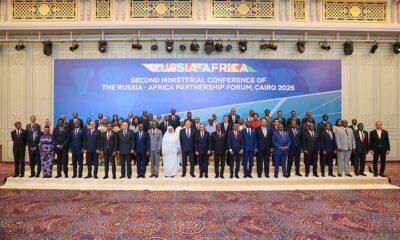

Russia Promoting Dialogue with Africa on Implementing 2023-2026 Strategic Action Plan -By Kestér Kenn Klomegâh
On December 19-20, the Second Ministerial Conference of the Russia-Africa Partnership Forum was held in Cairo, Egypt. It was held...

At 72, A Father’s Embrace: Akume, Alia, And The Future Of Benue -By Leonard Karshima Shilgba
As our leader turns 72 in December 2025—a significant and symbolic age—I humbly call on the Benue State Government and stakeholders to initiate...

United States and Russia Resolving Trade Issues and Pursuing New Opportunities -By Kestér Kenn Klomegâh
The American Chamber of Commerce (AmCham) will be working in the system of the Chamber of Commerce and Industry (CCI)...


Nigeria’s Middle Class Is Slipping Into Poverty — And We Are All at Risk -By Abdulhamid Rabiu
What is urgently needed is a shift from abstract economic targets to people-centered policies. Inflation control must be prioritized. Wages...

Second Ministerial Conference: Shaping Russian-African Strategic Partnerships -By Kestér Kenn Klomegâh
As indicated from above, the most important issues of multifaceted development are included on the Russian-African agenda, with a focus...