
Political Issues
Passport Deposit, The Law, And The Perils Of Loud Ignorance -By Danjuma Lamido
The facts are straightforward. In late January 2025, the Nigeria Police Force arraigned Sowore before the Federal High Court in Abuja on a 17-count charge related to cybercrime. On January 30, 2025, the court granted him bail for ₦10 million. As a specific condition of that bail, the presiding judge, Justice Musa Liman, ordered Sowore to deposit his passport with the court registrar.

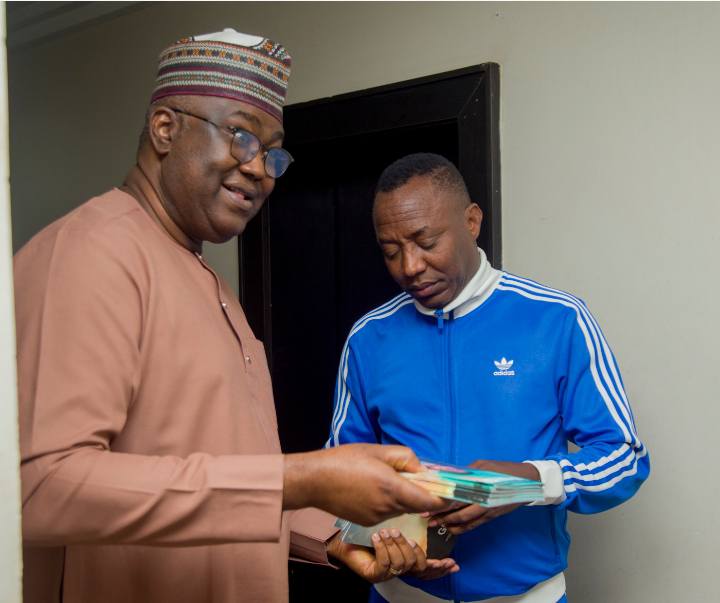
Former presidential candidate and Peoples Democratic Party (PDP) chieftain, Dr Gbenga Hashim, has recently chosen the path of noise over knowledge in reacting to the lawful deposit of the passport of another former presidential candidate, Omoyele Sowore.
By condemning the court-ordered passport deposit as an “abuse of power” and a “grave threat to freedoms,” Hashim only succeeded in advertising a troubling ignorance of basic legal procedure and the doctrine of separation of powers.
If Dr Hashim truly wished to understand the matter, the sensible route would have been to approach the court record, not issue sweeping condemnations after a visit from a well-known rabble-rouser.
Passport deposits are not executive whims; they are routine judicial conditions attached to bail in many jurisdictions, including Nigeria. They exist to ensure a defendant’s availability for trial, not to muzzle free speech.
It is therefore astonishing that a so-called former presidential candidate would urge President Bola Ahmed Tinubu to “immediately order” the release of Sowore’s passport.
Such a call betrays a fundamental lack of understanding of the separation of powers.
The President does not sit as a supervisor over courts of competent jurisdiction, and he has no business issuing directives on matters actively before the judiciary.
One is left to wonder how an individual with such a shallow grasp of constitutional boundaries ever imagined himself fit to lead Nigeria.
On the question of “dissenting voices,” let us be clear. Omoyele Sowore is not a dissenting voice in the noble sense of the phrase.
He is a serial noise maker, an opportunist and a blackmailer who has turned provocation into a livelihood, misleading blind followers with misinformation and fake news, now his well-established trademarks.
This is not “speaking truth to power”; it is manufacturing outrage for relevance. Worse still, Sowore represents a bad example for young Nigerians who genuinely seek a new political order anchored on ideas, integrity and responsibility.
For the avoidance of doubt, nobody is persecuting Sowore for courageously telling the truth to power. What he is being called to answer for is alleged misinformation and conduct deemed capable of undermining public order under existing law.
The facts are straightforward. In late January 2025, the Nigeria Police Force arraigned Sowore before the Federal High Court in Abuja on a 17-count charge related to cybercrime. On January 30, 2025, the court granted him bail for ₦10 million. As a specific condition of that bail, the presiding judge, Justice Musa Liman, ordered Sowore to deposit his passport with the court registrar.
In early March 2025, Sowore’s legal team applied for the release of his passport to enable him to travel, citing his right to freedom of movement. On March 4, 2025, the Federal High Court rejected the application and ruled that the passport must remain with the court while the trial continues. That decision, whether one likes it or not, is a judicial determination, not an executive vendetta.
The charges themselves arose from Sowore’s public attacks on the Inspector-General of Police, Kayode Egbetokun, whom he described on social media in December 2024 as an “illegal IGP,” comments the authorities allege were intended to cause a breakdown of law and order in violation of the Cybercrimes Act.
President Bola Ahmed Tinubu has rightly maintained a hands-off posture. He will not, and should not, interfere in a matter before a competent court.
Therefore, calls on him to “decisively order” the release of Sowore’s passport “in the interest of justice” are not only baseless but dangerous, as they invite executive intrusion into judicial space.
Dr Gbenga Hashim would do well to temper his rhetoric with study. Understanding how the law works is not optional for anyone who aspires to national leadership.
Until then, loud statements in defence of a professional provocateur only diminish the seriousness of our political discourse.
Danjuma Lamido writes from Yola, Adamawa State.. Email: danjumalamido2011@gmail.com



Role of Youths in Nation Building -By Kusompwa Lazarus Motiyedi
It is true that today’s youth did not experience the horrors of the Nigerian Civil War or the severe economic...

Putin Receives Newly Appointed Foreign Ambassadors in Bolshoi Kremlin Palace -By Kestér Kenn Klomegâh
According to him, the foundations of these relationships were laid back during the struggle of African peoples for freedom and...


Why Obi Cubana Shouldn’t Have Given His Life to Jesus (Part 1) -By Ugochukwu Ugwuanyi
But then, why the fuss about Obi Cubana's repentance, what with the American Rap King, Snoop Dog, repenting from gangsterism...


Invincible Defence Technology: Consciousness-Based Solutions to Interstate and Intrastate Violence -By Dr. David Leffler
Technology refers to the systematic application of knowledge and tools. In the case of IDT, this brain-based “technology” is the...

Amnesty International’s Selective Outrage And The Sowore Narrative -By Kelvin Adegbenga
Amnesty International also appears to suffer from institutional amnesia. It is on public record that the Nigerian Army once called...