
Political Issues
Praying That Moves To Impeach Fubara Hit More Legal Brick Walls To Defeat Godfatherism -By Isaac Asabor
That is why many Nigerians, like this writer, are not neutral observers in the Rivers crisis. They are emotionally and morally invested, praying that impeachment plots fail, that courts hold firm, and that institutions refuse to be conscripted. That the plot to impeach Fubara hit more legal brick walls as it has been hitting them recently, and in turn send a red flag to godfathers and would-be godfathers. As 2027 approaches, such a precedent would discourage godfathers nationwide.

Since Nigeria’s return to civil rule in 1999, one political sin that has literarily refused repentance is no doubt godfatherism. It has survived constitutional amendments, mocked electoral reforms, and hollowed out the promise of democracy. Like a shadow authority, it operates beyond ballots and accountability, deciding who emerges, who governs, and who truly holds power. More than two decades later, it remains one of the clearest explanations for why Nigeria still struggles to convert elections into genuine popular rule.
Despite the rituals of democracy, campaigns, voting, inaugurations, the substance has often been absent. Power frequently resides not with the electorate or even the elected, but with unelected patrons who anoint successors and expect lifelong obedience in return. It is politics by proxy, governance by remote control. And as Scripture warns, “Woe to those who decree unrighteous decrees, who write misfortune, which they have prescribed” (Isaiah 10:1).
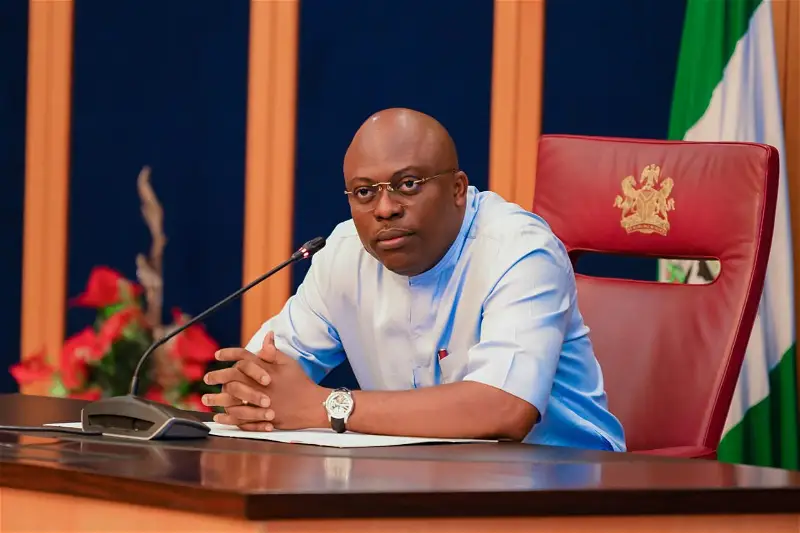
This is why the crisis unfolding in Rivers State has taken on national and even moral significance. Nigerians, including this writer, are not merely watching the political standoff between Governor Siminalayi Fubara and his predecessor, Nyesom Wike; many are quietly praying that every move to impeach Fubara runs into insurmountable legal brick walls. Not out of sentiment, but out of a deep longing to see godfatherism finally meet resistance that it cannot bulldoze.
In fact, from the birth of the Fourth Republic, Nigeria’s democracy suffered from continuity rather than rupture. Military rule ended, but power did not decentralize. Political financiers, retired generals, entrenched party barons, and former governors simply changed uniforms. The authoritarian instinct survived the transition. Elections became formalities, while real decisions were made elsewhere. As the Bible cautions, “You cannot pour new wine into old wineskins” (Luke 5:37). Nigeria tried, and paid the price.
The godfather model was simple and effective. A sponsor funds campaigns, captures party structures, manipulates primaries, and bends institutions. In exchange, the godson governs under invisible chains. Appointments are dictated. Contracts are shared. Budgets become settlement documents. Loyalty replaces competence. Gratitude becomes state policy. Governance is no longer about service; it is about repayment. Against the backdrop of the foregoing, it is not out of place to opine that the scxriptural injunction that says“The borrower is servant to the lender” as enshrined in Proverbs 22:7 has become Nigeria’s political reality.
Across the country, this script has played out with local accents. In the South-West, it often degenerated into open warfare that crippled governance. In the South-East, it assumed a quieter but equally suffocating form, where candidates were pre-selected and elections merely ratified elite consensus. In parts of the North, layered patronage networks anchored in dynasties and economic power performed the same function. Different styles, same outcome: the voter was sidelined, democracy diminished.
Predictably, voter apathy deepened. Nigerians did not disengage because they were ignorant or lazy, but because experience taught them that outcomes were often predetermined. When citizens realize that power is negotiated elsewhere, participation feels futile. Democracy becomes theatre. And as Scripture reminds us, “Where there is no justice, the people groan” (Proverbs 29:2).
Godfatherism also hollowed out governance. Leaders installed by patrons rarely govern freely. Decisions are filtered through private interests that bear no public responsibility. Budgets become tools of appeasement. Institutions are weaponized against dissent. When independence emerges, it is swiftly punished, through impeachment threats, party sabotage, or judicial ambushes. “They have healed the wound of my people lightly, saying, ‘Peace, peace,’ when there is no peace” (Jeremiah 6:14).
This is exactly where Rivers State stands today. Governor Siminalayi Fubara’s refusal to function as a political extension of Nyesom Wike has activated the familiar godfather arsenal: legislative brinkmanship, impeachment threats, legal maneuvers, and institutional paralysis. It is the old playbook, bend the system until submission is restored, or wreck it if obedience fails.
Yet Rivers also exposes the irony of godfatherism. Its architects often become trapped by the very system they built. Wike, who consolidated immense power as governor, now confronts the limits of influence in a constitutional order that, however imperfect still recognizes the authority of an elected incumbent. Fubara’s resistance highlights the unresolved contradiction in Nigerian politics: governors are constitutionally autonomous but politically subordinated.
This tension has haunted Nigeria since 1999. Who truly governs the elected official or the unelected sponsor? When the answer tilts toward the latter, democracy erodes. Institutions weaken. Legitimacy collapses. The constitution says one thing; political reality says another. Godfatherism thrives in this gap. “You shall know the truth, and the truth shall make you free” (John 8:32), but Nigeria has often settled for convenient falsehoods.
That is why many Nigerians, like this writer, are not neutral observers in the Rivers crisis. They are emotionally and morally invested, praying that impeachment plots fail, that courts hold firm, and that institutions refuse to be conscripted. That the plot to impeach Fubara hit more legal brick walls as it has been hitting them recently, and in turn send a red flag to godfathers and would-be godfathers. As 2027 approaches, such a precedent would discourage godfathers nationwide.
In fact, if impeachment against Fubara fails, if legal obstacles hold, if institutions refuse to bend, and if Fubara completes his mandate with real autonomy, the implications would be profound. It would prove that godfatherism is not invincible. It would establish a rare and powerful precedent: that resistance can survive, that independence does not always end in political annihilation.
This will not end godfatherism overnight. Nigeria’s political culture is too entrenched, too monetized, and too cynical for miracles. But politics runs on signals. Once it becomes clear that defiance does not automatically lead to destruction, fear begins to weaken. Calculations change. Space opens. “For God has not given us a spirit of fear, but of power and of a sound mind” (2 Timothy 1:7).
At its core, the Rivers crisis is a test of Nigeria’s democratic maturity. Democracies are sustained not just by laws, but by enforced norms. The most urgent norm Nigeria must now assert is simple: former officeholders do not own states. Mandates belong to the people, not to political benefactors. “Remove the ancient landmark which your fathers have set” (Proverbs 22:28) was a warning, not an instruction.
For 25 years, godfatherism has violated this principle with impunity. It has reduced governance to debt repayment, distorted leadership selection, and alienated citizens. It has turned democracy into an investment scheme rather than a social contract. The result is a nation governed by yesterday’s power brokers while today’s challenges fester.
This is why many Nigerians are praying that Fubara’s survival becomes more than a personal victory. They are praying it becomes a symbolic blow against a system that has held the country hostage since 1999. Symbols matter, especially in societies starved of positive precedents.
Ultimately, Rivers is not about two men. It is about whether Nigeria will continue recycling failed power structures or begin, cautiously and imperfectly, to loosen the grip of godfatherism. If the impeachment project collapses under the weight of law and reason, the message will be unmistakable: the era of absolute political ownership may finally be cracking.
And if that crack widens, even slightly, Nigeria’s democracy may begin to look less like a hostage of its past, and more like a work in progress inching, however slowly, toward justice, accountability, and true popular sovereignty.



Museveni’s Uganda: Family Company Limited -By Isaac Asabor
Museveni will not be remembered for the ideals he once espoused. He will be judged by how long he clung...

Africa Experiencing New Stage of Reawakening -By Kestér Kenn Klomegâh
The Russia-Africa summits earlier took place in Sochi (October 2019) and St. Petersburg (July 2023). Russia and Africa are currently...

The New York Times Misses the Forest for the Trees in Nigeria -By Nnamdi Prince
If the Times is so concerned about accurate data, perhaps it should direct its considerable resources toward independently investigating and...


The Pragmatism of Principle: Redefining Loyalty in an Age of Change -By Florence Ozor
While I do not endorse political nomadism, one must acknowledge that strategic realignment can be expedient. Take Peter Obi: after...


Lessons for Today: MLK for Continental African Leadership – A Psychoafricalytic Mirror for Power, Dignity, and Continental Renewal -By Psychologist John Egbeazien Oshodi
When African leaders abandon indigenous wisdom, they often adopt the colonial logic of control. Citizens become subjects. Protest becomes treason....