
Breaking News
President Tinubu signs four Tax Reform Bills into law
Meanwhile, the Joint Revenue Board (Establishment) Bill sets up a national governance structure to coordinate tax efforts across all tiers of government. It also introduces a Tax Appeal Tribunal and an Office of the Tax Ombudsman to enhance taxpayer rights and dispute resolution.

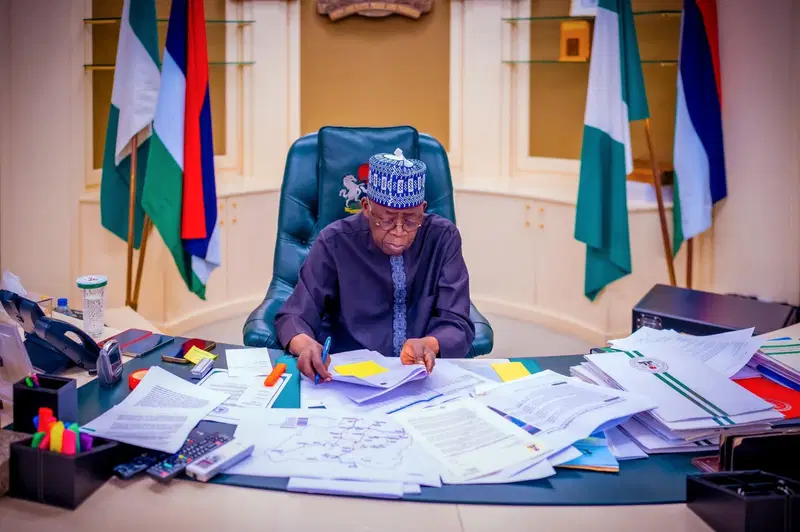
President Bola Tinubu has signed four tax reform bills, recently passed by the National Assembly, into law.
The signing ceremony took place at the Presidential Villa on Thursday and was attended by top government officials, including Senate President Godswill Akpabio, Speaker of the House of
Representatives Tajudeen Abbas, as well as the Senate and House Majority Leaders and chairmen of the respective finance committees.
Also present were the Chairman of the Nigeria Governors’ Forum and Kwara State Governor AbdulRahman AbdulRazaq; the Chairman of the Progressive Governors’ Forum and Imo State Governor Hope Uzodimma; Minister of Finance and Coordinating Minister of the Economy Wale Edun; and Attorney-General of the Federation Lateef Fagbemi, SAN.
The four bills, the Nigeria Tax Bill, the Nigeria Tax Administration Bill, the Nigeria Revenue Service (Establishment) Bill, and the Joint Revenue Board (Establishment) Bill, were passed by the National Assembly after extensive consultations with stakeholders and interest groups.
The new laws aim to overhaul Nigeria’s fiscal and revenue administration framework, a move described as a significant milestone in the nation’s economic reform agenda.
Speaking at the event, President Tinubu stated that the bills reflect his administration’s commitment to creating a modern, transparent, and efficient tax system that supports national development, promotes investment, and reduces the tax burden on individuals and businesses.
The Nigeria Tax Bill (Ease of Doing Business) consolidates fragmented tax statutes into a single legal framework to reduce tax duplication, enhance clarity, and make compliance easier for taxpayers.
The Nigeria Tax Administration Bill harmonises tax administration processes across federal, state, and local government levels, ensuring uniformity and improving efficiency.
The Nigeria Revenue Service (Establishment) Bill repeals the existing Federal Inland Revenue Service (FIRS) Act, paving the way for the establishment of a new, performance-driven Nigeria Revenue Service (NRS).
The NRS will have expanded responsibilities, including the collection of non-tax revenue, and will be equipped with strong accountability and transparency mechanisms.
Meanwhile, the Joint Revenue Board (Establishment) Bill sets up a national governance structure to coordinate tax efforts across all tiers of government. It also introduces a Tax Appeal Tribunal and an Office of the Tax Ombudsman to enhance taxpayer rights and dispute resolution.
Officials have described the new tax laws as a bold step toward boosting Nigeria’s revenue base, reducing investor uncertainty, and deepening fiscal decentralisation. The reforms are also expected to spur job creation, improve public service delivery, and build greater public confidence in the tax system.
State House officials say the signing of these bills is part of President Tinubu’s broader economic reform agenda, aimed at achieving macroeconomic stability and sustainable growth.
Earlier on Thursday, President Tinubu had explained that the laws would unify Nigeria’s fragmented tax system, eliminate redundant overlaps, and encourage transparent, coordinated tax collection at all levels. The President also emphasised that the tax reforms will ease the burden on working families, small businesses, and low-income earners while correcting inefficiencies that have long plagued the nation’s tax system.
On his verified X handle, @officialABAT, President Tinubu wrote that the new tax laws set the groundwork for “the Nigeria of tomorrow, leaner, fairer, and focused on unlocking opportunities for all.” He assured Nigerians that his administration is committed to a tax regime that rewards enterprise, protects the vulnerable, and mobilises revenue without punishing productivity.
He added that these reforms go beyond simply simplifying tax codes, noting that they include some of the most significant tax reliefs in a generation, targeted at low-income earners, small businesses, and working-class families.
“For too long, our tax system has been a patchwork, complex, inequitable, and burdensome,” President Tinubu said. “That era ends today. We are laying the foundation for a tax regime that is fair, transparent, and fit for a modern, ambitious Nigeria.”


Africa’s Crisis of Military Coups and Insecurity -By Safiya Zakari Muhammad
The erosion of democracy has also weakened regional and international security cooperation. In some cases, juntas have expelled traditional partners...


Governor Uba Sani’s Resolute Commitment On Rural Development -By Abdulrashid Sani Gimi
In the long run, the 2026 fiscal strategy transcends conventional budgetary practice. With a total outlay of ₦985.9 billion, a...


Lack of Financial Support Holding Back Russia’s Economic Influence in Africa: A Case Study of Missed Opportunities in Nigeria -By Kestér Kenn Klomegâh
As Africa's largest economy, Nigeria cannot afford another decade of promises without projects. The future of its development lies with...


The Impact Of Social Media On Youth Mental Health -By Jemimah Hezekiah
Governments and tech companies also have a role to play. Enforcing anti-cyberbullying policies, offering digital literacy programs, and providing mental...


Every Night We Pray to Survive: Voices from Insecure Communities -By Rinret istifanus
As the nation debates policies and strategies, these voices remind us that insecurity is not just a headline it is...