
National Issues
President Tinubu, when the World Watches Incidents like this, the DSS does not Protect your Image, it Injures it in the Realm of Human Rights -By Psychologist John Egbeazien Oshodi
A modern security service must learn that real power is demonstrated through restraint, emotional intelligence, and respect for human dignity. Without this cultural change, abuse will repeat itself under different names, and the public will continue to lose trust.

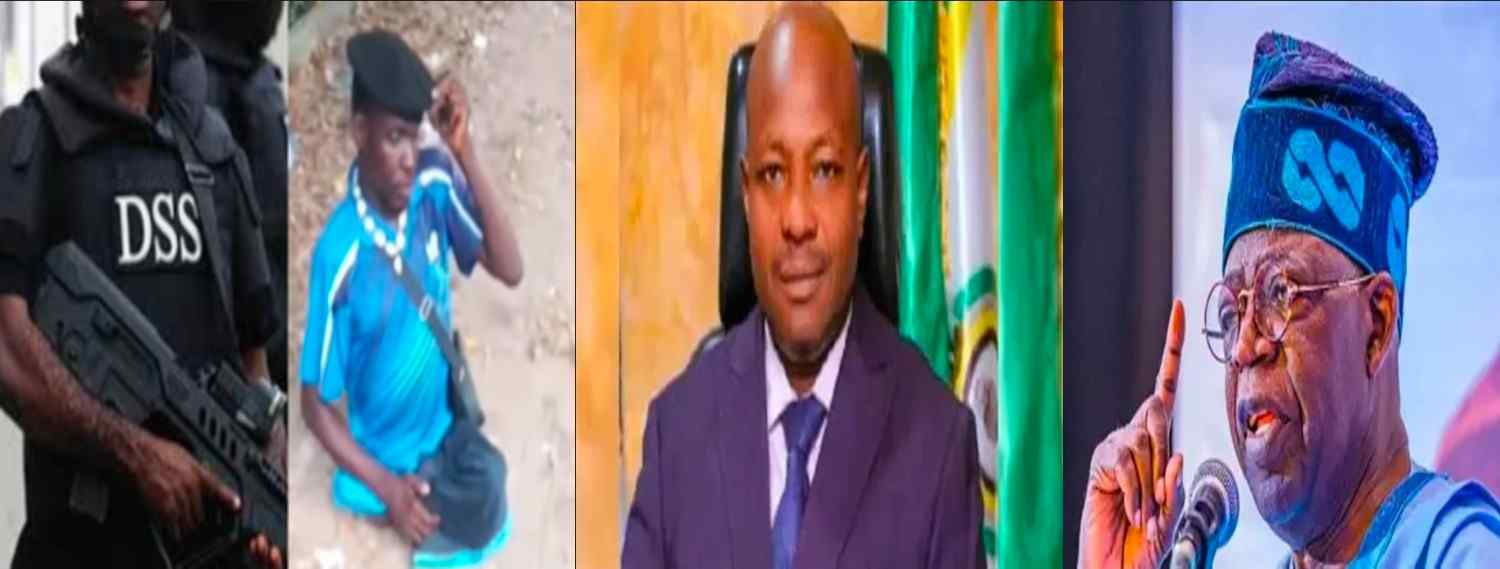
The world does not misread scenes like this. A physically challenged citizen writes his pain on his own car, and instead of debate, dialogue, or outreach, the response is seizure and intimidation. That is not the language of strength. That is the language of fear.
Strong leadership does not run from criticism. It examines it. It absorbs it. It uses it as a guide for reform. When security agencies punish ordinary citizens for speaking, they do not defend the presidency. They expose it as anxious and insecure, as if truth itself has become a threat that must be arrested.
And once institutions begin to treat opinion as an offense, public trust slowly collapses. Citizens withdraw emotionally. They speak less, not because they are happier, but because they are afraid. Governance then becomes harder, harsher, and more distant, because the people no longer feel invited into the national conversation.
Mr President, this is not protection. This is a quiet form of self damage. The more such incidents occur, the more your administration becomes associated not with reform and progress, but with suppression and fear. This moment therefore calls for correction, not denial.
Leadership grows stronger when it chooses transparency over intimidation, law over impulse, and listening over punishment. History always rewards the leaders who recognize that power is safest when it stands beside the people, not when it tries to silence them.
A Single Incident That Exposes a Larger Problem
There are moments in the life of any democracy when a single act against a single citizen becomes more than a local incident. It becomes a mirror. It reflects the condition of leadership, the emotional climate of the nation, and the place the country now holds in the eyes of the world.
The story of Solomon Umudi, the physically challenged artisan in Edo State whose car was seized by security agents because he wrote phrases critical of the government, is one such mirror. His story is not unusual. It echoes the silent frustrations of market women, students, civil servants, farmers, and young people who feel abandoned.
When leaders dismiss such incidents as minor, they fail to see the deep emotional reading being taken by the public. Every abuse of power becomes part of a growing psychological record inside the minds of citizens. That record eventually transforms into distrust. And once distrust becomes rooted, even genuine reforms are viewed with suspicion.
This single case therefore becomes a national symbol. It tells the world how authority behaves when confronted with pain coming from the weakest voices. It exposes not just institutional behavior, but the soul of governance.
A Working Citizen Turned Into a Target
Here is a man surviving through his own labor, carrying his generator in his car to power his work, navigating disability, costs, fear, and economic hardship.
He is not a criminal. He is not a threat to national security. He is simply a Nigerian trying to survive in a very difficult climate. Instead of becoming a symbol of resilience and worthy recognition, he becomes a target simply because he wrote what millions silently feel.
On his car he wrote:
“Tinubu is the worst President. Nigerian pastors have failed us. No judiciary in Nigeria. Nigerians are hungry.”
“These things I wrote are how I feel,” he said, “because of what we are going through.”
Those words came from personal struggle, not hatred. They came from hunger, disappointment, and an honest cry for leadership that listens. When government chooses punishment instead of understanding, it sends a deeper message that pain is unacceptable and truth is unwelcome.
A nation that turns struggling citizens into enemies is already losing moral authority. Leadership does not gain respect by crushing the poor. It gains respect by understanding them.
When Criticism Becomes Treated as a Crime
What Solomon experienced was more than the seizure of a car. It was the psychological message that voices must go silent. Silence becomes survival. Speech becomes danger.
In a democracy, that message is profoundly dangerous. When criticism is viewed as an attack rather than as feedback, leaders begin to misread reality. They surround themselves with praise and isolate themselves from truth. This eventually creates emotional distance between government and citizens.
When security agencies operate as if criticism is a crime, the fear they create does not remain local. It travels. It spreads like emotional smoke. It becomes news far beyond Nigeria. International observers, human rights organizations, and foreign governments watch and form judgments.
They do not see a car. They see a pattern. They see a psychological portrait of governance. And they measure national stability based on how power reacts to pain.
Democracy Cannot Survive Without the Constitution
Nigeria may struggle. It may be imperfect. It may tremble under economic pressure and insecurity. But Nigeria still has a constitution.
That constitution is not symbolic decoration. It exists to restrain power. It exists to ensure that state institutions never become tools of fear. Nothing in that constitution authorizes any security agency to seize a personal vehicle because a citizen expressed anger or disappointment.
Freedom of expression is not a reward that government hands out to obedient citizens. It is a right guaranteed to every Nigerian, whether rich or poor, whether loved by the government or deeply critical of it.
When officers ignore that right, they step outside the law. And when officers step outside the law, democracy is harmed, because law becomes selective. Once the law becomes selective, justice becomes emotional, and fear replaces fairness.
Accountability Must Not Be Optional
The officers involved in this act must be located and investigated. Real investigation, not internal cover up. If found to have acted unlawfully, they should be dismissed.
A nation cannot claim to fight corruption while sheltering officials who abuse their authority. If officers remain protected, citizens receive a clear message:
The law belongs to government, not to the people.
Accountability is not revenge. Accountability is a reminder that everyone, including officers, stands beneath the constitution. When citizens see abusive officers kept in service, they stop believing in justice. When they see wrongdoers punished, their faith begins to return.
A democracy without accountability eventually becomes a quiet dictatorship.
The Duty of DSS Leadership
The Director General of the DSS cannot remain silent. Silence becomes endorsement.
Leadership must show the nation that intimidation is unacceptable. This is not a personal matter. It is institutional health. When an agency drifts toward fear based governance, leadership must correct it. Otherwise, the agency becomes an emotional danger to the society it was built to protect.
Solomon’s car must be returned immediately and in full condition. His dignity must be restored. And the process must be transparent. People must see that the law still has meaning and that government still recognizes limits.
Only then can citizens believe that security agencies exist for protection, not intimidation.
Where the State Hesitates, Civil Society Must Rise
Human rights organizations, disability advocates, and legal aid bodies must intervene. This is not charity. This is duty.
This case exposes a pattern across the nation. Ordinary Nigerians are speaking less, not because life is easier, but because fear is growing. A physically challenged citizen working hard to survive should not become an example of oppression.
If human rights cannot stand here, then the idea of human rights collapses. Civil society gains legitimacy only when it defends the vulnerable, not when it watches in silence.
The Silent Psychological Damage
When citizens see such treatment, something changes inside them. They begin to internalize fear. They begin to self censor. They learn that silence is safer than truth.
This emotional withdrawal is far more dangerous than protest. A society filled with silent people is emotionally dying. Families teach children not to speak. Workers avoid civic discussion. Youths detach from national identity.
When fear becomes a normal way of life, mental health deteriorates, hope disappears, and alienation spreads. A country cannot build progress on emotional paralysis.
The Global Image of Power Versus Fear
At a time when the world, America especially, has placed Nigeria on lists of countries of particular concern, Mr President, you do not need more stories like this attached to your name and your government. Incidents like the humiliation of a physically challenged man for writing his pain on his own car become one more exhibit in the case against Nigeria’s commitment to basic freedoms.
The world is watching. Investors, allies, humanitarian partners, and democracies across the globe look closely at how Nigeria handles dissent. Embassies file reports. Lawmakers in other countries quote these stories. Human rights bodies document them and present them in international forums.
When they see citizens punished for expressing hardship, they conclude that leadership lacks confidence. They conclude that government prefers suppression over listening. That reputation slowly isolates nations, not always through loud sanctions, but through quiet mistrust, reduced investment, travel warnings, and a damaged image that follows the country everywhere.
Respect is not built through force. Respect is built through fairness. The international community understands that free societies are more stable than frightened ones. Every time a voice is silenced with intimidation instead of answered with dialogue, the world sees a government that fears its own people more than it fears global embarrassment.
A Call to Leadership and to Conscience
Mr President, authority that feels threatened by criticism is already shaking on the inside. Strength is shown when leaders listen, even when the words are painful, unfair, or emotionally charged. A secure government does not chase down cars with angry messages. A secure government listens, reflects, and responds with policy, not punishment.
Returning Solomon’s car is only the first step. Disciplining the officers is the next. But the larger work is rebuilding trust between government and people. That trust cannot be restored by speeches alone. It must be demonstrated through visible corrections, open admission of wrongdoing, and a clear line drawn against further abuse. A future built on fear cannot lead to stability, no matter how powerful the security agencies may appear today.
Political power eventually ends. Historical memory does not. Nigeria will remember whether leadership defended citizens or allowed security agencies to silence them. Children who see this now will grow up with a fixed story in their minds about what your presidency meant. You still have the chance to decide whether that story will be one of correction and courage, or one of silence and surrender to intimidation.
The Path of Law Must Now Open
This story must not stop at outrage. Outrage fades. The law is what remains. The courts exist for moments like this, when citizens face the full weight of the state without due process and without respect. A democracy that refuses to use its legal channels to correct abuse has already surrendered part of its soul.
Solomon deserves legal guidance, not just public sympathy. The constitution allows civil action against both abusive officers and institutions that act outside the law. Filing a civil suit is not rebellion. It is a request for constitutional order. It is a way of saying that the promises written in the national charter must now be honored in real life.
When courts speak, institutions are forced to learn. A clear judicial pronouncement on this matter would tell every agency that Nigerians are not voiceless subjects, but rights bearing citizens. That is the path of law that must now open, not only for Solomon, but for every citizen who fears that tomorrow it could be them.
Why Civil Action Matters for the Nation
Civil suits create legal memory. They do more than resolve one dispute. They write a lesson into the record. They draw clear lines. They warn future officers that intimidation will come with consequences, not promotion. They tell institutions that fear tactics are not strategy. They are violations.
When a disabled citizen successfully stands before the court, every other Nigerian gains courage. They see that justice is not reserved for elites, politicians, or the well connected. They see that democracy still has breath, and that the constitution is not a decorative book but a living protection.
That emotional restoration is powerful. It rebuilds faith in the system. It encourages peaceful redress instead of underground anger. It shows the young that there is a lawful path for resistance, and that they do not need to abandon the country in order to find dignity. In that way, one civil action can heal a wound in the national psyche.
Human Rights Groups Must Move Beyond Statements
Press statements are not enough. The time for only condemning and observing has passed. Representation is required. A man in this position needs lawyers who will file papers, stand in court, and insist on accountability. He needs organizations that will attach their names, reputations, and resources to his case.
Lawyers must volunteer. Disability organizations must stand at the courthouse with him. Human rights groups must treat this not as a side story, but as a defining test of their relevance. If they cannot show up when a physically challenged artisan is punished for expressing hunger and despair, then their mission statements risk becoming empty slogans.
The purpose is not to embarrass government. The purpose is to protect the future of constitutional liberty. By standing with one man today, they protect countless unnamed Nigerians tomorrow. That is the true work of human rights, beyond conferences and communiques.
Holding the DSS Accountable Through the Courts
The authority of security agencies is not sacred. It is regulated. They are not monarchs. They are servants of the law. When they step outside that law, they must be brought back inside through judicial correction.
A clear judicial ruling would send a message that echoes from the lowest rank to the highest office:
Constitution above uniform.
Rights above intimidation.
Such a ruling would force internal reforms, retraining, and policy changes. It would make supervisors think twice before authorizing reckless operations. It would remind every officer that the badge and the gun do not place them above the ordinary citizen, especially one who is already struggling with physical disability and economic hardship. That message alone can reshape how agencies operate, and it can begin to return security work to its true purpose, which is protection, not persecution.
A National Lesson Hidden Inside One Man’s Pain
This case is a national reflection. Traders, students, journalists, clergy, and workers are all watching. They want to know whether criticism is still legal in their own country. They are quietly asking themselves: If a man like this can be treated this way, what hope do we have?
Supporting this man shows that citizenship carries dignity. It shows that vulnerability does not cancel voice. It teaches the next generation that truth does not belong only to the powerful. It belongs to every citizen who has the courage to speak about hardship, injustice, and failure in the hope that something might change.
If his pain leads to correction, Nigeria will learn that even the suffering of one person can bring light to the whole house. If his pain is ignored, then the lesson will be darker: that the system has chosen fear over reform and silence over conscience. That is why this single case cannot be treated as a minor event. It is a classroom for the entire republic.
The Need for Training and Humane Policing
This incident exposes something deeper than misconduct. It exposes a lack of training, empathy, and discipline in how some officers handle vulnerable citizens. A security agency in a democratic society must be more than a force. It must be a service that understands people, especially those living with physical or intellectual disabilities.
Officers must be trained to recognize disability.
They must be trained to speak calmly.
They must be trained to de escalate, not intimidate.
A citizen in physical difficulty should never face fear from those sworn to protect. Instead, they should receive assistance, patience, and protection. When officers treat disabled citizens with aggression, it does not show strength. It shows institutional weakness and emotional immaturity.
Comprehensive training is needed in three major areas:
1. Disability awareness and respectful communication.
2. Understanding trauma and how intimidation harms mental health.
3. Constitutional rights and the limits of lawful authority.
A modern security service must learn that real power is demonstrated through restraint, emotional intelligence, and respect for human dignity. Without this cultural change, abuse will repeat itself under different names, and the public will continue to lose trust.
Training therefore is not an optional reform.
It is a national necessity.
A Final Call to Conscience
Mr President, your response will define more than this case. It will shape national psychology and international perception at a time when the world, especially the United States and other democracies, is already expressing deep concern about Nigeria’s human rights climate.
The DSS must return the car.
The officers must face consequence.
The courts must be allowed to speak.
And beyond these legal steps, the DSS must issue a public apology to this man. Not to shame the institution, but to acknowledge openly that his dignity was violated and that the state recognizes its error. A sincere public apology heals wounds faster than quiet silence. It restores confidence that institutions are still capable of humility.
But even these actions are not enough without a clear presidential signal that Nigerians will not be punished for expressing their hunger, their fear, and their disappointment. A democracy where citizens fear to speak is already emotionally collapsing. Justice is not noise. Justice is stability. When justice is visible, citizens calm down. When injustice is protected, anger goes underground and trust disappears.
History is already taking notes. It will record whether this administration chose to stand with a physically challenged craftsman who wrote his truth on his own car, or to stand with those who hijacked his property and tried to hijack his voice. The choice made now will outlive everyone involved.
About the Author
Prof. John Egbeazien Oshodi is an American psychologist, an expert in policing and corrections, and an educator with expertise in forensic, legal, clinical, and cross-cultural psychology, including public ethical policy. A native of Uromi, Edo State, Nigeria, and son of a 37-year veteran of the Nigeria Police Force, he has long worked at the intersection of psychology, justice, and governance. In 2011, he helped introduce advanced forensic psychology to Nigeria through the National Universities Commission and Nasarawa State University, where he served as Associate Professor of Psychology.
He teaches in the Doctorate in Clinical and School Psychology at Nova Southeastern University; the Doctorate Clinical Psychology, BS Psychology, and BS Tempo Criminal Justice programs at Walden University; and lectures virtually in Management and Leadership Studies at Weldios University and ISCOM University. He is also the President and Chief Psychologist at the Oshodi Foundation, Center for Psychological and Forensic Services, United States.
Prof. Oshodi is a Black Republican in the United States but belongs to no political party in Nigeria—his work is guided solely by justice, good governance, democracy, and Africa’s development. He is the founder of Psychoafricalysis (Psychoafricalytic Psychology), a culturally grounded framework that integrates African sociocultural realities, historical awareness, and future-oriented identity. He has authored more than 500 articles, multiple books, and numerous peer-reviewed works on Africentric psychology, higher education reform, forensic and correctional psychology, African democracy, and decolonized models of clinical and community engagement.


Baba Has Entered The Classroom -By Isaac Asabor
If what Trump is doing is walking into a noisy global classroom and insisting on discipline, then let us be...

As Trump Exposes Why Tinubu Must Go Sooner -By SKC Ogbonnia
The Nigerian president is not only culpable of heinous crimes, but he is also weakened beyond redemption. His continued stay...


How Lavrov’s Philosophy of “Ubuntu” Reflects on the Level of Africa’s Media Presence in Russia -By Kestér Kenn Klomegâh
The December 19–20 Ministerial Conference reaffirmed commitments to fully implement the Russia–Africa Partnership Forum Action Plan (2023–2026), adopted at the...
Why Trump’s Move Against Maduro Makes Sense -By Isaac Asabor
Trump’s decision also invites other nations to step up, to reconsider their passive complicity in the face of egregious abuse....

From Aso Rock To The People: Governance Is Alive -By Danjuma Lamido
Nigerian politics is not for jesters or perpetual protesters; it is for serious-minded people with depth, experience, and a clear...