
Sports
Privatizing Nigerian Government-Owned Football Clubs: A Path to Sporting Success -By Muhammad Yahaya Abubakar
I strongly suggest stakeholders and football enthusiasts to recognize the need for change and embrace the idea of privatization our clubs for a better sporting system to the clubs, managers, players and the sponsors. If we accept the path to the privatization we can unleash the true potential of Nigerian football clubs, propelling them to new heights on both domestic and international stages.


The debate surrounding the privatization of Nigerian government-owned football clubs has gained significant traction in recent times. Drawing inspiration from success stories in European football, particularly the Europa League, it becomes clear that privatization holds the potential to transform our football landscape. While examine these examples to underscore the positive impact of private ownership and the possibilities it presents for Nigerian clubs.
Looking back to Sevilla FC, a Spanish club with an illustrious history, stands as an exemplary model of success and how private ownership can elevate a club’s fortunes. Having secured the Europa League title a record six times, Sevilla FC’s dominance in the competition showcases the transformative power of privatization. Following their privatization in 1992, the club experienced a remarkable turnaround. Private investment enabled the construction of a state-of-the-art training facility, improved scouting networks, and the attraction of top-tier players. Sevilla FC’s strategic approach and effective management propelled them to become a major force in European football.
Another clear demonstration that shows a path to premier league prominence was Wolverhampton Wanderers, fondly known as Wolves, embarked on a journey to revive their fortunes after privatization in 2016. The club’s acquisition by Chinese conglomerate Fosun International brought substantial financial backing, enabling investments in player recruitment and infrastructure. With astute recruitment strategies and effective management, Wolves quickly climbed the ranks, achieving promotion to the Premier League in 2018. Their subsequent qualification for the Europa League demonstrated the transformative power of private ownership in rebuilding a club and propelling it to new heights.
Another rising of a new powerhouse in the football history was RB Leipzig, a German club established in 2009, has experienced rapid ascension thanks to strategic private investment. With Red Bull as their owner, the club received significant resources and implemented a visionary long-term plan. RB Leipzig’s rise has been nothing short of meteoric, consistently challenging traditional powerhouses in domestic and European competitions. Their participation in the Europa League showcases the impact private ownership can have in nurturing a club’s growth and challenging the established order.
Excellence was a sustain when it come to Ajax Amsterdam, one of Europe’s most renowned clubs, has sustained success through a unique model of private ownership. Operating as a member-owned association, with private shareholders investing in the club’s growth, Ajax demonstrates that different ownership models can thrive when coupled with private investment and strategic planning. Ajax’s consistent presence in the Europa League, including their recent impressive run to the semifinals, underlines the viability of such models.
When one look at these European success stories, I believe that privatizing Nigerian government-owned football clubs holds immense potential for our sporting landscape. By embracing private ownership, we can create a sustainable ecosystem that nurtures talent, attracts quality players, and enhances our clubs’ competitiveness. The positive outcomes witnessed in Sevilla FC, Wolverhampton Wanderers, RB Leipzig, and Ajax Amsterdam clearly shows the transformative impact of privatization in football.
I strongly suggest stakeholders and football enthusiasts to recognize the need for change and embrace the idea of privatization our clubs for a better sporting system to the clubs, managers, players and the sponsors. If we accept the path to the privatization we can unleash the true potential of Nigerian football clubs, propelling them to new heights on both domestic and international stages.



Good Governance as a Tool for National Development -By Blessing Matthew
Good governance prioritizes the interests and welfare of the people above personal or sectional interests. It encourages transparency, accountability, rule...


Role of Youths in Nation Building -By Kusompwa Lazarus Motiyedi
It is true that today’s youth did not experience the horrors of the Nigerian Civil War or the severe economic...
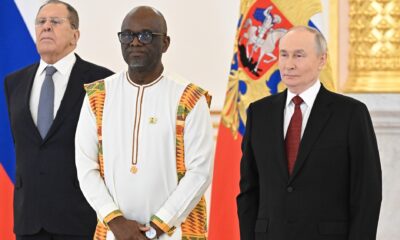

Putin Receives Newly Appointed Foreign Ambassadors in Bolshoi Kremlin Palace -By Kestér Kenn Klomegâh
According to him, the foundations of these relationships were laid back during the struggle of African peoples for freedom and...


Why Obi Cubana Shouldn’t Have Given His Life to Jesus (Part 1) -By Ugochukwu Ugwuanyi
But then, why the fuss about Obi Cubana's repentance, what with the American Rap King, Snoop Dog, repenting from gangsterism...


Invincible Defence Technology: Consciousness-Based Solutions to Interstate and Intrastate Violence -By Dr. David Leffler
Technology refers to the systematic application of knowledge and tools. In the case of IDT, this brain-based “technology” is the...