
Forgotten Dairies
Sad, As The War Of Attrition In Rivers Threatens To Stall State’s Development -By Isaac Asabor
The war of attrition also undermines accountability. Oversight mechanisms become tools of intimidation rather than instruments of governance. Policies stall, projects are delayed, and the machinery of government becomes reactive instead of proactive. The longer this continues, the more difficult it will be to restore confidence among investors, civil society, and ordinary citizens. Rivers State may boast wealth and resources, but wealth cannot compensate for the absence of sound governance.


Rivers State is at a crossroads, and the situation is deeply concerning. What is unfolding is not a principled contest of ideas between the executive and the legislature. It is not a disagreement about governance priorities or constitutional mandates. At its core, this is a prolonged power struggle, a war of attrition, between Governor Siminalayi Fubara, Speaker Martins Amaewhule, and former Governor Nyesom Wike. All other actors, including the citizens of Rivers, are collateral damage in this relentless battle for political supremacy.
Reducing the crisis to “Fubara versus the lawmakers” is misleading. Legislatures rarely act in perfect unison without a coordinating force. What we have witnessed in Rivers State since the 2023 elections bears all the hallmarks of a proxy war: carefully choreographed, emotionally charged, and deeply personal. The House of Assembly, once a symbol of legislative independence, has been repurposed as a battleground where loyalty to personalities outweighs constitutional responsibility.
At the heart of this impasse is Wike’s continued dominance over the state’s political machinery. Though he no longer holds executive office in the state, his influence remains deeply entrenched, particularly within the Assembly. The speed with which lawmakers align, the near absence of dissent, and the intensity of their opposition to the governor all point in one direction: this is not oversight; this is enforcement. That lawmakers feel compelled to act in unison is hardly surprising, after all, Wike once boasted that he personally bought nomination forms for them ahead of the 2023 elections, and some even repaid the gesture with gifts, including a car. Loyalty built on personal favors rather than principle now drives this standoff, and in a state where governance is supposed to serve the people, such partisan entanglements are a direct threat to democracy itself.
Equally troubling is the posture of the Speaker, Martins Amaewhule. Rather than rise above factional interests to protect the integrity of the House, he has chosen to personalize the conflict. His actions suggest a man fighting less for legislative autonomy and more for political supremacy. When a Speaker prioritizes loyalty and combativeness over duty and principle, governance suffers, and the Assembly loses credibility.
Governor Fubara, for his part, cannot escape scrutiny. Attempting to assert independence from a godfather system without first dismantling its entrenched structures was politically naïve. Rivers politics has never rewarded half-measures. Challenging a political order that elevated you requires strategy, patience, and coalition-building, not simply moral conviction. But while political miscalculations may explain the governor’s predicament, they do not justify the paralysis imposed on the machinery of governance.
The real victims in this protracted struggle are the people of Rivers State. Governance has slowed to a crawl. Investor confidence is eroding. Critical policies and infrastructure projects stall indefinitely. Roads remain unfinished, healthcare delivery lags, and opportunities for economic growth vanish as political energies are diverted toward personal vendettas. While the political elite flex muscles and exchange accusations, ordinary citizens bear the brunt: unemployment rises, public services deteriorate, and the cost of living escalates.
This war of attrition is made even more ironic by the current composition of the House of Assembly. The body, now dominated by lawmakers who defected from the Peoples Democratic Party (PDP) to the All Progressives Congress (APC), appears still to take cues from a suspended PDP member. These defections, once presented as principled realignments, now reveal themselves as tactical maneuvers motivated by personal loyalty rather than ideology, policy, or public service. In practical terms, the Assembly’s independence has been compromised, and its constitutional responsibilities subordinated to the ambitions of one man.
Such a scenario is not just politically absurd, it is institutionally dangerous. In stable democracies, party affiliation, ideological coherence, and institutional autonomy matter. In Rivers, labels are fluid, principles negotiable, and power the only constant. The consequence is an Assembly that appears confused, compromised, and disconnected from the mandate it claims to uphold. This is governance in reverse: a legislative body wielded as an instrument of personal and factional interests rather than as a guardian of public welfare.
The cost of this stalemate is tangible. Civil servants operate under uncertainty. Contractors hesitate to execute projects, fearful of abrupt policy shifts or bureaucratic obstruction. Communities wait endlessly for development projects that may never move beyond paper approvals. While political actors trade insults and flex influence, ordinary citizens struggle with crumbling infrastructure, inadequate healthcare, and a lack of meaningful employment. The human and economic toll of this war of attrition is mounting daily, yet the principal actors remain absorbed in a battle of wills.
Political immaturity on all sides exacerbates the crisis. The Speaker must remember that his first duty is to the House and the people, not to any political benefactor. Wike must recognize that influence exercised without restraint becomes sabotage rather than legacy-building. Fubara must appreciate that leadership requires courage, calculation, and coalition-building to navigate entrenched power dynamics without compromising state governance.
Above all, the voters of 2023, the people who entrusted these leaders with the mandate to govern, must not be forgotten. Those votes were cast not to settle old scores or preserve fading empires. They were cast in hope: hope for stability, development, responsive governance, and tangible improvements in their daily lives. Each day this political impasse lingers, that hope diminishes, eroding public trust and confidence in the state’s leadership.
Rivers State cannot continue as hostage to unresolved egos and unfinished political business. The current struggle is already detrimental to development, and if allowed to persist, it risks inflicting long-term damage. Roads, schools, hospitals, and industries cannot thrive under a political climate dominated by brinkmanship and vendettas. The state’s potential is enormous, but that potential is squandered when political victory is prioritized over public good.
The war of attrition also undermines accountability. Oversight mechanisms become tools of intimidation rather than instruments of governance. Policies stall, projects are delayed, and the machinery of government becomes reactive instead of proactive. The longer this continues, the more difficult it will be to restore confidence among investors, civil society, and ordinary citizens. Rivers State may boast wealth and resources, but wealth cannot compensate for the absence of sound governance.
History is unforgiving to leaders who mistake personal battles for public service. None of the principal actors, whether Fubara, Wike, or Amaewhule will emerge as true winners if Rivers loses. Political dominance achieved at the expense of development is hollow. Authority enforced through institutional paralysis is unsustainable. Loyalty weaponized against governance ultimately backfires, undermining the very structures it seeks to control.
The warning is clear: power is temporary, but the consequences of bad leadership are permanent. Rivers State deserves better than this stalemate, and history will judge harshly those who chose personal victory over public good. Political maturity, restraint, and prioritization of state development over ego-driven conflicts are urgently required.
In practical terms, this means the Speaker must focus on legislative independence and the broader welfare of Rivers people rather than factional loyalty. Wike must temper influence with responsibility, recognizing that unchecked control does more harm than good. Fubara must engage in strategic governance, building coalitions and asserting authority without triggering institutional sabotage. Above all, all actors must prioritize the long-term future of the state over short-term personal triumphs.
Rivers State, endowed with enormous human and natural resources, has the capacity for rapid development. Yet that potential is being eroded daily by a political war of attrition that has no end in sight. Investors are watching, civil servants are anxious, and citizens are growing impatient. The clock is ticking, and the cost of inaction is immense.
The message is simple: Rivers’ development cannot wait for political egos to reconcile. Every day spent in this stalemate is a day lost for roads that could be built, hospitals that could be upgraded, schools that could be resourced, and livelihoods that could be improved. If this war continues, the state risks being remembered not for its potential, but for political instability and governance failure.
It is, indeed, sad that the state finds itself in this position. Yet, there is still hope. If political actors choose wisdom over ego, strategy over vendetta, and public service over personal gain, Rivers can regain its trajectory toward meaningful development. But time is not on the side of those who delay. The war of attrition must end, for the sake of the people, for the sake of progress, and for the future of Rivers State.


The Kampala Declaration: How African Youth Can Lead Food System Transformation to Accelerate the Achievement of Zero Hunger by 2030 -By Emeka Christian Umunnakwe
If Africa is serious about achieving Zero Hunger by 2030, these perceptions must be confronted with deliberate action. Young people...


China Finances New ECOWAS Headquarters -By Kestér Kenn Klomegâh
In accordance with the agreement concluded between the ECOWAS and the Government of China, the building by the Shanghai Construction...


The Arrest Of Nicholas Maduro By The US And Other Matters -By Hajia Hadiza Mohammed
Since the advent of the current administration, the country has been weaken internally with self-serving leaders insensitive to the yearnings...


When Nations Break Their Reformers: Why EFCC Cannot Carry Nigeria’s Burden Alone — And Why Power Must Fear God -By Prof. John Egbeazien Oshodi
Public frustration with the EFCC over perceived selective enforcement is understandable. Nigerians see some arrests carried out suddenly and forcefully,...
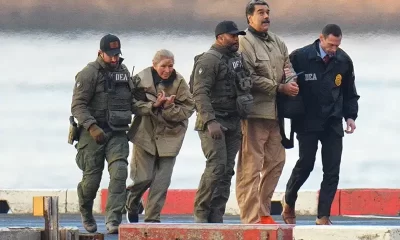

Poor, Poor, Maduro -By IfeanyiChukwu Afuba
Little wonder his ouster elicited celebrations. The ease of his capture is telling. There is only one explanation for the...