
Forgotten Dairies
Shifting Waves Fine-tuning Russia’s Economic Agenda -By Kestér Kenn Klomegâh
Feedback and ongoing dialogue with the business community and investors are key to improving the business climate and strengthening investment momentum as a guarantee of sustainable long-term economic growth. Here, the opinions and proposals of both domestic businesses and foreign partners are crucial, as are consideration of best international practices and the evaluation of Russia’s experiences to address the challenges and problems that businesses consider paramount and most important.

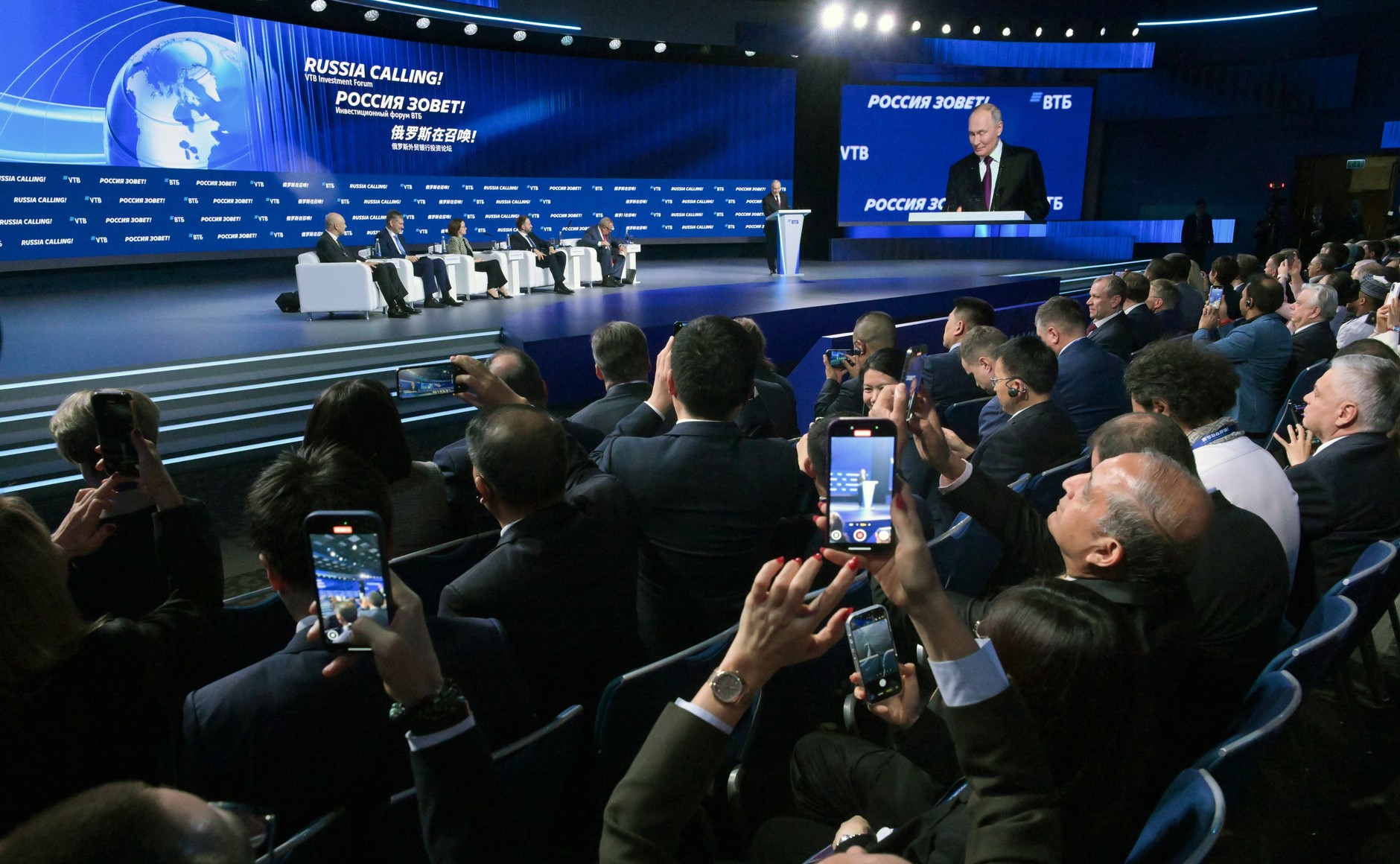
Russian President Vladimir Putin addressed the plenary session of the Russia Calling! forum. It was the 16th VTB Investment Forum held on December 2, under the theme – Reaching Higher: Bold Choices for the New Economy. As a good tradition, the event brought together entrepreneurs and investors from dozens of countries for a substantive dialogue on issues pertinent to business and directly influencing the development of trade and investment ties with foreign states.
Here are some of the key points:
First and foremost, Putin agreed with the fact that there must be global competition. Nevertheless, Russia has to strategically work with the business community, operate in a sufficiently cohesive and in an effective manner. Putin, however, pointed to key trends in the global economy and world markets, as well as in Russia’s economy – on the specific tasks we are setting to advance business initiatives in our country, to launch new promising projects, and thereby to expand opportunities for profitable investment across various sectors.
According to his explanation, the modern world is characterised by high turbulence, largely provoked by the non-competitive practices of certain Western states. Exploiting their monopolistic position in specific markets and in the financial sphere, they impose illegitimate unilateral restrictions, seeking in this way to pressure sovereign states that pursue independent policies. In essence, their aim is to eliminate competitors and to preserve their former privileges in a rapidly changing world – that very slipping monopoly.
Without a doubt, Russia today, feels sensitive to the external pressure, and has to advance cooperation with the countries that are interested in interacting with potential Russian partners. Over the past three years, Russia has significantly increased trade, primarily with key partners, such as China and India, through friendship and strategic interaction. Russia offers great opportunities for entrepreneurs and investors, and stable key macroeconomic indicators ensure the safety of such operations.
He reiterated that Russia is open to cooperation with foreign businesses in trade, the real sector, and the stock market. These offer significant opportunities for entrepreneurs and investors, and the stability of key macroeconomic indicators guarantees the reliability of such cooperation.
Public finances remain stable. Key priorities have been fully funded: social obligations, defense and national security, as well as the achievement of national development goals.
At the same time, economic growth is slowing, and some imbalances have also emerged. The Russian government and the Central Bank were tasked with fundamental objectives: ensuring the transition to a balanced growth model, maintaining low unemployment and inflation, and simultaneously initiating structural changes in the economy, taking into account the policy of “whitening” the economy and strengthening the competitive environment.
Measures Required
First and foremost, the need to achieve higher investment momentum, increase investment in the development of service industries, and launch new projects in industry, agriculture, infrastructure, high technology, tourism, and so on. Over the past three years, investment has grown at an accelerated pace: 6.7 percent in 2022, 9.8 percent in 2023, and 7.4 percent in 2024. This year, the growth rate is more modest, but overall remains positive.
What’s the reason? Corporate profits have declined in a number of economic sectors, as is well known—that is, their own funds for investment—while the cost of borrowed funds and bank loans, which domestic businesses largely used to finance projects, has objectively increased. These are obvious and understandable factors.
In recent years, Russia’s financial sector has managed to significantly restructure its operations, replacing unreliable external sources of financing with internal ones. As a result, the external debt of real sector enterprises has been reduced by almost half. But, there was some concern at the outset: the economy and industry, in general, have to withstand.
Does Russia Need Foreign Investments
In the case of foreign investments, a federal perspective on where it’s best for foreign partners to implement a particular project and what federal support measures to utilize could be useful.
For such initiatives, Putin proposed creating a unified investment support ecosystem so that entrepreneurs and companies can receive professional consultations and assistance throughout the entire project lifecycle, from conception to implementation.
Putin proposed creating such an ecosystem within VEB Corporation, with the participation of the Ministry of Economic Development.
Furthermore, it’s necessary to strengthen the role of the stock market as a source of investment funds, especially since interest in Russia’s stock market is high among individuals and institutional investors. The current economic situation is reflected in the Russian stock market. Its market capitalization has declined slightly and now stands at around 23 percent of GDP.
Clearly, the Russian stock market has room for growth and new placements. Additional efforts are needed to increase its market capitalization so that its potential can be harnessed for the benefit of the entire country.
In this regard, Putin proposed the following:
(i) First, investor investment in bonds and fund shares is growing. However, increasing debt is not the only tool for expanding production and launching investment projects. For long-term development, attracting equity capital is nonetheless crucial.
To strengthen this work, the Government has to quickly formulate a program for initial and secondary public offerings of shares in state-owned companies, and the ministries to outline industry-specific plans for listing large issuers on the stock market, while, of course, providing specific, effective incentives for businesses that list their shares, including linking existing support measures to the companies’ public status.
(ii) Second, the need to improve the efficiency and transparency of joint-stock company management so that their shareholders can be confident in the reliability of their investment and the return on their investment.
The program emphasizes the publication of corporate indicators that are meaningful for investors, including net assets, dividend yield, forecasts, development plans, and so on. Participants in the shareholder value creation program will form a pool of companies that will serve as a benchmark for other Russian issuers, a seal of quality for investors.
Putin asked the Government to ensure that the largest state-owned joint-stock companies participate in this program by the end of next year, and to align operating conditions and executive incentives with increased shareholder value.
(iii) And finally, the third point. It’s important to continue to improve the attractiveness of the capital market, strengthen investor confidence, and ensure an influx of funds. More and more citizens are signing up for long-term savings programs, which serve as an important source of long-term investments.
Furthermore, incentives are provided for employers who co-finance their employees’ savings in the long-term savings program. These incentives will come into effect on September 1, 2026. Monitoring how these innovations work and how businesses and individuals evaluate their effectiveness, after which it will further require fine-tuning these measures or launch additional mechanisms for the development of the stock market.
Putin’s Final Words
Feedback and ongoing dialogue with the business community and investors are key to improving the business climate and strengthening investment momentum as a guarantee of sustainable long-term economic growth. Here, the opinions and proposals of both domestic businesses and foreign partners are crucial, as are consideration of best international practices and the evaluation of Russia’s experiences to address the challenges and problems that businesses consider paramount and most important.
It’s crucial that the “Russia Calling!” forum provides an excellent opportunity to engage in open, constructive discussion on all these issues, and for foreign partners and considers their entrepreneurial interests in working with Russia, and in the Russian Federation.
—



The Pragmatism of Principle: Redefining Loyalty in an Age of Change -By Florence Ozor
While I do not endorse political nomadism, one must acknowledge that strategic realignment can be expedient. Take Peter Obi: after...


Lessons for Today: MLK for Continental African Leadership – A Psychoafricalytic Mirror for Power, Dignity, and Continental Renewal -By Psychologist John Egbeazien Oshodi
When African leaders abandon indigenous wisdom, they often adopt the colonial logic of control. Citizens become subjects. Protest becomes treason....


The Poverty Crisis: A Global Challenge to Human Dignity and Development -By Jennifer Joab
The poverty crisis is not just an economic problem but a profound human tragedy that affects the social, political, and...


Good Governance as a Tool for National Development -By Blessing Matthew
Good governance prioritizes the interests and welfare of the people above personal or sectional interests. It encourages transparency, accountability, rule...


Role of Youths in Nation Building -By Kusompwa Lazarus Motiyedi
It is true that today’s youth did not experience the horrors of the Nigerian Civil War or the severe economic...