
Sports
Sports in Nigeria: A Victim of Circumstance -By Okwuasaba David
The government and the sports ministry must be sincere in their dealings. If most sport leaders and directors, are firm, sports in Nigeria may become better once more. Another attempt to solve this problem as suggested by some public sports analysts could be in the expansion of the role the private sport sector in the country.


Sports in Nigeria between the years 1980-2000, still live in cultural memory for most Nigerians, as those years were particularly marked by a global showcase of talents and will. For practical emphasis, in 1989, at the African Championship Athletics competition, our athletes dominated the table with 14 gold, 12 silver and 9 bronze medals. It was hinted that at the time, Nigeria was a force to reckon with, locally in Africa and even in international sport competitions. In 1996, at the Summer Olympics held in Atlanta, the Nigerian football team i.e. The Super Eagles rode on a path to gold after defeating Brazil, the best national football team at the time. A feat recognized as not just as a win for Nigeria, but for Africa. Two years later, the country would become the first African country to complete the group stages as the top team in the world cup. Nigeria’s successes were not limited to football alone. At the same Olympics at Atlanta, Chioma Ajunwa became the first Nigerian to win Olympic gold in a field event. Even locally, our national football league was quite a moving success. But in recent times, we have witnessed a decline in athletics as a country. Nigeria as a country has only finished as top once in all athletic competitions participated in since the last two decades, in 2002 and 2012. The football sector, which is often regarded as the number one sports in Nigeria, has constantly failed to attain that expected dominance in global competitions. In 2021, our young and promising Super Eagles squad did not only fail to put up a good challenge at the African Cup of Nations, they also failed to qualify for the 2022 world cup at Qatar, and the list could go on. All these are not to in any way downplay the efforts and successes of Nigerians who still go against all odds to make fitting the country’s name through their various individual brilliance in various sports competitions locally and internationally.
Moreover, it is a fact that the sport sector has continued to lag behind just like other sectors in Nigeria over the years. In fact, as far as sports is concerned, Nigeria is now regarded as sleeping giants. Consequently, most of the athletes and sports persons have left Nigeria to other countries in search for greener pastures and a better career in sports. In the 2009 National Sports Policy of Nigeria, it is clearly outlined as its mission, “the development of the sports sector to a world class level where it would provide continuous improvement of quality of life for the entire citizenry to the extent that Nigeria would be recognized as one of the leading sporting countries in the world.” But this mission is yet to be realized. Thus, some questions abound. What really happened to Nigeria? Why the persistent decline in sports? What is the way out?
While corruption has been identified as a bane of decline in the sports sector of Nigeria, worthy of mention is that the issues that arise from the decline in sports are not external, but internal. Reporting their interview with Mr Godwin Kienka, the chairman of the sports reforms committee set up in 2016 by the Minister of Sports and Youth Development, the Sun Magazine highlighted Kienka’s comment when asked about the nature of the problem with Nigeria’s sports. According to Kienka, from state sports councils to the sports ministry, everyone admitted that “the truth about the problem of our sports is that they are self-inflicted.” This arises from the fact that the sports industry in Nigeria is tied to its politics. A certain decadent and perverse attitude and behavior now seems to have grown into virtually all sectors of the Nigerian State, and this not excluding her sports sector. There is no gainsaying the fact that if a proper probe is done into the dealings of government officials and other directors in Nigeria sports, one could huddle up a whole bunch of foul plays committed over the years in our sports and how in various ways, responsibilities have been failed to be dutifully carried out.
The outstanding quality of human resources and talents in Nigeria does not need overemphasizing. So, it is not an issue of incompetence on the part of our athletes and sport persons. Rather it is an issue of some certain negligence and the bureaucracy of our system. Failure to provide proper facilities, failed remuneration of athletes and the inability to harness the available resources. It is pertinent to further state that this problem goes beyond leadership in the political sphere. It traces down to as lowest level of leadership, among those responsible for Nigerian sports, a long line of ineptitude seems to have cut through from the grassroots to the highest bodies and left holes at every sector.
Given the above ugly situations, it is necessary to begin to speak on the practical issues and solutions in the sports sector. It is important to note that this has been done countless of times. As a matter of fact, over ten reform committees have been set up in both state and national levels over the past decade in an attempt to resolve the issues surrounding this discourse. Not to talk of the many articles and even books that have been written in an attempt to analyze and proffer solutions to this problem. Yet, it gets worse by the day.
Therefore, our attempt at rejuvenating sports must pay primary attention to this basic problem. The government and the sports ministry must be sincere in their dealings. If most sport leaders and directors, are firm, sports in Nigeria may become better once more. Another attempt to solve this problem as suggested by some public sports analysts could be in the expansion of the role the private sport sector in the country. In most European countries where there is high level of recorded success in the field of sports, alongside the public sector, the private sector with certain regulations also has a great role in providing financial and support for sport infrastructure, providing sport activities and services for citizens, usually in the forms of sport clubs and produce and sell sport products and services. Beyond its social outlook, the sports sector is a highly commercial sector. If the government should play its part and allow other various companies who may be interested and capable contribute their quotas.


Good Governance as a Tool for National Development -By Blessing Matthew
Good governance prioritizes the interests and welfare of the people above personal or sectional interests. It encourages transparency, accountability, rule...


Role of Youths in Nation Building -By Kusompwa Lazarus Motiyedi
It is true that today’s youth did not experience the horrors of the Nigerian Civil War or the severe economic...
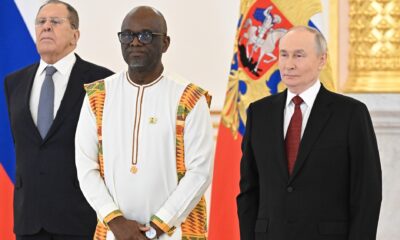

Putin Receives Newly Appointed Foreign Ambassadors in Bolshoi Kremlin Palace -By Kestér Kenn Klomegâh
According to him, the foundations of these relationships were laid back during the struggle of African peoples for freedom and...


Why Obi Cubana Shouldn’t Have Given His Life to Jesus (Part 1) -By Ugochukwu Ugwuanyi
But then, why the fuss about Obi Cubana's repentance, what with the American Rap King, Snoop Dog, repenting from gangsterism...


Invincible Defence Technology: Consciousness-Based Solutions to Interstate and Intrastate Violence -By Dr. David Leffler
Technology refers to the systematic application of knowledge and tools. In the case of IDT, this brain-based “technology” is the...