
Global Issues
The ECOWAS Democracy Paradox: A Flawed Arbiter in an Era of Autocratic Drift -By Jeff Okoroafor
As ECOWAS condemns Guinea-Bissau’s coup, I analyze how its failure to address “constitutional coups” by elected leaders has eroded credibility and created conditions for military takeovers across West Africa.

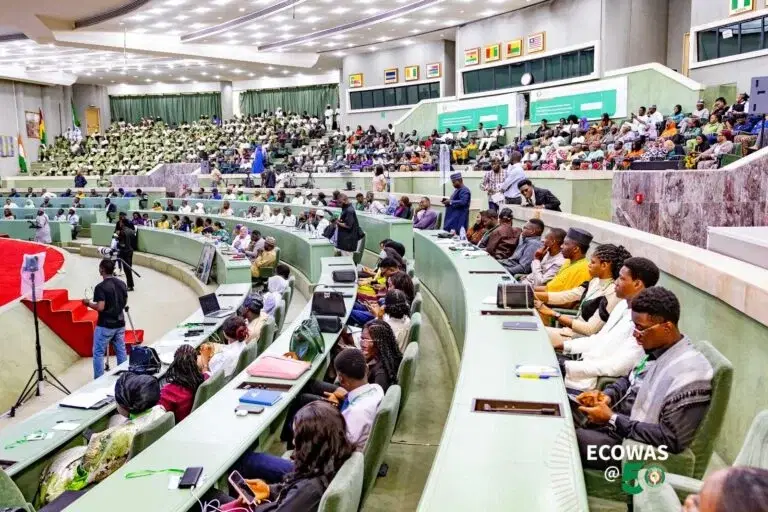
The speaker of the ECOWAS Parliament, Memounatou Ibrahima, has spoken with predictable clarity on the recent military coup in Guinea-Bissau. She condemned it as an “unacceptable assault on democracy,” a “direct threat to regional stability,” and affirmed the bloc’s “zero-tolerance principle against unconstitutional changes of government.” These are the right words, spoken into a vacuum of credibility. For while ECOWAS is quick to roar when soldiers seize power by force, it remains a whisper—or worse, a silent accomplice—when elected leaders systematically dismantle democracy by decree, a process we might term the “constitutional coup.”
This glaring inconsistency is not a minor flaw; it is the central failure that has eroded ECOWAS’s legitimacy and fueled the very instability it claims to combat. The regional body has become, in the eyes of millions of West Africans, not a guardian of democratic principles, but a protection racket for a club of incumbents, only enforcing rules when the method of power-grabbing is militarily crude, not legally cunning.
The Selective Enforcement of Democratic Protocols
ECOWAS has a robust legal framework. The 2001 Protocol on Democracy and Good Governance explicitly prohibits not just military putsches, but also the “substantial modification” of electoral laws less than six months before an election, and the refusal of an incumbent to relinquish power after losing an election. Yet, its application is wildly selective.
- The “Constitutional Coup” Blind Spot: Where was ECOWAS’s forceful intervention when President Alassane Ouattara of Côte d’Ivoire circumvented constitutional term limits in 2020, arguing a legal technicality, leading to a boycott, violence, and an election many deemed illegitimate? Where were the stiff sanctions when Guinean President Alpha Condé manipulated a referendum and constitution to secure a controversial third term in 2020, a move that poisoned politics and created conditions many argue precipitated the 2021 military coup? ECOWAS issued muted statements and engaged in fruitless dialogue, treating these as internal political matters rather than the fundamental violations of its core protocols they were. By focusing solely on the method (military vs. legalistic) and not the outcome (the erosion of democratic tenets), ECOWAS signals that autocracy is acceptable if done in a suit and with a pen.
- The Election-Only Democracy: ECOWAS expends immense resources and political capital to ensure elections are held—a crucial but insufficient metric. It dispatches observer missions that often offer tepid praise for technically “peaceful” polls, even when the playing field is grotesquely uneven, opposition leaders are jailed or disqualified, and state media is a ruling party mouthpiece. Once the election is concluded, its mandate seems to end. It shows little sustained interest in the broader governance deficits that create coup fodder: rampant corruption that siphons national wealth, security forces that terrorize citizens, collapsing public services, youth unemployment, and the brutal repression of protests. A regime can starve its people of justice, dignity, and development for years, but ECOWAS only mobilizes its machinery when that regime is physically removed by soldiers. This makes ECOWAS appear less like a champion of the people and more like a guardian of the status quo.
- Contested Leadership and the Credibility Deficit: How can an organization led by individuals with their own contested democratic credentials credibly enforce norms? For years, the chairmanship has been held by leaders accused of undermining democratic institutions at home. This creates a crisis of moral authority. It is difficult to take seriously condemnations of coups from a body whose own leading voices have manipulated constitutions or presided over deeply flawed electoral processes. Furthermore, the perceived influence of regional giants, particularly Nigeria, often leads to accusations that ECOWAS foreign policy is an extension of specific national interests, not a principled regional stance.
The Guinea-Bissau Flashpoint and a Path Forward
The Guinea-Bissau coup is indeed a tragedy, a violent interruption of a fragile process. But ECOWAS’s ritualistic response—condemnation, threatened sanctions, calls for restoration—will ring hollow unless it is part of a profound strategic shift. The people of West Africa are not nostalgic for military rule; they are desperately hungry for governance that works. The soldiers who take power often exploit this deep, legitimate frustration with failed democratic experiments.
For ECOWAS to reclaim its mandate and truly ensure “democratic dividends for the people,” it must:
1. Expand the Definition of “Unconstitutional Change.” Its protocols must be amended or interpreted to explicitly address constitutional subversion—the manipulation of term limits, the judicial harassment of opponents, and the legislative capture that makes elections a foregone conclusion. These should trigger the same escalating diplomatic and economic pressures as military coups.
2. Institute Permanent, Pro-Active Governance Monitoring. ECOWAS needs a Standing Council for Democratic Resilience, independent of the heads of state, composed of respected jurists, civil society leaders, and former officials. This body should produce regular, public scorecards on member states, monitoring not just elections but also civic space, judicial independence, corruption perceptions, and socio-economic inclusion. It should speak up before crises erupt.
3. Shift from Leader-Protection to Citizen-Protection. ECOWAS’s primary constituency must be the West African citizen, not the West African president. It should strengthen its early warning systems to include political and governance indicators and empower its Parliament to hold governments accountable. It must create safe channels to support civil society and independent media under threat.
4. Embrace a “Democratic Sanctions” Menu. Instead of blanket economic sanctions that often punish populations, develop a targeted “democratic sanctions” menu: travel bans and asset freezes for individuals undermining democracy; suspension from specific beneficial regional projects; and limits on financial transactions for regimes in violation. Apply them consistently, whether the perpetrator wears a uniform or a presidential sash.
In conclusion, the soldiers in Guinea-Bissau have committed a crime against the constitutional order. But ECOWAS stands accused of a slower, more insidious crime: the negligent guardianship of democracy. By acting only when the patient is on the operating table after a gunshot wound, while ignoring the metastatic cancer of corruption and authoritarian drift, it has failed in its duty. Until ECOWAS finds the courage and consistency to hold all power to account—that seized by the gun and that clung to by legal trickery—its condemnations will remain just words, and the coups will continue to be, in part, a terrible symptom of its own inaction. The people of West Africa deserve a guardian, not a gravedigger, for their democratic aspirations.

Jeff Okoroafor
Jeff Okoroafor is a social accountability advocate and a political commentator focused on governance, accountability, and social justice in West Africa.



The Pragmatism of Principle: Redefining Loyalty in an Age of Change -By Florence Ozor
While I do not endorse political nomadism, one must acknowledge that strategic realignment can be expedient. Take Peter Obi: after...

Lessons for Today: MLK for Continental African Leadership – A Psychoafricalytic Mirror for Power, Dignity, and Continental Renewal -By Psychologist John Egbeazien Oshodi
When African leaders abandon indigenous wisdom, they often adopt the colonial logic of control. Citizens become subjects. Protest becomes treason....


The Poverty Crisis: A Global Challenge to Human Dignity and Development -By Jennifer Joab
The poverty crisis is not just an economic problem but a profound human tragedy that affects the social, political, and...

Good Governance as a Tool for National Development -By Blessing Matthew
Good governance prioritizes the interests and welfare of the people above personal or sectional interests. It encourages transparency, accountability, rule...


Role of Youths in Nation Building -By Kusompwa Lazarus Motiyedi
It is true that today’s youth did not experience the horrors of the Nigerian Civil War or the severe economic...