
Political Issues
The Endless Cycle Of Discord Between Predecessors And Successors In Rivers -By Isaac Asabor
Unfortunately, the agreement did not last. Almost immediately, fault lines appeared. Fubara began asserting independence, while Wike expected continued loyalty and influence. What followed was political chaos: a divided House of Assembly, impeachment threats, mass defections, and a governance paralysis, and that once again made Rivers a national embarrassment. Even the intervention of President Bola Tinubu failed to impose lasting peace. Wike reached an agreement with Fubara, and the agreement was not met. The pattern remained unbroken.

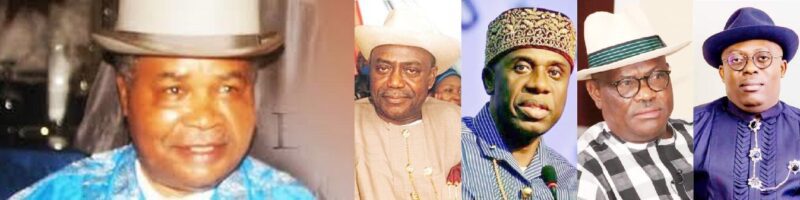
There is something profoundly tragic about Rivers State politics. Not tragic in the theatrical sense, but tragic in the classical meaning of a story whose ending is known in advance, yet whose characters march stubbornly toward it anyway. Over the years, Rivers has perfected a political ritual in which power is transferred, only for gratitude to evaporate, alliances to collapse, and former benefactors to become sworn enemies. It is a cycle so consistent that it now feels less like coincidence and more like destiny.
This grim reality is what Pastor David Ibiyeomie attempted to capture when he recently described Rivers State’s recurring political crises as a “spiritual problem.” Speaking during Salvation Ministries’ Glory Reign programme in January 2026, the cleric argued that the endless battles between governors and their predecessors defy ordinary political logic. While many may bristle at the spiritual framing, the historical record lends disturbing weight to his argument. In Rivers State, godfathers make kings, and those kings almost inevitably turn against their makers.
As historically documented, Chief Ada George, a respected elder and former governor of the state in the third republic from 1992 to 1993, was a major political force during the era Nigeria transited from military to civilian rule. Unfortunately, a disagreement arose between him and his former deputy, Peter Odili (who later became governor, 1999–2007). The disagreement was rooted in intense political rivalry, opposing party affiliations, and accusations of fueling violence in the state.
It bears recalling that in 1999, Rivers State was in dire need of stability, credibility, and seasoned leadership. The leadership pivot required at the time was embodied in Dr. Peter Odili, whose emergence was largely facilitated by the political instrumentality of Ada George. Odili did not ascend in isolation; he was the product of deliberate political grooming, elite consensus, and strategic backing from key power brokers, foremost among them Ada George.
Yet, no sooner had Odili settled into office than the familiar cracks began to appear. Power, once secured, became something to guard jealously rather than share respectfully. The relationship between Ada George and Odili deteriorated rapidly. Political structures associated with the elder statesman were weakened, his influence curtailed, and his voice increasingly ignored. What should have been a dignified partnership between mentor and protégé degenerated into estrangement. Ada George helped Odili to power, and they quarreled. The template had been set.
By the time Odili was finishing his second term, he had become the new godfather of Rivers politics. His influence was overwhelming, and he was determined to manage succession. Enter Chibuike Rotimi Amaechi, Odili’s loyal ally and political heir. Amaechi’s journey to Government House was paved by Odili’s backing, both within the PDP and across the state’s political establishment. Even when Amaechi was unlawfully sidelined in 2007, Odili’s shadow loomed large over the political drama that followed.
When the Supreme Court eventually restored Amaechi as governor, many expected continuity and loyalty. Instead, what unfolded was a slow but deliberate political divorce. Amaechi, like Odili before him, sought to assert autonomy. Odili’s influence was rolled back, his loyalists displaced, and his era symbolically dismantled. The godson rebelled against the godfather, not just to govern, but to dominate. Odili helped Amaechi, and they quarreled. Again, the cycle repeated itself with unsettling precision.
Amaechi, perhaps convinced that his own experience would not be replicated, went on to groom his own successor. Nyesom Wike emerged under Amaechi’s watch as Chief of Staff, later as Minister of State for Education, and eventually as the political powerhouse Amaechi trusted to keep Rivers within his sphere of influence. Wike’s political rise was neither accidental nor self-made; it was engineered, nurtured, and sustained by Amaechi’s backing.
But Rivers politics does not reward loyalty; it punishes it. The relationship between Amaechi and Wike collapsed spectacularly. Amaechi defected to the APC, Wike remained in the PDP, and Rivers State became the theatre of a bitter, prolonged conflict. Institutions were polarized, governance suffered, and the state descended into years of political hostility. Amaechi helped Wike, and they quarreled, perhaps more viciously than any pair before them.
By the time Wike completed his two terms as governor, he had become the most powerful political figure Rivers State had produced in decades. It was therefore no surprise that he sought to manage succession tightly. Siminalayi Fubara, a technocrat and former accountant-general of the state, was presented as a loyal, safe choice. There was an agreement, which Nigerians do not know of as it is an agreement between Wike and Fubara. The agreement, nicknamed “Agreement is agreement” was designed to protect Wike’s political interests while allowing Fubara to govern. Selfishly
Unfortunately, the agreement did not last. Almost immediately, fault lines appeared. Fubara began asserting independence, while Wike expected continued loyalty and influence. What followed was political chaos: a divided House of Assembly, impeachment threats, mass defections, and a governance paralysis, and that once again made Rivers a national embarrassment. Even the intervention of President Bola Tinubu failed to impose lasting peace. Wike reached an agreement with Fubara, and the agreement was not met. The pattern remained unbroken.
It is this stubborn predictability that lends credibility to Pastor Ibiyeomie’s claim that the problem runs deeper than politics. When every generation repeats the same mistake, one must ask whether Rivers State has internalized a culture of betrayal. Here, godfathers do not know when to let go, and godsons believe rebellion is the only path to legitimacy. Power is treated as personal property, not a public trust.
Perhaps the most chilling aspect of this cycle is its future implication. As Ibiyeomie observed, if Governor Fubara were to choose a successor today, that successor would likely fight him tomorrow. This is not prophecy; it is historical logic. Rivers politics has become a factory for broken alliances, and no individual, no matter how well-intentioned, has escaped unscarred.
Prayer, as Pastor Ibiyeomie has offered, may bring comfort and hope. But Rivers State also needs brutal honesty. Until its political actors learn that succession does not require subjugation, that loyalty does not mean servitude, and that agreements must be honored in good faith, the storms will continue. The problem is not just spiritual; it is ethical, institutional, and cultural.
Until these lessons are learned, Rivers State will remain trapped in the endless cycle of discord between godfathers and godsons, condemned to repeat its past, one broken alliance at a time.



Nigerians Are Always Happy -By Prince Charles Dickson PhD
Living in Nigeria is like being in a relationship with someone who loves you in theory but forgets you in...


Museveni’s Uganda: Family Company Limited -By Isaac Asabor
Museveni will not be remembered for the ideals he once espoused. He will be judged by how long he clung...

Africa Experiencing New Stage of Reawakening -By Kestér Kenn Klomegâh
The Russia-Africa summits earlier took place in Sochi (October 2019) and St. Petersburg (July 2023). Russia and Africa are currently...


The New York Times Misses the Forest for the Trees in Nigeria -By Nnamdi Prince
If the Times is so concerned about accurate data, perhaps it should direct its considerable resources toward independently investigating and...


The Pragmatism of Principle: Redefining Loyalty in an Age of Change -By Florence Ozor
While I do not endorse political nomadism, one must acknowledge that strategic realignment can be expedient. Take Peter Obi: after...