
National Issues
The Irony Of Justice: Abubakar Malami Fall From Grace And Sheikh Zakzaky Quiet Triumph -By Ahmad Babangida Baba
This tale of two men underscores the fleeting nature of power in Nigeria’s turbulent landscape. Malami’s current predicament serves as a reminder that accountability can come knocking, even for those who once held the keys to the kingdom. For Zakzaky, it’s a chapter of redemption, proving that truth and resilience can outlast even the harshest trials. As the new year approaches, one can’t help but reflect: in the court of public opinion, justice may be slow, but it often finds its way.

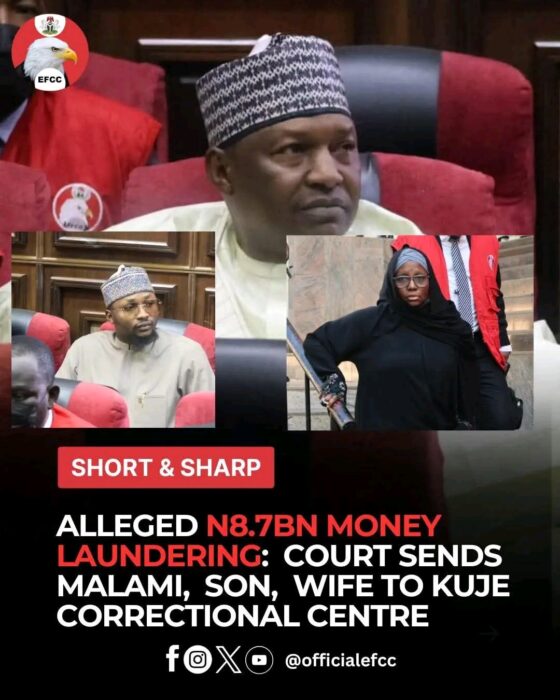
In the ever-shifting sands of Nigerian politics, where power can elevate one to untouchable heights only to cast them into the depths of scrutiny, few stories capture the essence of poetic justice quite like that of Abubakar Malami and Sheikh Ibrahim Zakzaky. Once a formidable figure as Nigeria’s Attorney General and Minister of Justice under President Muhammadu Buhari, Malami wielded his authority with a confidence that often bordered on audacity. Today, as 2025 draws to a close, he finds himself entangled in the very system he once commanded, facing charges that have landed him and his son in detention. Meanwhile, Sheikh Zakzaky, the man Malami helped keep behind bars for years despite widespread claims of innocence, walks free in Abuja, healthier and more resolute than ever.
Let’s rewind to the height of Malami’s influence. Serving from 2015 to 2023, the Senior Advocate of Nigeria (SAN) was no stranger to controversy. When it came to Sheikh Zakzaky, the revered leader of the Islamic Movement in Nigeria (IMN), Malami’s stance was unyielding. In late 2019, amid growing calls for Zakzaky’s release after his prolonged detention following the 2015 Zaria massacre, Malami publicly deflected responsibility. He argued that the federal government couldn’t intervene because Zakzaky’s case fell under Kaduna State law, even as human rights groups and courts decried the detention as unlawful and arbitrary. “The fate of Sheikh Zakzaky lies in the hands of the Kaduna State Government,” Malami stated at the time, a remark that critics saw as a convenient sidestep. The IMN accused him of orchestrating a “mischievous attempt” to perpetuate illegal imprisonment, knowing full well that Zakzaky and his wife Umma Zeenatuddeen Ibraheem had been held without fair trial, their health deteriorating in custody.
Malami’s words carried weight, but they also echoed with what many perceived as disregard for due process. He knew—or at least, evidence suggested he should have known—that multiple court rulings, including from the ECOWAS Court in 2016, had ordered Zakzaky’s release. Yet, the cleric remained detained, enduring years of hardship that included the loss of an eye and severe health issues from untreated injuries. Malami’s tenure was marked by such bold assertions, often framing detentions as necessary for national security, even as accusations of selective justice swirled.
Fast forward to December 2025, and the tables have turned in a way that feels almost scripted. Malami, now out of office, was dramatically arrested by the Economic and Financial Crimes Commission (EFCC) on December 8. Along with his son, Abdulaziz, and another associate, he faces 16 counts of money laundering and concealment involving over N1 billion—allegations tied to suspicious bank accounts and financial dealings during his time in power. What started as questioning in late November escalated to rearrest and overnight detention, with Malami spending nights in EFCC custody despite a court granting him interim bail. His office has decried the agency’s “open defiance” of judicial orders, labeling it a “media trial” and an infringement on his rights. Sources close to the matter describe a man once accustomed to giving orders now lamenting the slow grind of the legal system, his family caught in the crossfire.
The irony is palpable. The same man who justified prolonged detentions now cries foul over his own. As Punch Newspaper reported, Malami’s team has accused the EFCC of ignoring bail conditions, echoing the very complaints leveled against his administration during Zakzaky’s ordeal. While Malami awaits arraignment in early January 2026, his life has been upended—freedom curtailed, reputation under siege, and a once-powerful legacy now overshadowed by scandal.
In stark contrast stands Sheikh Zakzaky, the resilient Shi’a leader whose movement has inspired millions across Africa. Acquitted and released in July 2021 after a Kaduna High Court dismissed all charges against him and his wife, Zeenah, Zakzaky has reclaimed his life with quiet determination. Following his release, he sought medical treatment abroad, traveling to Iran in October 2023 for specialized care that addressed lingering health issues from his detention, including lead poisoning and vision problems. By February 2024, he returned to Nigeria, greeted by throngs of supporters in Abuja, vowing to continue his mission of unity and resistance against oppression.
Today, at 72, Zakzaky appears healthier and more active than in years past. Residing in Abuja, he has been spotted engaging with communities, meeting families of martyrs from past clashes, and speaking out on issues like Palestinian solidarity. Just this month, on December 19, he addressed followers, asserting that the IMN “cannot be frightened” by threats—a testament to his enduring spirit. No longer confined to a cell, Zakzaky lives freely, surrounded by family and adherents, focusing on education, interfaith dialogue, and social justice. His story has evolved from one of suffering to inspiration, a beacon for those who believe in perseverance amid adversity.
This tale of two men underscores the fleeting nature of power in Nigeria’s turbulent landscape. Malami’s current predicament serves as a reminder that accountability can come knocking, even for those who once held the keys to the kingdom. For Zakzaky, it’s a chapter of redemption, proving that truth and resilience can outlast even the harshest trials. As the new year approaches, one can’t help but reflect: in the court of public opinion, justice may be slow, but it often finds its way.


Lack of Financial Support Holding Back Russia’s Economic Influence in Africa: A Case Study of Missed Opportunities in Nigeria -By Kestér Kenn Klomegâh
As Africa's largest economy, Nigeria cannot afford another decade of promises without projects. The future of its development lies with...


The Impact Of Social Media On Youth Mental Health -By Jemimah Hezekiah
Governments and tech companies also have a role to play. Enforcing anti-cyberbullying policies, offering digital literacy programs, and providing mental...

Every Night We Pray to Survive: Voices from Insecure Communities -By Rinret istifanus
As the nation debates policies and strategies, these voices remind us that insecurity is not just a headline it is...

The Cost of Building: Reflections from Inside Northern Nigerian Governance -By Naufal Ahmad
We need a new ethic of engagement. I’m not saying don’t question leaders. I’ve been an internal critic for most...


Genotype Confirmation: Why It Must Be Included As Part Of The Elements Of Marriage -By Tajudeen Abdulrauf Dasuki
Sickle cell is not a mere disease , that we count as minor issue, it is only those have it,...