
Political Issues
The Political Afterlife of Ayo Fayose -By Oluwafemi Popoola
One must confront the truth that Fayose’s loud, almost theatrical support for Nyesom Wike and the Tinubu administration has very little to do with justice, fairness, or any sudden commitment to truth. This is repayment. Politics, like village life, has long memories. When Fayose was ensnared in his EFCC troubles, when the walls felt as though they were closing in and allies suddenly developed bad phone networks, Wike stood by him. He spoke loudly.

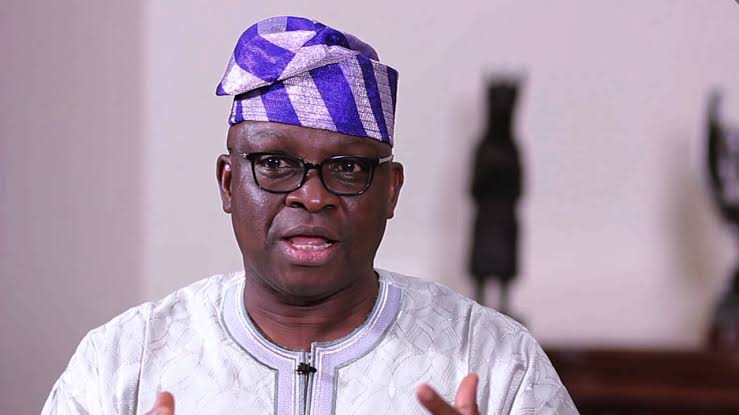
When the former Ekiti State governor, Ayodele Fayose turned 65 last November, he crossed a threshold traditionally reserved for reflection. Age, one would think, should bring restraint. In Yoruba cosmology, age is expected to civilise the spirit, tame recklessness and refine speech. Elders are regarded as custodians of balance. They are expected to shelve excesses, to speak less from impulse and more from wisdom.
Outside Africa, classical philosophers like Cicero famously described old age as the crown of wisdom. But Fayose defies both culture and philosophy. He seems untouched by this expectation. He’s louder and more combative than ever, as though determined to prove that time has taught him nothing
It is this expectation that makes the recent public utterances of Fayose so jarring. Rather than the calm voice of an elder statesman, he has chosen the shrill cadence of political combat, inserting himself noisily into series of disputes. He was recently involved with Oyo State Governor Seyi Makinde, Rivers State Governor Siminalayi Fubara, and even the broader calculations of President Bola Tinubu’s administration. The question is not merely what Fayose is saying, but why he is saying it now, and on whose behalf.
On December 28, 2025, Fayose reignited a simmering political feud by accusing Governor Seyi Makinde of concealing a purported N50 billion federal intervention fund allegedly received after the tragic January 2024 explosion in Ibadan. Appearing on TVC’s Journalists’ Hangout, Fayose claimed that only a fraction of the money reached victims, while the rest was diverted to political ends, including Makinde’s alleged presidential ambition. When challenged, Fayose released documents through the X page of Lere Olayinka, a known media aide to Nyesom Wike, further muddying the waters and raising legitimate questions about motive.
Transparency, Fayose claimed. But transparency delivered selectively, through partisan channels, and conveniently aligned with the interests of powerful actors in Abuja and Port Harcourt, hardly convinces. Ironically, Fayose’s own “leaks” helped Nigerians realise that intervention funds were not unique to Oyo. A federal memo from August 2024 revealed that several states benefited, with Lagos reportedly receiving far more.
This intervention did not occur in isolation. It followed Makinde’s own revelations that Nyesom Wike had offered to “hold down” the PDP to aid President Tinubu’s second-term ambition, and that Tinubu personally asked Makinde to help organise the APC in Oyo State, an offer he said he rejected.
One would think Fayose’s sudden zeal feels like a spontaneous moral awakening. But does it? Fayose increasingly looks like the newest catch, the freshly sharpened weapon being deployed by the Wike political machine and, by extension, interests aligned with the Tinubu administration, to intimidate, distract, or discredit dissenting voices within the opposition.
The pattern is becoming clearer. On January 10, 2026, Fayose declared that only fasting and prayers could save Rivers State Governor Siminalayi Fubara from impeachment, framing a grave constitutional crisis as a kind of spiritual melodrama. Days later, he questioned Fubara’s claim to political leadership in Rivers, invoking Lagos as an example of President Tinubu’s overriding influence, and even praising the declaration of emergency rule as a political “lifeline” that saved Fubara from extinction. Around the same period, the Ekiti governor took his talents to the opposition space, issuing a solemn warning to the African Democratic Congress (ADC). He said without Peter Obi, the party would be irrelevant.
It thus felt like an innocent observation, but it wasn’t. It was a carefully clumsy jab at Atiku Abubakar and other political heavyweights who had found their way into the ADC. The logic was transparent to the point of embarrassment—inflate Obi as the lone political asset, shrink everyone else into expendable extras, and quietly poison the well ahead of 2027.
If Obi could be made to believe he alone mattered, the ADC could be nudged into fielding a weaker, more fractured ticket. It was strategy, yes, but of the playground variety. Predictable. Childish. And ultimately futile.
What is truly amazing is the role Fayose now seems comfortable playing. This is a two-time governor, for crying out loud. His posture presently looks like a freelance attack dog. One would think such a résumé would command restraint or at least sophistication. Instead, Fayose appears happy auditioning as a political errand boy, doing the kind of hatchet jobs more naturally suited to Reno Omokri or Femi Fani-Kayode. Even those two, by all accounts, have already been “engaged,”. Already lined up for ambassadorial consolation prizes. So one is tempted to ask: why Fayose now? Has the bench become so thin, or is Fayose, to borrow Rotimi Amaechi’s now-famous lament, hungry again? Amaechi spoke of hunger while decrying Nigeria’s economic hardship at his 60th birthday. Fayose’s hunger seems more about relevance, an appetite for attention, patronage, and validation from power.
One must confront the truth that Fayose’s loud, almost theatrical support for Nyesom Wike and the Tinubu administration has very little to do with justice, fairness, or any sudden commitment to truth. This is repayment. Politics, like village life, has long memories. When Fayose was ensnared in his EFCC troubles, when the walls felt as though they were closing in and allies suddenly developed bad phone networks, Wike stood by him. He spoke loudly. He defended him publicly. In Nigerian political culture, such loyalty is not forgotten. It is banked. And today, Fayose appears to be cashing out that old cheque, with interest, regardless of the damage it does to logic, consistency, or conscience.
And then there is credibility. How does one take Fayose seriously without recalling the famous theatrics? The neck brace. The injured hand. The solemn announcements of “severe pains.” The performance was Oscar-worthy, even if the plot collapsed midway. Nicknamed “Peter the Rock” by amused Nigerians, Fayose showed that pain, like outrage, can be convincingly staged. A man who can act pain can also act principle. The skill set is transferable.
There is something darkly comic about watching a 65-year-old man behave like a political influencer desperate for engagement metrics. While others his age are writing memoirs, planting trees, or perfecting the art of silence, Fayose is still throwing verbal stones on live television.
One imagines him waking up, checking the news cycle, and thinking, “Who can I annoy today so they remember I’m still here?”
But beneath the humour lies a sadness. What Fayose is doing is beneath him. Beneath the office he once occupied. A two-time governor should not be reduced to running errands for stronger men or recycling talking points crafted elsewhere. There is a dignity that ought to come with experience, a gravitas that age should insist upon. Fayose has chosen noise instead.
Politics, of course, is a dirty game. It stains. It corrodes. It rewards shamelessness and punishes hesitation. It can take a man’s dignity quietly, without him noticing, until one day he looks in the mirror and sees not a statesman, but a survivor clinging to relevance.
Oluwafemi Popoola is a Nigerian journalist, media strategist, and columnist. He can be reached via bromeo2013@gmail.com


The New York Times Misses the Forest for the Trees in Nigeria -By Nnamdi Prince
If the Times is so concerned about accurate data, perhaps it should direct its considerable resources toward independently investigating and...


The Pragmatism of Principle: Redefining Loyalty in an Age of Change -By Florence Ozor
While I do not endorse political nomadism, one must acknowledge that strategic realignment can be expedient. Take Peter Obi: after...


Lessons for Today: MLK for Continental African Leadership – A Psychoafricalytic Mirror for Power, Dignity, and Continental Renewal -By Psychologist John Egbeazien Oshodi
When African leaders abandon indigenous wisdom, they often adopt the colonial logic of control. Citizens become subjects. Protest becomes treason....


The Poverty Crisis: A Global Challenge to Human Dignity and Development -By Jennifer Joab
The poverty crisis is not just an economic problem but a profound human tragedy that affects the social, political, and...

Good Governance as a Tool for National Development -By Blessing Matthew
Good governance prioritizes the interests and welfare of the people above personal or sectional interests. It encourages transparency, accountability, rule...