
National Issues
The Politics of Governance: Are Nigerians Being Fairly Treated? -By Yohanna Bwala

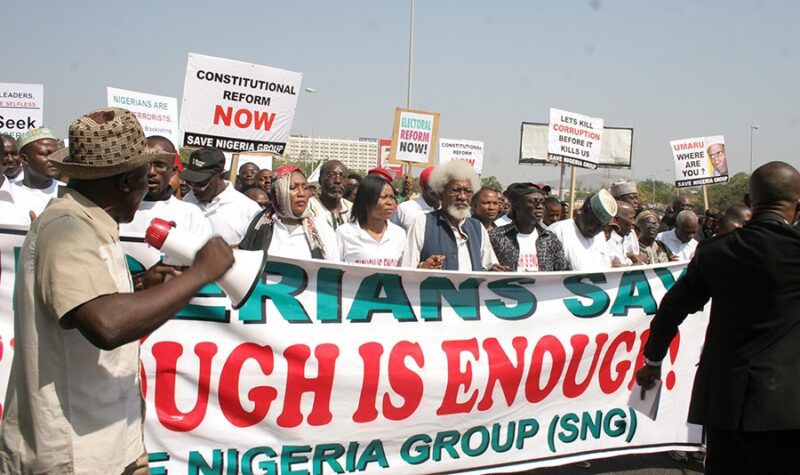

Due to years of practicing politics and governance in a twisted and self-serving fashion, the political ideology of elevating one’s personal interest over and above national interest has been engrained in the DNA of the average Nigerian politician. Not only is this type of politics unsustainable, it is also suicidal to our existence as a nation.
The current face-off between the executive and the legislative arms of government is not only nauseating, it also portrays the nation in bad light. When lawmakers wield power for the sole purpose of self-preservation of their egos, rather than doing so in the public interest, they unknowingly end up pitching themselves against the same set of people they are there to serve. To know if Nigerians are being fair to them or not, senators need to step away from their privileged positions and dispassionately observe their conduct from the perspective of the taxpayer. We are not saying the Senate should agree with the executive on every matter brought before it; in fact, friction between the two arms of government is a sign of the evolution of our democratic processes. However, when such frictions drag on for far too long, it goes beyond what is in best interest of the nation.
We don’t usually witness such faceoff between state legislators and governors because the influence of the governors over state legislators is far too intimidating, that whatever they bring before the state assembly is passed with little or no opposition, no matter how detrimental such submissions are to the growth of the state. After all, by the virtue of having their elections on the same day, the governors play a huge role in the emergence of majority of the state legislators. As such, their loyalty lies more with the governors than their constituents. At the national level, reverse is the case. The Senate, as currently constituted, parades powerful individuals with deep pockets and decades of political experience. PDP senators and those of the New PDP wing of the APC did not throw their weight behind the emergence of the Senate president just because they loved his face, they knew the only way to have their interests protected is by enthroning a leader of their choice.
There is no need crying over spilled milk. The damage was done during the power sharing process in the APC. The APC as a party shot itself in the foot by accepting powerful decampes from the New PDP, without conceding certain positions to them; thereby necessitating the hijack of the leadership of the National Assembly. The president cannot totally absolve himself of the blame for this; he and his party are one. When the president and his party stalwarts went round the country in 2015 urging the electorate to vote for all APC candidates running for political offices (“SAK!”), they had by implication endorsed the good, the bad and the ugly.
As much as we would want to blame individual players in the faceoff between the national executive and legislature, it is imperative that we acknowledge the source of the problem, so as to chart a way forward, not because we fancy their style of politics, but because of its dire consequence on our fortunes as a nation. The structural defect within the APC has played a huge role in the current state of stagnation in the polity. A party that is having major issues identifying something as basic as a true national leader cannot speak with one voice. A good political party shows its worth in the way it manages national crisis, not only its capacity to win elections. A car accommodating passengers with diverse intended destinations cannot go far, it is bound to experience breakdown along the trip, unless a consensus is reached on where everyone is heading to. So long as the APC fails to fix their internal party wrangling, the party will continue dragging the nation down with it.
In the life a nation, a day lost to unnecessary political power play cannot be regained, not to mention two long weeks. When politics interferes with governance for this long, it is the common man that suffers. The chaos within the APC as a party is telling on the fortunes of the average non-partisan Nigerian on the street. As Peter Tosh once said: “I am not a politician, I only suffer the consequences.” Whatever political dispute that is manifesting as the faceoff between the executive and legislature, this should be fixed quickly so that the major actors in the crisis can resume the duties for which we sent them there. Nigeria is greater than APC and PDP put together. When a taxpayer parts with his hard-earned money, he does so with the belief that such funds are returning to him as the sweet fruits of good governance, and not to facilitate political wrestle-mania between those responsible for providing governance.
In harsh economic times like this, as the ruling elites continue living as if there is no recession in the land, a social class gap is created, such that the poor and the downtrodden in the society are forced by hardship, to start seeing those of the political class as adversaries. And that is a situation those in the political class should not allow to deteriorate. When the downtrodden in any society exceed their ‘elastic limit’, the reaction that normally follows is better imagined. In public service, ‘perception is often more important than reality.’
Yohanna Bwala is a Lagos-based Environmental Geologist.


Second Ministerial Conference: Shaping Russian-African Strategic Partnerships -By Kestér Kenn Klomegâh
As indicated from above, the most important issues of multifaceted development are included on the Russian-African agenda, with a focus...


When Matrimony Is Dead On Arrival, The Wedding Was Only A Ceremony -By Isaac Asabor
Marriage is not for everyone, and that truth needs to be said plainly. It requires emotional intelligence, self-control, humility, and...

Awards Without Impact: Rethinking ‘Good Governance’ In Bauchi State -By Yasir Shehu Adam
True good governance is not proven in Abuja halls or award plaques. It is proven in functional classrooms, well-equipped hospitals,...


When “Happily Ever After” Starts Expiring: A Deep Dive into the Alarming Rise of Failed Marriages -By Peace Adams Bitrus
Weddings have become theatrical performances. Months of planning, millions spent, lights, cameras, choreographed dances… but very little attention is given...
Cease The Unchecked Looting -By Abba Dukawa
To address this, the Independent Corrupt Practices and Other Related Offences Commission (ICPC) and the Economic and Financial Crimes Commission...