
Political Issues
Tinubu And His Cut-And-Paste Campaign Manifesto -By Gozie Irogboli
How can Tinubu convince anyone of his sincerity to develop the ports of Niger Delta when in fact, he and his people erroneously thought that doing that would diminish the status of Lagos and have subtly fought anyone that intended to do so in the past. And how does he intend to do that when a whooping sum of $2.59 billion has just been approved by the Buhari regime to develop a deep-sea port in Badagry? Is he going to cancel that and utilize the sum for the Niger Delta ports or..?

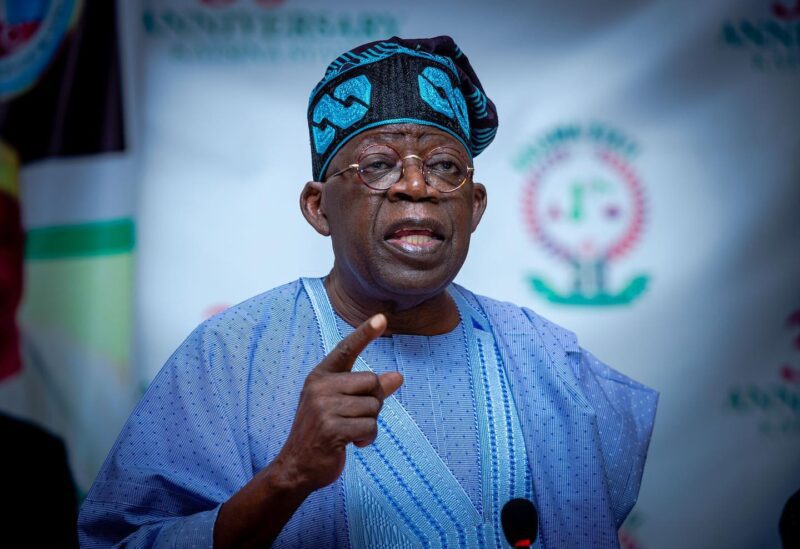
Nigeria is in an electoral season and those jousting for elective positions are busy churning out their proposed programs to the public. But sadly, the gullible and the malleable Nigeria public do not care much about the suitability or the capability of the election candidates as should be assessed primarily from the contents of their manifestoes and hence the circulation of all manner of documents in the name of manifesto.
Generally, a standard campaign manifesto should contain the necessary background analysis of the current situation, highlighting the challenges, opportunities and potentials with a view to identifying what needs to be done and then a statement of the vision and mission of the candidate together with his goals as well as the graphic details of how he intends to achieve the set goals articulated usually through strategic stakeholders’ engagement.
Thus, the campaign manifesto is supposed to present the picturesque view of the candidates ideas concerning the work to be done, demonstrates his full grasp of the situation, show a clear understanding of the nature and magnitude of the job that he is coming to do as well as his capacity and knowledge of the operating environment. The manifesto is supposed to be the program and the working document of the candidates and a covenant sort of with the people that he is coming to represent or superintend over their affairs and as such a standard to appraise performance. It is supposed to be a policy document, a roadmap as well as the compass that will guide the candidate while in office.
But, in Nigeria where people tend to have false notion about leadership and everything, the manifesto seem to be of little significance. The presentation of campaign manifestoes is a mere perfunctory exercise by election candidates who most times know nothing about the contents of their manifestoes. Most times what the candidates do is to hire experts or consultants to cook up their manifestoes with little or no personal input. The result being that they know next to nothing about the document that they present to the public. This appears to be the case in All Progressives Congress (APC) 2015 manifesto wherein they denied all their campaign promises earning the inglorious appellation: All Promises Cancelled (APC) in the process. Sometimes too, what candidates do is to pirate the manifestoes of past successful candidates. As pointed out by Dele Momodu, Tinubu seems to have plagiarized MKO Abiola’s June 12 Manifesto. And if that is true, it shows clearly that Tinubu is actually dwelling in the past. Nigeria of 1993 is quite different from Nigeria of today, thirty years after and so it will be inappropriate to adopt the same manifesto without recourse to the period and prevailing circumstances.
Unfortunately however, the Nigerian politicians get away with their fraud and their glaring inadequacies because the ignorant Nigerian public, divided along ethnic and religious cleavages, never hold them accountable for their words and actions. The peoples’ notion about politics seems to center on blind ethnic solidarity. To them politics is about the enthronement of your tribesman in power irrespective of his inadequacies. That was why despite the repudiation of its campaign promises and its woeful performance in the first tenure, the APC regime survived beyond 2019 because the North insisted that it must complete its eight-year tenure and the Southwest insisted on voting APC so that by 2023 it would be their turn. But beyond that, the politicians have also weaponized poverty as a sinister tool to manipulate their people. That is why despite the fact the North has been in government more than any other region, it has the worst human development indices. The Southwest that has shared power with the North since the era of the civil war has not had any significant advantage in human development index either. Tinubu’s Lagos, despite the obvious advantage and head start it has over every other state in Nigeria has one of the worst HDI record in the South. Like the North where the Alimajiri constitutes a social scourge, Lagos has the horde of uneducated, unskilled youth population that survives on crime, swindling, extortion and all manner of social vices.
It is against this background that an examination of the manifestoes of the presidential candidates for the 2023 election will be imperative. And a peep into the Tinubu campaign manifesto released recently is enough to reveal the inherent contradictions and inconsistencies in it. There is no clearly specified algorithm between the identified issues and the solutions proffered. It is more of a statement of intentions without corresponding strategies to accomplish them. And some have aptly called it the Emi-Lokan manifesto. And all I could see in the said Emi-Lokan manifesto is the usual grandstanding and triumphalism of failure associated with the APC regime. Indeed, Tinubu’s campaign manifesto is as bogus as his spurious claim to have developed Lagos.
And for someone that pledged to continue Buhari’s policies, it is farcical that he could entitle his 80-page manifesto document “Renewed Hope 2023: Action Plan for a Better Nigeria”. Tinubu prides himself as the one that brought and enthroned Buhari. He was also quoted to have declared that Buhari has done well and that he would retain his policies. Mr. Festus Keyamo, his campaign spokesperson has also said that if Tinubu is elected, he would rule Nigeria exactly the way Buhari did. And if Buhari who have been generally adjudged to be a monumental failure is being rated by Tinubu and his team as a success, it means that they have false sense of governance and leadership and so will not give Nigeria the relief that it is in dire need of at present. The choice of Mr. Tinubu’s running mate is pointer to the fact that the status quo will be sustained if he is elected.
Undoubtedly, the Asiwaju Bola Ahmed Tinubu campaign manifesto is an assemblage of the usual campaign platitudes that the candidate has no capacity or the willingness to implement and Tinubu is not new to that kind of electoral subterfuge. How can Tinubu convince anyone of his sincerity to develop the ports of Niger Delta when in fact, he and his people erroneously thought that doing that would diminish the status of Lagos and have subtly fought anyone that intended to do so in the past. And how does he intend to do that when a whooping sum of $2.59 billion has just been approved by the Buhari regime to develop a deep-sea port in Badagry? Is he going to cancel that and utilize the sum for the Niger Delta ports or..? It is believed that one of the reasons for the attack on Stella Oduah and Jonathan from Tinubu and his group was associated with the development of the international airport at Enugu and that was why shortly after they came to power, they downgraded the said airport.
Interestingly, Tinubu stated in the manifesto that Nigerians do not want the broken, unimaginative, failed promises repackaged and fed to them again and yet he stated that the total transformation of Nigeria can be achieved by building on the foundation laid by the present APC administration that is known for failed promises. He pledged to continue the Social Intervention Program that is judged by Nigerians as a sham and harmonized the Nigerian exchange rate problems that he claimed was outside the control of the country just as the APC had promised to make the Naira equal to the dollar in 2015. He also pledged to end the petroleum subsidy regime and channel the funds to other more productive uses.
Indeed, the APC as a political group is notorious for bulk-passing and shirking responsibilities. For instance, in the APC’s 2015 party manifesto, the restructuring agenda was the second item on their proposed schedule but upon coming to power when the citizens raised the issue of restructuring, the party opposed it vehemently. The same way it pledged to uphold the rule of law and human rights but never obeyed court orders and yet desperately sought to enact laws to stifle free speech and civil advocacy.
Tinubu’s campaign manifesto is exactly what it is: a matter-of-course document presented to fulfill all righteousness. In reality, Tinubu appears not ready for the task ahead in terms of the prevailing circumstances. He is probably banking on some secret and inscrutable pact with the powers that be as encapsulated in his Emi-Lokan declaration. No doubt, the specter of the past misdeeds and inconsistencies will continue to hunt Tinubu and the APC.
Gozie Irogboli
An economist, a novelist, consultant and public policy analyst

Cease The Unchecked Looting -By Abba Dukawa
To address this, the Independent Corrupt Practices and Other Related Offences Commission (ICPC) and the Economic and Financial Crimes Commission...


Moscow University Museum Presents Insights into African Artistic Culture -By Kestér Kenn Klomegâh
In his contribution, Louis Gouend, Chairman of the Commission for Work with African Diasporas at Moscow State University's Russian-African Club,...


Justice, Peace And Integrity Of Creation Prerequisite To Good Living -By Melissa Thomas
There are many ways to promote peace in our world of today but perhaps the best way is to promote...


Africa Squeezed Between Import Substitution and Dependency Syndrome -By Kestér Kenn Klomegâh
The key buyers of Russian grain on the continent are Egypt, Algeria, Kenya, Libya, Tunisia, Nigeria, Morocco, South Africa, Tanzania...

Accelerating Intra-Africa Trade and Sustainable Development -By Kestér Kenn Klomegâh
The AU Private Sector Forum has held several forums, with key recommendations. These recommendations provide valuable insights into the challenges...