
Global Issues
Trans-Africa: A Journey of Freedom, Hope, And The Dream Of One Africa -By Kestér Kenn Klomegâh
Through it all, the campaign underscored that the challenge of visa regimes is not simply bureaucratic red tape but a continuing legacy of colonial fragmentation that still dictates who can move, trade, love, learn, and connect. “Visa restrictions are reminiscent of apartheid-era treatment of Africans,” Mubarak observed during the Liberia leg of the tour, drawing a direct line from colonial divisions to present-day barriers that choke intra-African commerce and cultural exchange.

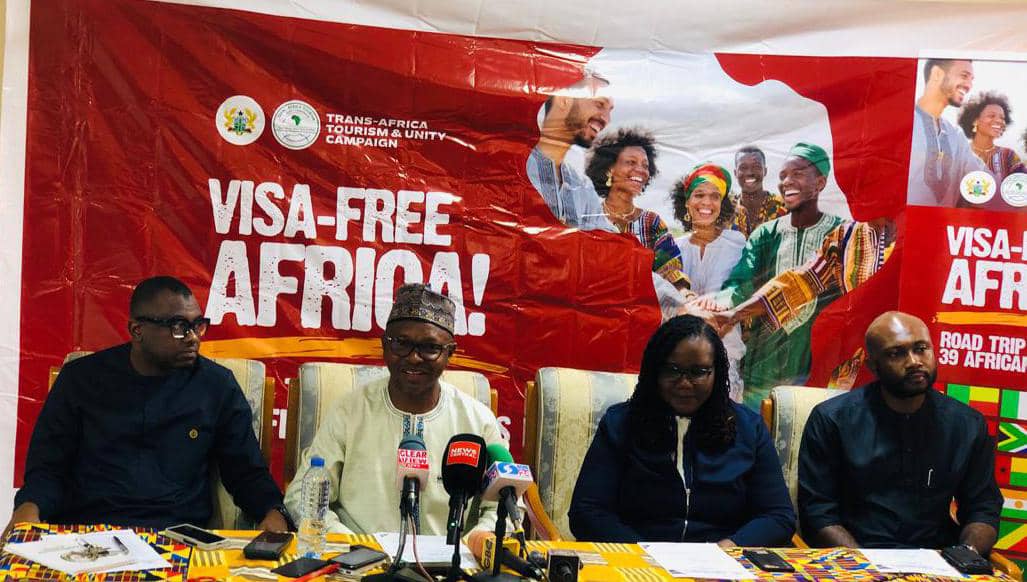
The Pan-African Progressive Front (PPF) awaits in joyous anticipation of the return of the Trans Africa tourism and unity campaign team as they end the Visa-Free Campaign journeyed across 39 nations. PPF is extremely proud of this great and historic milestone achieved by 8 team members who left Ghana with a quest of uniting nations who unfortunately have been divided by the historic inhumane consequences of slave trade and colonialism.
On a crisp morning in Accra on August 18, 2025, a small convoy of rugged vehicles rumbled through the historic streets of Ghana’s capital, their tyres kicking up red dust and hearts pounding with anticipation. The Trans-Africa Tourism & Unity Campaign, a 40,000-kilometre odyssey spanning 39 nations across the continent, had begun.
Led by Ghanaian Pan-Africanist, former Member of Parliament and seasoned communicator Hon. Ras Mubarak, this was no ordinary road trip. It was a pilgrimage; a living manifesto urging Africans to reclaim their right to move freely, trade boldly and see their homeland not as fragmented states but as a single, interconnected tapestry of cultures and possibility.
From the outset, the campaign carried both joy and burden. There were exuberant welcomes at border towns where crowds danced to local rhythms, greeting the team with banners, singing songs of unity and raising voices in praise of Africa’s extraordinary diversity. In places like Gaborone, Botswana, the campaign celebrated national pride and the shared enthusiasm for deeper continental ties, where colors, dance, and tradition illustrated centuries of shared heritage.
Yet the journey was not without its grittier moments. Traversing across countries revealed the uneven terrain of policy and infrastructure that still traps Africans in administrative borders meant to divide rather than empower. In Cameroon, bureaucratic inertia and an electronic visa system that failed days before a key crossing forced the team to backtrack ten hours to Nigeria to reapply a stark symbol of the barriers ordinary Africans face when crossing a border for trade, learning, family reunions, or tourism.
There were road accidents in Zambia, and moments when logistics and weather tested the spirit of even the most resilient campaigners. Twice, visas were denied in Mauritania, and in Botswana, the team endured a three-month ordeal just to secure entry papers despite Hon. Ras Mubarak’s international profile. These trials, far from deterring the group, became teaching moments and living proof of why a visa-free Africa is not a luxury but a necessity for farmers, traders, students, and artisans whose livelihoods depend on mobility and access.
Across Burkina Faso, Côte d’Ivoire, Uganda, Kenya, Namibia, Zimbabwe and beyond, the team’s social media posts and heartfelt dispatches told of interactions with youth entrepreneurs, cultural artists, tourism officials, and elders who shared stories of homeland and horizon. In Windhoek, Namibia, the team’s message resonated with local tourism boards eager to unlock the potential of cross-border cultural exchange. In Uganda, Ras Mubarak stood beneath a blazing African sun and reminded gathered crowds that Africa’s greatest treasure has always been its people, creativity and relentless spirit.
What set this journey apart was not just the mileage but the human encounters. In markets and dusty intersections, in community halls and border checkpoints, Africans shared laughter, meals, songs and deep-seated yearnings for unity. It was laughter mixed with exhaustion, but also with conviction that by weaving together a collective story of shared destiny, the continent could finally transcend the artificial borders that have long circumscribed human potential.
Through it all, the campaign underscored that the challenge of visa regimes is not simply bureaucratic red tape but a continuing legacy of colonial fragmentation that still dictates who can move, trade, love, learn, and connect. “Visa restrictions are reminiscent of apartheid-era treatment of Africans,” Mubarak observed during the Liberia leg of the tour, drawing a direct line from colonial divisions to present-day barriers that choke intra-African commerce and cultural exchange.
Yet in the face of adversity, progress flickered. Nations like Benin, Kenya and Rwanda have embraced visa-free policies for Africans, and others, including Ghana, have pledged to expand that commitment by the end of 2026, amplifying hope that the dream of a truly border-less Africa is achievable.
As the sun dips low on the 22nd January, 2026, the Trans-Africa team rolls back into Accra, with a completed journey. Their arrival at Independence Square, the hallowed ground where Ghana’s own freedom was declared six decades earlier, to be met with tearful embraces, cheers, drums, and song. Young Africans from every region of the continent will stand shoulder to shoulder, and witness not just a return home, but the birth of a renewed commitment to unity.
This campaign equal parts diplomatic mission, cultural embrace, and grassroots mobilization, has ignited imaginations across generations. It has reminded we Africans that our continent is not a mosaic of isolated parts but a living, breathing organism knit together by shared histories and futures. Its encounter with farmers, traders, students, artists and leaders alike, has taught that, in shared movement lies shared prosperity, that in shared borders lies the freedom to dream, and that in unity lies the power to rewrite the continent’s narrative for all who come after. Following the journey of the team across their social media, late night calls and early morning check-ins, signified only one truth; we are in this together.


Oaths, Cosmology and the Fate of African Democracy -By Patrick Iwelunmor
While the integration of indigenous deities into formal governance may raise questions of constitutional compatibility, these challenges are not insurmountable....

Trans-Africa: A Journey of Freedom, Hope, And The Dream Of One Africa -By Kestér Kenn Klomegâh
Through it all, the campaign underscored that the challenge of visa regimes is not simply bureaucratic red tape but a...

Africa Experiencing New Stage of Reawakening -By Kestér Kenn Klomegâh
The Russia-Africa summits earlier took place in Sochi (October 2019) and St. Petersburg (July 2023). Russia and Africa are currently...

The New York Times Misses the Forest for the Trees in Nigeria -By Nnamdi Prince
If the Times is so concerned about accurate data, perhaps it should direct its considerable resources toward independently investigating and...


The Pragmatism of Principle: Redefining Loyalty in an Age of Change -By Florence Ozor
While I do not endorse political nomadism, one must acknowledge that strategic realignment can be expedient. Take Peter Obi: after...