
National Issues
Understanding Why Nigerians Look Down On Journalists -By Isaac Asabor
Against the backdrop of the foregoing retrogressive factors, it is not an exaggeration to say that many Journalists are literarily caught in the web of poor dressing culture. This, no doubt, has made Nigerian Journalists to be looked down upon by somebody like Mr. Femi Fani-Kayode.

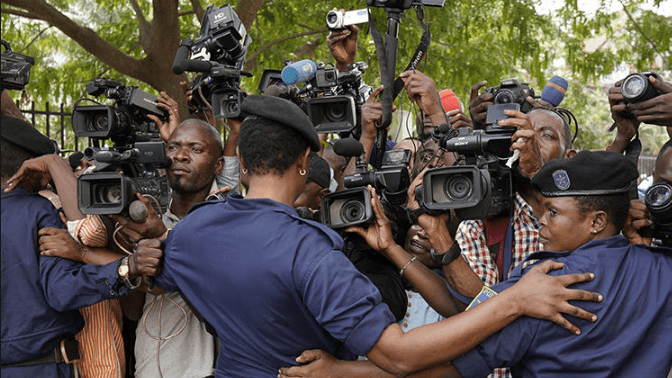
There is no denying the fact that poor public opinion and the lack of camaraderie among media personnel are among the contributing factors to the demise of respect for the journalism profession in Nigeria. The foregoing view, no doubt, came to light when the colleagues of Mr. Eyo Charles, the Daily Trust’s Correspondent that was publicly dressed down by Mr. Fani-Kayode, a former minister in response to a question which many considered to be innocuous, and which was asked by the Journalist. As observed by many Nigerians that watched the trending video that exposed where the former minister flew off the handle, the Journalist’s colleagues were blaming him for asking the question. The act of betrayal which was collectively displayed by his colleague was also observed and pointed out by one of Nigeria’s senior journalists, Omoyele Sowore, the publisher of SaharaReporters who described Fani-Kayode’s action as denigrating. He tweeted, “Femi Fani-Kayode here rampaging and denigrating a journalist for asking him a simple question, “who is bankrolling your PR junkets these days?”. You have to blame the other journalists who sat there and even blamed their colleague for doing his job for him for asking the question”. In fact, one of the Journalists that was putting on red shirt was heard saying, “You see your life, you see your life, I told you”.
Without any iota of exaggeration, what happened between Daily Trust’s Correspondent and Fani-Kayode has no doubt triggered debate across newsrooms in the country. The debate is hinged on the question: “What is making the public to have less regards for Journalists despite the fact that most of them hold second degrees in disciplines that cut across mass communication, business administration and other specialized areas of study to complement with the beat they are assigned to? Most Nigerians that are not abreast of the dynamics of the media are unarguably not aware that in the newsroom that there are those that possess degrees in law, accounting, banking, insurance among other professional qualifications. Majority of this category of Journalists came into the profession upon obtaining post-graduate degrees in Journalism and mass communication out of the love and passion they have for the profession. It is against the foregoing backdrop that Fani-Kayode’s ranting became laughable, particularly when he asked, “Don’t ever talk to me like that. Who do you think you are talking to?
Since the show of shame occurred in Calabar, not few trained Journalists are pondering on whether everybody is now a Journalist. Some social media enthusiasts that do not have what it takes to write an intro of a 200-word news story have been restless posting and commenting on social media platforms that the Correspondent of Daily Trust who was in the eyes of the storm in Calabar with Fani-Kayode asked an unprofessional question. To my view, they cannot be blamed. In a day and age where over half of the world has access to cell phones, and where information travels faster and reaches a greater audience than ever before, everyone sees himself or herself as a Journalist. No thanks to citizen journalism where citizens play an active role in the process of collecting, reporting, analyzing, and disseminating news and information.
To buttress the fact that Eyo did not in any way asked a “rude question” as Fani-Kayode and his co-travelers have been saying, it is expedient to quote a professional colleague, Mr. John Ogunsemore, who in his view said, “Rude question? Well, there’s no such thing as a “rude question” in journalism. A Chicago journalist and humorist by the name of Finley Peter Dunne once said, more than a century ago, that, “the job of the newspaper is to comfort the afflicted and afflict the comfortable.” In other words, journalists have no obligation to comfort the comfortable. Their duty is to afflict the comfortable or, if you like, to be “rude” to the comfortable.
“Asking questions that get a politician’s dander up, that inflame a politician’s passions, is a prized skill in journalism. Here’s why: Politicians reveal the most headline-worthy information when reporters cause them to lose control of their emotions. Loss of emotional control forces them to depart from their scripted, predictable, choreographed, and often mendacious and boring performances”.
Without any iota of exaggeration, social media is changing the way news travels and is interpreted. With sites such as Twitter, Facebook, Youtube, and Instagram, people from all walks of life are having the opportunity to share their stories and document their realities, and then, share it with billions across the globe. Under the milieu of the foregoing, it is not surprising that anyone can come on social media platform and educate trained Journalists on how to ask professional questions.
Against the backdrop of Mr. Fani-Kayode in recent weeks, who has been inaugurating projects that were initiated and executed by governors in Peoples Democratic Party’s (PDP) States deserved the kind of question that he was asked. Or how else could he have been asked when he is not holding any official appointment under the present government or within the PDP? Those who are holding brief for Fani-Kayode should not forget that he has already developed a hatred for the Journalist before he was dressed down sequel to the question he considered to be an embarrassing one. He confessed amidst his ranting, “I could see from your face before you got here, how stupid you are. Don’t ever talk to me like that”.
To many active Journalists, “brown envelope journalism” is one of the reasons that make every Tom, Dick, and Harry sees Journalists in low estimation. “Brown envelope” is regarded as a common practice in Nigeria. It would be recalled in this context that prior to the 1990s that most news publications were government-owned. For instance, during the Babangida regime which lasted from 1985 to 1993 there was an unprecedented rise of media activism which saw journalists opposed militarized democratization. The period also saw the rating of journalism as a noble profession, and which resulted in a lack of law or regulations. One of the effects is that the Nigerian media witnessed a period that thrived under the arena for sponsored stories, and consequently thrust Journalists into a position where brown envelope journalism practice became the in-thing. Though “Brown envelope” was unarguably considered to be unethical but surprisingly media regulatory bodies such as the Nigerian Union of Journalist (NUJ) applied a code of ethics to discourage the practice. But alas! The effort of the NUJ has not yielded any result, even as you read this piece.
Against of the foregoing backdrop, not few Nigerians are probing to understand the reason why the problem of “Brown envelope” is becoming rife and uncontrollable within the Journalism profession. To many, the cause of brown envelope journalism can be linked to poor remuneration of journalists. Many journalists’ salaries are not paid on time and bosses sometimes justify this non-payment by telling their employees to use the media platform to earn money. There are instances where employers in the media sector owe employees six months’ salaries and above, and even when paid, many journalists still earn less than their transportation fare per day. The media sector is a place where graduate journalist earn as little as N40, 000 monthly. It may be difficult for journalists who are hungry, and have families to feed, and live on salaries alone and neglect taking brown envelopes.
In 2015, the Nigeria Union of Journalists demonstrated against This Day newspapers after salary payments were delayed for nine months. Recalled that a 2013 survey study of journalists’ perception of the causes of Brown Envelope Syndrome practices in Nigeria indicates that 6% of journalists interviewed associated poor remuneration as a reason for collecting “Brown envelope”, while 2% indicated a delay in salary payments as the reason.
Another cause may be the influence of advertisers on the financial performance of media houses. Due to the revenues that accrue to media firms through advertisements, the media houses are well aware of the interest of advertisers and consider those interests in the packaging of sensitive news.
Against the backdrop of the foregoing retrogressive factors, it is not an exaggeration to say that many Journalists are literarily caught in the web of poor dressing culture. This, no doubt, has made Nigerian Journalists to be looked down upon by somebody like Mr. Femi Fani-Kayode.



Singapore’s Leaders Built An Economy; Nigeria’s Keep Building Excuses -By Isaac Asabor
Singapore paired economic growth with social stability. Through the Housing Development Board, the government built large-scale public housing, providing affordable...


Tax Considerations for CFD Traders in South Africa: What Experienced Traders Should Know
What looks like a sweet profit on your platform screen can shrink fast once the tax bill hits. When you're...


Russia–India Dialogue Provides Platform for Strengthening Bilateral Entrepreneurship -By Kestér Kenn Klomegâh
The Dialogue was organized by the Indian Business Alliance, the Business Council for Cooperation with India, the Government of Moscow,...


The Kampala Declaration: How African Youth Can Lead Food System Transformation to Accelerate the Achievement of Zero Hunger by 2030 -By Emeka Christian Umunnakwe
If Africa is serious about achieving Zero Hunger by 2030, these perceptions must be confronted with deliberate action. Young people...


China Finances New ECOWAS Headquarters -By Kestér Kenn Klomegâh
In accordance with the agreement concluded between the ECOWAS and the Government of China, the building by the Shanghai Construction...