
Political Issues
Voice Of Jacob, Hand Of Esau: Inside The Power Struggle Behind Fubara’s Impeachment -By Isaac Asabor
Impeachment, in theory, is a constitutional mechanism designed to hold executives accountable for serious misconduct. In practice, Nigeria’s political history tells a different story. From Diepreye Alamieyeseigha in Bayelsa to Rashidi Ladoja in Oyo and Murtala Nyako in Adamawa, impeachment has often been less about accountability and more about political extermination.

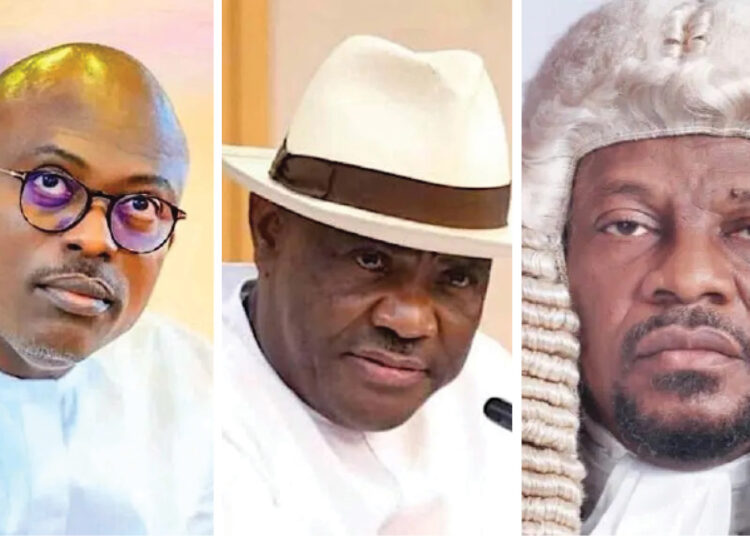
Few biblical metaphors travel as easily through Nigeria’s political terrain as “the voice is Jacob’s, but the hand is Esau’s.” It is a phrase that has survived military rule, civilian transitions, godfather politics, and party defections. Today, it has found fresh relevance in Rivers State, where the impeachment process against Governor Siminalayi Fubara is widely seen as less about governance and more about power, who wields it, who lost it, and who is determined to reclaim it.
Across political circles, media commentary, and party caucuses, the phrase has become shorthand for what many believe is unfolding: a carefully choreographed political operation in which the visible actors are not the true authors of the drama. The lawmakers may speak, motions may be moved, and notices may be served, but in the background looms a larger, more powerful presence.
The phrase originates from the Book of Genesis, when Jacob, disguised as his brother Esau, deceived their father Isaac to obtain a blessing. Isaac, sensing something amiss, famously remarked that while the voice sounded like Jacob’s, the hands felt like Esau’s. In modern political usage, the meaning is blunt: the face presented to the public is not the real driver of events.
In Rivers State, the analogy is being deployed to describe a situation where the Rivers State House of Assembly appears to be the engine of Governor Fubara’s impeachment, yet many observers insist the real momentum comes from outside Government House and beyond the Assembly complex.
To understand the current crisis, one must revisit the political relationship between Siminalayi Fubara and his predecessor, Nyesom Wike. Fubara did not emerge as governor through an independent political base. He was Wike’s choice, his anointed successor, and a product of tightly controlled political machinery that dominated Rivers State for eight years.
That arrangement began to unravel almost immediately after Fubara assumed office. What started as disagreements over appointments, control of party structures, and access to state resources soon escalated into open confrontation. By late 2023 and throughout 2024, Rivers State had become a theatre of political brinkmanship, defections, parallel legislative sittings, judicial interventions, and street-level tensions.
At the heart of the conflict lies a familiar Nigerian dilemma: a godfather unwilling to relinquish influence and a successor determined to govern without a leash.
Impeachment, in theory, is a constitutional mechanism designed to hold executives accountable for serious misconduct. In practice, Nigeria’s political history tells a different story. From Diepreye Alamieyeseigha in Bayelsa to Rashidi Ladoja in Oyo and Murtala Nyako in Adamawa, impeachment has often been less about accountability and more about political extermination.
The move against Fubara fits neatly into this tradition. Analysts argue that the current impeachment process is not driven by sudden discoveries of financial impropriety or constitutional violations, but by a long-running power struggle that has failed to find resolution through dialogue or political compromise.
The charges, spending state funds without legislative approval and violating peace agreements, are serious on paper. But critics point out that similar accusation is common in executive–legislative disputes across Nigeria and rarely escalates to impeachment unless there is a deeper political motive.
Central to the “hand of Esau” narrative is Nyesom Wike, now Minister of the Federal Capital Territory (FCT). Though no longer governor, Wike remains one of the most influential political figures in Rivers State. He controls significant political structures, commands loyalty within the legislature, and maintains a national profile that amplifies his reach.
Commentators argue that the lawmakers pushing the impeachment are acting as proxies. In this framing, they are the “voice of Jacob”, the visible agents articulating allegations and moving motions, while Wike is perceived as the “hand of Esau,” the force directing strategy and applying pressure behind the scenes.
This perception is reinforced by the composition of the Assembly itself. Many of the lawmakers involved owe their political careers to Wike’s political network. Their alignment, therefore, appears less ideological and more transactional.
Beyond personalities, the Rivers crisis is increasingly described as a proxy war. On one side is Fubara, attempting to consolidate authority and redefine the power structure of the state. On the other is Wike, fighting to preserve relevance, influence, and control over the political future of Rivers State.
Given the foregoing political situation, every legislative action, court filing, and party statement is interpreted through this lens. The impeachment is not seen as an isolated event but as part of a continuum of political combat, one that includes previous attempts to paralyze governance, split the Assembly, and undermine executive authority.
In this proxy war, institutions become weapons. The legislature becomes a battlefield, constitutional provisions become ammunition, and impeachment becomes the ultimate strike.
Perhaps the most compelling aspect of the “hand of Esau” narrative is the suspicion of hidden agendas. With the 2027 general elections on the horizon, control of Rivers State, a key political and economic hub, carries enormous strategic value.
Observers believe the impeachment effort is as much about the future as it is about the present. Removing or weakening Fubara would reshape the state’s political equation, determine who controls party structures, and influence candidate selection in the next electoral cycle.
In this context, peace agreements and allegations of misconduct are seen as tools rather than triggers, useful justifications for a power play already decided.
In fact, President Bola Tinubu’s reported involvement in brokering a peace deal adds another layer of complexity. The impeachment notice alleges that Governor Fubara violated agreements reached during this mediation. That claim raises uncomfortable questions: Was the peace ever genuine? Or was it merely a pause in hostilities?
Critics argue that invoking Tinubu’s mediation gives the impeachment moral and political weight, but it also exposes the fragility of elite conflict resolution in Nigeria. Agreements reached at the top often fail because they do not address the underlying struggle for control.
The impeachment move has not gone unchallenged. A faction of the All Progressives Congress (APC) in Rivers State has publicly rejected the process, warning that it could destabilize the state. Their intervention highlights another reality: Rivers politics is no longer neatly divided along party lines.
Alliances are fluid, interests overlap, and opposition does not always come from expected quarters. The APC faction’s call for lawmakers to resist “external pressures” is itself an acknowledgment that the Assembly may not be acting independently.
The Fubara impeachment saga is not just a Rivers story. It reflects a broader national problem: the weakness of institutions in the face of personal power. When impeachment becomes a political weapon rather than a constitutional safeguard, democracy itself is diminished.
The whistling of the biblical metaphor, “voice of Jacob, hands of Esau” since the process of impeaching commenced is telling. It suggests a public deeply skeptical of official narratives and keenly aware of the gap between appearance and reality.
As of January 8, 2026, the impeachment process is formally underway. Whether it succeeds or collapses remains uncertain. Court battles, political negotiations, and federal interventions could still alter the trajectory.
What is clear, however, is that the phrase “the voice of Jacob and the hand of Esau” has captured the public mood. It reflects a widespread belief that the Rivers crisis is not about ethics or procedure, but about power, who holds it, who lost it, and who is determined to reclaim it, no matter the cost.
In Rivers State, the voices may change, the allegations may evolve, but as long as the hands behind the curtain remain the same, few will believe that this is merely an impeachment.



The Arrest Of Nicholas Maduro By The US And Other Matters -By Hajia Hadiza Mohammed
Since the advent of the current administration, the country has been weaken internally with self-serving leaders insensitive to the yearnings...


When Nations Break Their Reformers: Why EFCC Cannot Carry Nigeria’s Burden Alone — And Why Power Must Fear God -By Prof. John Egbeazien Oshodi
Public frustration with the EFCC over perceived selective enforcement is understandable. Nigerians see some arrests carried out suddenly and forcefully,...


Poor, Poor, Maduro -By IfeanyiChukwu Afuba
Little wonder his ouster elicited celebrations. The ease of his capture is telling. There is only one explanation for the...


Why African Leaders Must Fix Governance Before Crying Sovereignty -By Isaac Asabor
One of the great contradictions of African leadership today is selective morality. Leaders speak passionately about international law while violating...

Baba Has Entered The Classroom -By Isaac Asabor
If what Trump is doing is walking into a noisy global classroom and insisting on discipline, then let us be...