
Article of Faith
When Matrimony Is Dead On Arrival, The Wedding Was Only A Ceremony -By Isaac Asabor
Marriage is not for everyone, and that truth needs to be said plainly. It requires emotional intelligence, self-control, humility, and a willingness to grow. Without these, a wedding is just an expensive announcement of future dysfunction.

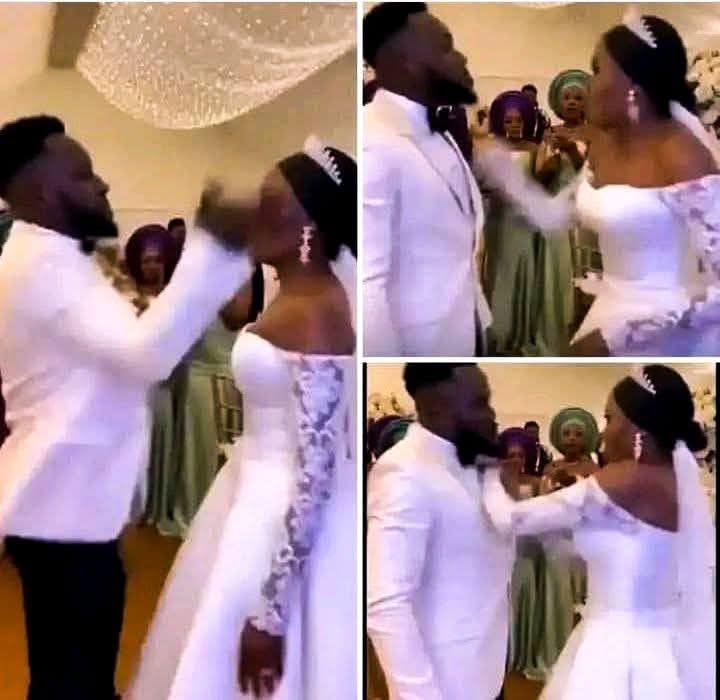
There was a time, perhaps romanticized, perhaps exaggerated, when a wedding day was treated as sacred ground. Not just sacred in the religious sense, but sacred in the social and moral imagination of the community. It was the day a man and a woman publicly declared restraint over impulse, commitment over convenience, and dialogue over drama. That is why the recent incident of a wedding reception in Nigeria degenerating into a public confrontation between newly married couples is more than gossip fodder. It is a disturbing mirror held up to a society that may no longer understand what the institution of marriage is, or what it demands.
A disagreement over a guest. A hug. A warning allegedly given before the wedding. Heated words. A slap. A counter-slap. The groom walking away from his own wedding reception. Cameras rolling. Videos uploaded. Comment sections erupting. In the space of minutes, what should have been the symbolic beginning of a shared life became a public spectacle of distrust, poor emotional control, and unresolved pre-marital baggage. As Olóyè T.D Esq (@BolanleCole) recounted on X, the sequence of events was stark:
“It was said that a young man from their neighborhood came to their wedding reception during dance and the wife immediately jumped up and hugged him. This was the same man that her husband has been warning her that he does not like her association with the man.
The moment that the man gave her a wedding gift and left, right there in the wedding reception, the husband started asking her who invited this man again and warned her not to bring the gift to his house. The woman got angry and started shouting at her husband, saying that ‘I am your wife and not your sl@ve and you can’t tell me who to associate with.’ The husband suddenly lost his temper and sl@pped her, and she hit the husband on his chest and sl@pped him back. At that moment, the husband decided to calm down. Few minutes after the incident, the husband angrily left the reception and did not come back until the wedding was dismissed. I wonder how this couple will live together in peace. Please who do we blame?”
Given the unprecedentedness of the absurdity that characterized the wedding, I think it is germane to opine in this context that marriage is not a tea party, and a wedding is not a stage.
A wedding reception is supposed to be celebratory, but it is not a carnival of unchecked emotions. It is the public extension of a private covenant. When a couple cannot restrain themselves from verbal and physical confrontation on the very first day of that covenant, before the music ends, before the guests leave, before the photographs are edited, it suggests something profoundly broken long before the wedding date.
The problem is not merely anger management. It is that marriage is increasingly approached as an event rather than an institution. The dress, the decor, the dance, the drone shots, these have taken precedence over preparation, counselling, and hard conversations. Too many couples invest months planning how to look good for Instagram, but spend little time asking whether they share values, boundaries, conflict-resolution styles, or emotional maturity.
If a groom believes, he has the right to physically strike his wife in public, that belief did not form overnight. It is rooted in attitudes toward power, masculinity, and control that predate the marriage. If a bride believes that boundaries discussed, or at least implied, before marriage can be dismissed with, “you have no right to tell me who I associate with,” then communication failed long before vows were exchanged.
This is not about choosing sides. It is about recognizing that marriage is not a battlefield for ego assertion. It is a disciplined partnership that demands restraint, respect, and a willingness to pause even when emotions are boiling.
One of the most alarming aspects of the incident is not the argument itself as conflict is inevitable in any relationship, but the speed with which it escalated into physical violence. What happened to stepping aside? What happened to whispering, “We’ll talk about this later”? What happened to protecting the dignity of your spouse, even when he or she insisted to be right?
Marriage requires the ability to defer confrontation. Not suppress it, but postpone it until it can be handled privately and constructively. A couple that cannot delay an argument for a few hours on their wedding day is signaling an inability to manage conflict in far more stressful circumstances, financial strain, child-rearing disagreements, extended family interference, or career setbacks.
The public nature of the confrontation matters. It stripped both parties of dignity and invited external judgment into what should have remained a private issue. Worse still, it normalized the idea that physical retaliation, slap for slap, is an acceptable response to marital disagreement. It is not. Ever.
The circulation of video clips and the feverish online debate that followed are part of the problem. Social media has become both judge and jury, reducing complex human failures into viral content, and in the process, the core lesson is lost.
Instead of asking why two people so ill-prepared for marriage were allowed, by families, religious institutions, and society, to proceed to the altar, the conversation becomes a shouting match over gender loyalty. Men defend men. Women defend women. Nuance dies. Accountability evaporates.
What should concern us more is that many young people watching the videos may internalize the wrong lessons. Some may conclude that public disrespect is normal. Others may think that violence is an understandable response to jealousy or defiance. A few may even see the attention as validation, proof that drama brings relevance.
Given the notoriety of the episode, it is germane to reiterate at this juncture that marriage is not content. It is not a performance. It is not a reality show.
In traditional Nigerian society, marriage was never just about two individuals. Families played an active role in vetting character, mediating conflicts, and preparing couples for the realities of married life. While not perfect, and sometimes oppressive, those structures emphasized responsibility and accountability.
Today, many families are more concerned with the size of the guest list than the stability of the union. Religious institutions rush couples through premarital classes that feel more like box-ticking exercises than deep engagement. Friends cheer red flags away in the name of “love conquers all.” It does not. Love without discipline is chaos.
If a groom harbored deep resentment or suspicion about a particular individual, why was that not resolved before the wedding? If a bride felt her autonomy was being threatened, why was that not addressed before vows were exchanged? Marriage does not magically resolve unresolved tensions; it amplifies them.
Now, it is expedient to ask, “What does the Incident really asks of us? The answer to the foregoing question cannot be farfetched as the incident forces society to confront uncomfortable truths. Have we so devalued matrimony that we treat it as reversible, disposable, and unserious? Do we encourage people to marry for optics rather than readiness? Do we mistake chemistry for compatibility and attraction for alignment?
Marriage is not merely about love. It is about governance, of emotions, desires, and reactions. It is about choosing restraint when provoked and choosing dialogue when angry. It is about protecting your partner’s dignity even when you feel wronged.
In fact, when a wedding reception becomes a scene of violence and abandonment, it is not just the couple that has failed. It is a collective failure, of preparation, mentorship, and cultural seriousness.
The question, then, is not whether the sanctity of matrimony has been devalued. The incident answers that with brutal clarity. The real question is whether society is willing to relearn what marriage demands before more unions collapse under the weight of immaturity and unresolved conflict.
Marriage is not for everyone, and that truth needs to be said plainly. It requires emotional intelligence, self-control, humility, and a willingness to grow. Without these, a wedding is just an expensive announcement of future dysfunction.
If the first major act of a marriage is public confrontation and violence as vividly recounted by Olóyè T.D Esq, the institution itself is crying out, not for hashtags or hot takes, but for a return to seriousness.



When Matrimony Is Dead On Arrival, The Wedding Was Only A Ceremony -By Isaac Asabor
Marriage is not for everyone, and that truth needs to be said plainly. It requires emotional intelligence, self-control, humility, and...


Awards Without Impact: Rethinking ‘Good Governance’ In Bauchi State -By Yasir Shehu Adam
True good governance is not proven in Abuja halls or award plaques. It is proven in functional classrooms, well-equipped hospitals,...


When “Happily Ever After” Starts Expiring: A Deep Dive into the Alarming Rise of Failed Marriages -By Peace Adams Bitrus
Weddings have become theatrical performances. Months of planning, millions spent, lights, cameras, choreographed dances… but very little attention is given...

Cease The Unchecked Looting -By Abba Dukawa
To address this, the Independent Corrupt Practices and Other Related Offences Commission (ICPC) and the Economic and Financial Crimes Commission...


Moscow University Museum Presents Insights into African Artistic Culture -By Kestér Kenn Klomegâh
In his contribution, Louis Gouend, Chairman of the Commission for Work with African Diasporas at Moscow State University's Russian-African Club,...