
Breaking News
After Leaving Office, Our Calendar Was Filled With Funerals — Aisha Buhari Recounts Buhari’s Final Days
Former First Lady Aisha Buhari reveals that after leaving office, the Buhari family was consumed by funerals and travel, recounting the former president’s final days, illness, and death in a new biography.

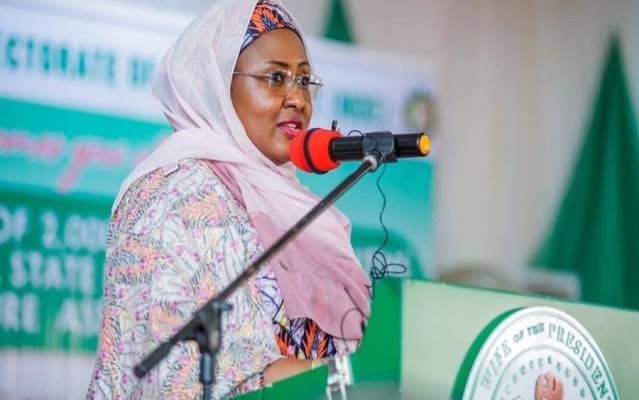
The final months of former President Muhammadu Buhari’s life were emotionally draining for his family, marked by worsening health challenges after he left office, according to former First Lady, Dr. Aisha Buhari.
Buhari, who completed two terms in office in his eighties, died after a period of illness, details of which Aisha shared in From Soldier to Statesman: The Legacy of Muhammadu Buhari, a biography written by Dr. Charles Omole.
Recounting those moments, Aisha said: “The final days were difficult. ICU for some days, then the ward, then the slide. The last three days were the worst.”
She noted that life after Buhari’s presidency became dominated by loss and travel. “After leaving office, in his final year before passing, phone calls increased and transatlantic trips became more frequent. The family’s calendar was filled with funerals and flights.”
According to her account, Buhari had travelled to the United Kingdom, as he often did, to fix a tooth and enjoy the summer weather. She remained in Abuja to mourn a nephew, later returned to London, and then travelled back to Nigeria following the death of an uncle.
Aisha described Buhari’s illness and death with striking detail, linking his respiratory struggles to his years as a soldier. She recalled that he spent 30 months in the bush during his military career, often drenched by rain in uniforms that dried on his body.
Decades later, she believed, the exposure to cold — compounded by constant air-conditioning while in office — affected his lungs and bones. She acknowledged that Buhari had smoked earlier in life and said age eventually took its toll, with pneumonia becoming his final battle.
The book revealed that Buhari’s children frequently moved through hospital corridors, with one daughter spending the night before his death at his bedside. When his condition worsened, doctors diagnosed acute pneumonia, a diagnosis that sparked public skepticism.
“When asked, ‘Pneumonia doesn’t usually kill people,’” Aisha agreed but responded: “It can, especially with old age, and perhaps with a lifetime’s exposure to cold and dust in the field. He always coughed, even when he laughed.”
She also recalled intimate hospital moments, including trying to lift Buhari’s shoulder to place a pillow suggested by a Gambian nurse to ease his breathing. “They counted together, ‘One, two, three,’ but they couldn’t shift the weight,” she said, noting the pillow was eventually placed sideways.
“‘Are you okay now?’ she asked. ‘Yes, thank you,’ he replied.”
There were prayers, rotating children sleeping by his side, repeated X-rays, sputum tests, and cautious optimism. Doctors maintained that it was pneumonia, though severe due to his age.
At about 2 p.m. one day, Aisha told Buhari she was going home briefly to rest and pray before returning. He nodded quietly. After leaving the hospital, she said she felt an unexplained disturbance.
“Let’s go back to the hospital,” she told her son, Yusuf. It was 4 p.m. — the same time, she later learned, that Buhari’s breathing changed and stopped. “We rarely arrive at the threshold of death before it happens. We only feel it as a tremor behind the door.”
Addressing rumors that Buhari died of cancer, Aisha insisted the diagnosis given to the family was pneumonia. “Other sources reported lung-related cancer, specifically pulmonary lymphoma,” she noted, explaining that such conditions can be difficult to distinguish from pneumonia on scans.
She maintained firmly: “The official diagnosis was pneumonia.”
Public reports varied, with some citing leukemia, others describing a prolonged illness, while international media reported a brief illness and burial in Daura two days later. Britannica recorded his death in London at age 82.
Aisha’s account adds personal moments — a magazine in his hand in ICU, jokes about moving him to a ward “since you are well enough to watch TV,” and light banter between them.
The book also highlighted poor strategic communication as a weakness of Buhari’s administration. “Simple and banal developments were transformed into major conspiracies due to a lack of openness and effective communication,” it stated.
Aisha echoed this view: “Rumors would begin, and stories would take on a life of their own, with no clear strategic direction to the messaging. Nigerians did not know what to believe. This fog of communication persisted until the very end.”
After Buhari’s death, she said some long-time associates felt their influence disappear. “Those who once held the levers of access… felt that their power had vanished along with the principal. They feared her and her son.”
She stressed that neither she nor her son sought revenge and said the state’s takeover of burial arrangements helped prevent further embarrassment. “The state’s management of the burial logistics both stabilized the ritual and limited opportunities for mischief,” she said, adding: “We did not come to fight.”
According to her, the presidency’s tight control of the burial denied “old courtiers” the chance to interfere. She described some as people “without capacity,” saying she could work with them “as a local government chairman,” but not at the level of a president.
Reflecting on internal tensions during Buhari’s presidency, Aisha said problems that began privately expanded within Aso Villa. “Aso Villa is not merely a home but an ecosystem,” she said, recalling how relatives, aides and courtiers filled the residence.
“They tried to push everybody out, including me,” she stated, before concluding: “This is my house. You can live wherever you like, but you cannot be in charge of my husband’s office and then also be in charge of me, his wife, inside my house.”
Opinion Nigeria News


United States and Russia Resolving Trade Issues and Pursuing New Opportunities -By Kestér Kenn Klomegâh
The American Chamber of Commerce (AmCham) will be working in the system of the Chamber of Commerce and Industry (CCI)...


Nigeria’s Middle Class Is Slipping Into Poverty — And We Are All at Risk -By Abdulhamid Rabiu
What is urgently needed is a shift from abstract economic targets to people-centered policies. Inflation control must be prioritized. Wages...


Second Ministerial Conference: Shaping Russian-African Strategic Partnerships -By Kestér Kenn Klomegâh
As indicated from above, the most important issues of multifaceted development are included on the Russian-African agenda, with a focus...


When Matrimony Is Dead On Arrival, The Wedding Was Only A Ceremony -By Isaac Asabor
Marriage is not for everyone, and that truth needs to be said plainly. It requires emotional intelligence, self-control, humility, and...


Awards Without Impact: Rethinking ‘Good Governance’ In Bauchi State -By Yasir Shehu Adam
True good governance is not proven in Abuja halls or award plaques. It is proven in functional classrooms, well-equipped hospitals,...