
Forgotten Dairies
Buhari, Osinbajo and the Politics of Posthumous Truth -By Oluwafemi Popoola
What makes this entire episode more troubling is the timing. Why now? Why did these truths wait patiently until Buhari could no longer confirm, deny, or contextualise them? Why are we only learning of these strong private opinions posthumously, filtered through third parties with their own interests? History teaches us to be wary of truths that emerge only when rebuttal is impossible.

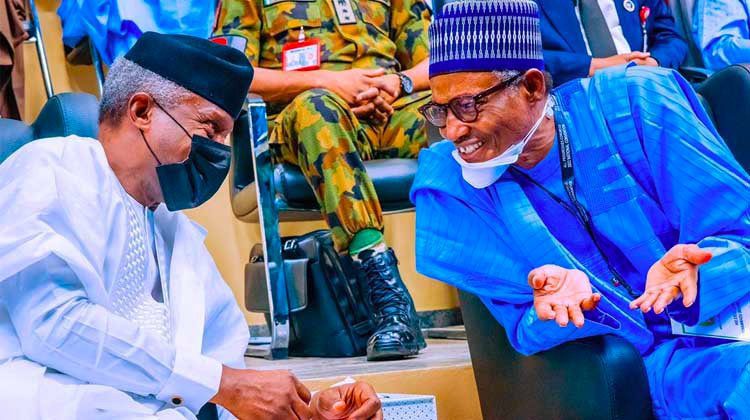
Nigeria has a thriving afterlife economy. Its raw material is the silence of departed powerful men. Its finished products are motives, conspiracies, and convenient truths. It is a thriving industry. Once a leader exits the stage, especially through death, the silence he leaves behind becomes an open marketplace.
Everyone trades in insider knowledge. Who he blocked, who he favoured and which ambitions he quietly sabotaged. Evidence is seldom given but the delivery is always confident. In this marketplace, the louder the storyteller, the more believable the story.
This is the space the new Buhari biography has eagerly occupied. The biography in question, authored by Charles Omole, director-general of the Institute for Police and Security Policy Research, was launched few days ago at the Presidential Villa in Abuja, attended by President Bola Tinubu and an impressive roll call of political heavyweights. Titled From Soldier to Statesman: The Legacy of Muhammadu Buhari. I have read excerpts, listened to interviews, and watched the social media jury convene itself with characteristic speed. From claims that Buhari never supported Yemi Osinbajo’s 2023 presidential bid, to startling domestic anecdotes involving locked doors, alleged forged signatures, shadowy aides, and cabals that sound like they stepped out of a Dan Brown novel, the book has offered Nigerians what we enjoy almost as much as fuel subsidy debates.
In the said book, one of the most talked-about revelations attributed to Aisha Buhari is almost cinematic. She reportedly said that at some point, Buhari locked his room over gossip that she wanted to kill him. According to her, the former president believed the grapevine and altered some of his habits.
It is difficult to read that without pausing, partly out of disbelief and partly out of sadness. Hannah Arendt once wrote about the “banality of evil,” but this sounds more like the banality of gossip. How rumor, when it gains oxygen around power, can distort even the most intimate relationships. I chuckled briefly at the sheer absurdity of it, then stopped laughing.
Whether that fear nursed by Buhari was rooted in reality or paranoia matters less than what it reveals. When a marriage produces such terror, the union has already failed in its most basic duty. No one wakes up one morning afraid of their spouse without a long trail of emotional decay behind it. And no one should remain in a marriage that has transformed into a threat, even if children, tradition, or public image argue otherwise. Power, it seems, does not only isolate leaders politically, it can imprison them psychologically, sometimes even from their own spouses.
And at the centre of its loudest claim is a deceptively simple assertion: that Muhammadu Buhari did not endorse Yemi Osinbajo’s bid for the presidency in 2023. Not that he opposed it openly. Not that he campaigned against it. Just that he did not endorse it. A careful accusation, this—soft enough to sound reasonable, sharp enough to wound. It is a claim now being waved around as settled fact, mostly because it comes wrapped in the authority of a book and carried by the voice of Aisha Buhari.
We are expected, it seems, to nod gravely and accept this as revelation. After all, who could know Buhari better than his wife? Who could speak more authoritatively about his private thoughts? Certainly not the public record. Certainly not eight years of documented partnership. Certainly not Buhari’s own speeches, commendations and decisions. No, the book wants us to believe that the authentic Buhari was different from the one Nigerians watched for nearly a decade. And all we needed to uncover this truth was his absence.
The book’s logic is almost elegant in its simplicity. Buhari, we are told, saw Osinbajo primarily as Tinubu’s man. He supposedly found it odd that Osinbajo would run for president when Tinubu, his political benefactor, was also in the race. He allegedly felt Osinbajo merely informed him of his ambition instead of seeking guidance. And from this cocktail of assumptions flows the conclusion: Buhari did not support Osinbajo.
Politics is not Sunday school, but it is also not a Nollywood subplot where motivations are reduced to who introduced whom. The idea that Buhari would serve eight years with a vice president, entrust him with presidential authority multiple times, and then privately reduce him to “someone I met through Tinubu” is not just implausible, it is insulting to Buhari’s own intelligence.
Apparently, eight years of intimate executive collaboration count for less than an introduction at a party. Acting as president during medical absences? Minor detail. Steering the economy in a recession? Administrative footnote. Running the country while the president is thousands of miles away? Irrelevant. What truly defines political legitimacy, according to this reasoning, is who shook your hand first.
From 2015 to 2023, Buhari and Osinbajo ran what many observers described as one of the most stable presidential partnerships in Nigeria’s democratic history. In February 2016, Buhari voluntarily handed over power to Osinbajo during a short vacation. It became an act that was almost revolutionary by Nigerian standards. During Buhari’s prolonged medical leave in 2017, Osinbajo effectively ran the country. Upon his return, Buhari said publicly, “I am pleased with the way the country was run in my absence,” and added that the Acting President “did a fantastic job.”
When Osinbajo, as Acting President, dismissed the Director-General of the DSS in 2018, Buhari resisted pressure to reverse the decision, noting that doing so would undermine institutional integrity and insult the authority he had delegated. Buhari consistently praised Osinbajo’s leadership of the National Economic Council, his role in the Social Investment Programmes, and his stewardship of reforms under the Economic Recovery and Growth Plan. He commended Osinbajo for spearheading the Ease of Doing Business initiative that moved Nigeria up 39 places on the World Bank index.
On multiple birthdays, Buhari publicly described Osinbajo as a loyal, dependable and admirably competent deputy. In a personal letter after a campaign incident, Buhari wrote, “I’m proud of our partnership and your unalloyed loyalty.” In May 2023, at the launch of Osinbajo Strides: Defining Moments of an Innovative Leader, Buhari described him as “a dedicated and loyal compatriot with a passion for excellence and service to the masses.”
It is against this overwhelming public record that the posthumous revisionism becomes unsettling.
This is why I am uneasy with the way Aisha Buhari’s claims are now being positioned as final truth. One can sympathise with her perspective, acknowledge her proximity to power, and still question the conclusions being drawn. There is also the uncomfortable sense that this may be an arranged hatchet job, sponsored, curated, and released at a time when the principal actor cannot respond. Aisha’s voice, emotionally powerful as it is, appears to have been co-opted to lend credibility to a narrative that serves present political interests.
The irony is hard to miss. Buhari himself once dismissed biographies, warning that they are often built on distortions and used as weapons against those one disagrees with. That statement now reads like an unintentional warning label. Despite being one of Nigeria’s most taciturn leaders, Buhari has attracted more books, both during his lifetime and after, than perhaps any president before him.
What makes this entire episode more troubling is the timing. Why now? Why did these truths wait patiently until Buhari could no longer confirm, deny, or contextualise them? Why are we only learning of these strong private opinions posthumously, filtered through third parties with their own interests? History teaches us to be wary of truths that emerge only when rebuttal is impossible.
One is tempted, at this point, to stage a metaphysical intervention. There is something almost unfair about this moment. One wishes President Buhari could rise, clear his throat, and ask for context. Or at least submit a rebuttal, politely. Sadly, death offers no right of reply. The grave is the ultimate non-disclosure agreement.
So Buhari remains silent, as he was in life, while others speak loudly for him in death. His restraint has been turned into an open microphone. His refusal to tell his own story has become a blank cheque for those eager to fill in the gaps, with speculation, grievance, and conveniently timed revelations.
The man who feared biographies would distort the truth may have been more prophetic than paranoid. The posthumous Buhari is now more talkative than the living one ever was.
The lesson here is not about Buhari or Osinbajo, It is about us. Our appetite for retroactive certainty, our eagerness to collapse complex political relationships into neat moral conclusions once the actors are gone. Posthumous truth, when stripped of balance and context, is less about history and more about power. And power, as we should have learned by now, never tells stories innocently.
Oluwafemi Popoola is a Nigerian journalist, media strategist, and columnist. He can be reached via bromeo2013@gmail.com



Why 2026 Must Be About Obeying God’s Word, Not Recycling Resolutions -By Isaac Asabor
Now, it is expedient to urge fellow Nigerians to stop pretending. The hard truth is this: many people enjoy making...

Russia Promoting Dialogue with Africa on Implementing 2023-2026 Strategic Action Plan -By Kestér Kenn Klomegâh
On December 19-20, the Second Ministerial Conference of the Russia-Africa Partnership Forum was held in Cairo, Egypt. It was held...

At 72, A Father’s Embrace: Akume, Alia, And The Future Of Benue -By Leonard Karshima Shilgba
As our leader turns 72 in December 2025—a significant and symbolic age—I humbly call on the Benue State Government and stakeholders to initiate...

United States and Russia Resolving Trade Issues and Pursuing New Opportunities -By Kestér Kenn Klomegâh
The American Chamber of Commerce (AmCham) will be working in the system of the Chamber of Commerce and Industry (CCI)...

Nigeria’s Middle Class Is Slipping Into Poverty — And We Are All at Risk -By Abdulhamid Rabiu
What is urgently needed is a shift from abstract economic targets to people-centered policies. Inflation control must be prioritized. Wages...