
National Issues
Covid-19: Of A Nation And Its Unpreparedness In The Wake Of The Global Pandemic -By Damilare Jeremiah Odeyemi

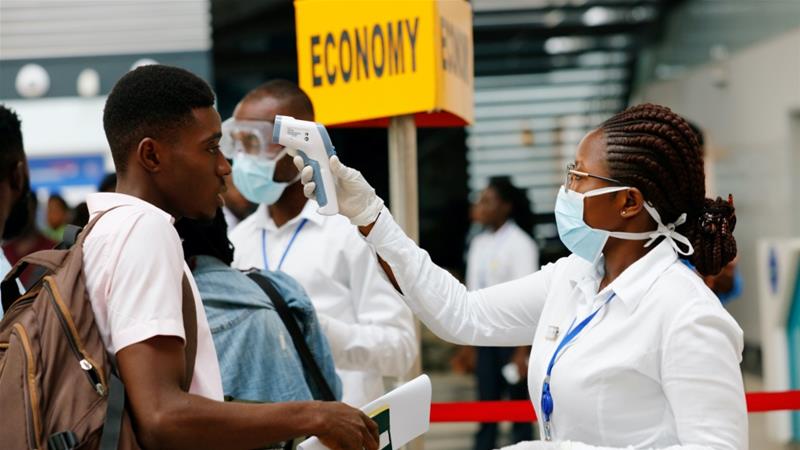
Before 2019 wind down, there had been a hypothetical pointer to what havoc Corona Virus has the potential of wrecking should the world leaders dally in their quest to nip its bud before it blossoms. The virus currently ravaging the globe has gradually found its feet among billions of inhabitants on earth. It’s quite sad that it was welcomed with a severe reaction which now engenders and metamorphosized into a thick shade of catastrophe that has the world leaders, both political and religious, on their toes, helplessly in search for a cure.
A couple of days ago, it was indicated that Italy recorded the death of COVID-19 victims has risen to over 15,000. While Spain and USA have recorded well over 11,814 and 8,113 deaths respectively, Africa the continent with the lowest case in the world is also facing huge challenge number of deaths rise to 334 as at the last update by the John Hopkins University.
Already, the odds are that Africa, most notably Nigeria, does not in any way stand a chance against this deadly pandemic considering the state of our health care facilities. Government’s snail-pace responses coupled with the recalcitrant attitude of the public towards the pervasive outcome of the virus’ contraction.
As tension keeps running high in developed countries with advance medical equipment, one cannot but question the rationality of the recently enacted government policies, most especially, one that has a direct tie with the education system of the country. It is quite rather unfortunate that in this clime, problems are often dealt with after the people must have suffered extensively and helplessly from its unchecked consequences which stem from either total neglect, deferred actionable steps or both. If not, halting educational programmes till further notice should not be the first pragmatic approach the government would think of in their pursuit to stand against one of the most significant outbreaks in the history of time.
It’s been two weeks Nigerian universities and consequently, primary schools were forced to close down to curtail the spread of the deadly virus, yet the fate of over 20 million students across the country is still dicey as the virus mark out new territories, and takes new course among states. It is quite heartbreaking and pathetic that despite the advancement in learning across the globe in the wake of the fourth industrial revolution, Nigerian universities are still operating on archaic and mundane pedagogy, leaving students with next-to-impossible chance of honing already acquired skills and/or taking up new ones, even in the face of this stay-indoor directive of the Federal Government.
As the global pandemic rages on, students in some advanced country of the world have started learning through open learnings, as universities move their educational teachings online. This alternative has not only helped students to stay in good shape, it means learning continues in the wake of a global lockdown.
However, in Nigeria, where mobile data price is on the high side and annoying internet services continue to being a nightmare to successful surf on internet webpages, Nigerian students’ only hope of learning from some online educational learning platforms remain cloudy due to exorbitant data plans and poor internet services.
In a country like ours, where few states have only digitized government activities and less than 20 percent of federal parastatal having a functional website, it has been subjected to debate and verbal engagement as to what time we have left till the country implode should the virus persist. While in UAE, governments officials continue to hold meetings via video-conferencing platforms, the national executive council has suspended its activities with the president said to be in isolation. Thus, working and learning from home has been seen as one of our major challenge as we continue to fight our way out Coronavirus.
As many continue to push the discourse of world’s economic recovery towards an unending end, it is quite unfortunate that over 3 billion inhabitants of the planet earth are still confused on when the whole world will be free of the virus. However, as developed countries continue with the fight against the virus, Nigeria is currently facing a difficult time as the virus exposes the country’s agelong maladministration. From the decadent education sector to the perennial electricity and the insalubrious health facilities, Nigerian leaders have continually dashed the hope of her citizens even in the face of a global pandemic.
Since the index case of COVID-19 reported in China around November 2019 and its seismic rise in some other affected countries in the early days of this year, it would have been more rational, more welcoming and the subsequent steps to be taken by the government to follow suit would have had a substantial degree of credibility and rationality if the scope of justifications for the land border closure could be extended to encapsulate the means of preventing Nigerians from the grip of the deadly virus which has caught the world unaware. This would have been a better and sound explanation to reason with rather than an adhoc implementation of border-closure bill that saw to the birth of exorbitant hike in the price of locally made foodstuffs in Nigerian markets, and acerbic reactions that was left in its trail thereafter, all summing to the aftermaths that betrayed all what the border-closure move stood for.
While the question of how a country with an estimated GDP per capita of around 2,032.86 U.S. dollars will survive this difficult times, the country’s biggest sector which accounts for around sixty-five percent of the economy – informal sector – is also facing huge setback as lockdown spreads to over ten states in the country including its commercial hub – Lagos. Surviving the historic COVID-19 era for many in Nigeria might require a comprehensive study and further analysis after the end of the pandemic.



At 72, A Father’s Embrace: Akume, Alia, And The Future Of Benue -By Leonard Karshima Shilgba
As our leader turns 72 in December 2025—a significant and symbolic age—I humbly call on the Benue State Government and stakeholders to initiate...

United States and Russia Resolving Trade Issues and Pursuing New Opportunities -By Kestér Kenn Klomegâh
The American Chamber of Commerce (AmCham) will be working in the system of the Chamber of Commerce and Industry (CCI)...


Nigeria’s Middle Class Is Slipping Into Poverty — And We Are All at Risk -By Abdulhamid Rabiu
What is urgently needed is a shift from abstract economic targets to people-centered policies. Inflation control must be prioritized. Wages...


Second Ministerial Conference: Shaping Russian-African Strategic Partnerships -By Kestér Kenn Klomegâh
As indicated from above, the most important issues of multifaceted development are included on the Russian-African agenda, with a focus...


When Matrimony Is Dead On Arrival, The Wedding Was Only A Ceremony -By Isaac Asabor
Marriage is not for everyone, and that truth needs to be said plainly. It requires emotional intelligence, self-control, humility, and...