
Breaking News
FEC Okays N58.47trn 2026 Budget Proposal
Nigeria’s Federal Executive Council has approved a ₦58.47 trillion 2026 budget proposal, outlining spending priorities, revenue projections and fiscal reforms ahead of presentation to the National Assembly.

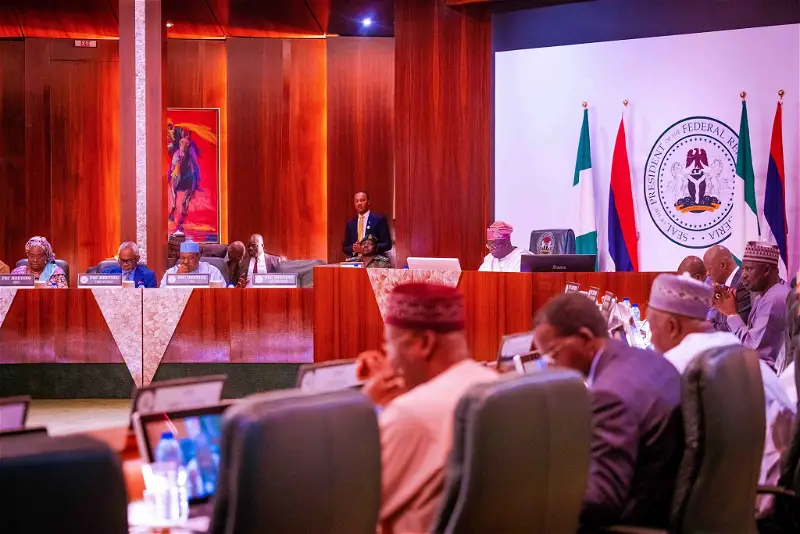
The Federal Executive Council (FEC) on Friday approved a ₦58.47 trillion budget proposal for the 2026 fiscal year.
Briefing journalists after the council meeting at the Presidential Villa, Abuja, the Director-General of the Budget Office of the Federation, Mr Tanimu Yakubu, said the approval followed a review of the 2026–2028 Medium-Term Expenditure Framework (MTEF) and Fiscal Strategy Paper (FSP).
According to Yakubu, the reviewed framework puts the total size of the budget at ₦54.46 trillion, with retained revenue estimated at ₦34.33 trillion.
He explained that the aggregate expenditure for the 2026 proposal is about six per cent higher than the 2025 budget estimate.
“This includes projected spending of government-owned enterprises amounting to ₦4.98 trillion, and ₦1.37 trillion for grants and donor-funded projects,” Yakubu said.
He added that aggregate spending also covers statutory transfers of ₦4.1 trillion, debt service of ₦15.52 trillion — including ₦3.38854 trillion for the sinking fund to retire maturing local obligations — personnel costs and pensions of ₦10.75 trillion, overhead costs of ₦2.22 trillion, and allocations for government-owned enterprises.
Yakubu noted that personnel costs, including pensions, are seven per cent higher than the 2025 provision, with ₦1.02 trillion earmarked for government-owned enterprises.
According to him, the 2026 budget reflects a deliberate effort to balance macroeconomic stabilisation, development priorities and medium-term fiscal sustainability.
“The assumptions are conservative and realistic, particularly on oil price, exchange rate and government-owned enterprises’ dividends,” he said.
He explained that while overall revenues are declining year-on-year, non-oil revenues now make up about two-thirds of total receipts, signalling a structural shift away from oil dependence.
“Corporate tax, VAT, customs and independent revenues remain the main fiscal anchors. Expenditure growth is driven largely by debt service, wages and pensions, rather than discretionary expansion,” Yakubu said.
He added that capital spending was marginally reduced to prioritise completion of ongoing projects and value for money, while the larger deficit reflects policy loosening.
“Financing will rely mainly on domestic borrowing, supported by concessional multilateral loans,” he said.
Earlier, the Minister of Budget and Economic Planning, Senator Abubakar Bagudu, confirmed that FEC considered both the 2026 budget proposal and amendments to the MTEF ahead of presentation to the National Assembly.
“We proposed a revision downwards of the exchange rate from ₦1,512 to ₦1,400 and the consequential changes in the budget size,” Bagudu said.
“So the Federal Executive Council approved both the amendment to the medium term framework and the 2026 budget proposal for presentation to the National Assembly.”
Also speaking, the Minister of Information and National Orientation, Alhaji Mohammed Idris, said the budget was the major item considered by FEC at the meeting.
“The budget has been looked at and discussed by members of the FEC after its due presentation by the Minister of Budget and Economic Planning and the Director-General of the Budget Office,” he said.
Opinion Nigeria News


United States and Russia Resolving Trade Issues and Pursuing New Opportunities -By Kestér Kenn Klomegâh
The American Chamber of Commerce (AmCham) will be working in the system of the Chamber of Commerce and Industry (CCI)...


Nigeria’s Middle Class Is Slipping Into Poverty — And We Are All at Risk -By Abdulhamid Rabiu
What is urgently needed is a shift from abstract economic targets to people-centered policies. Inflation control must be prioritized. Wages...

Second Ministerial Conference: Shaping Russian-African Strategic Partnerships -By Kestér Kenn Klomegâh
As indicated from above, the most important issues of multifaceted development are included on the Russian-African agenda, with a focus...


When Matrimony Is Dead On Arrival, The Wedding Was Only A Ceremony -By Isaac Asabor
Marriage is not for everyone, and that truth needs to be said plainly. It requires emotional intelligence, self-control, humility, and...

Awards Without Impact: Rethinking ‘Good Governance’ In Bauchi State -By Yasir Shehu Adam
True good governance is not proven in Abuja halls or award plaques. It is proven in functional classrooms, well-equipped hospitals,...