
Democracy & Governance
“I Will Tell Trump For You”: Nigeria’s Age-Old Habit Of Outsourcing Accountability -By Isaac Asabor
The problem is that Nigeria’s “big brother” is rarely in a position to intervene meaningfully. Tweets, speeches, and public condemnation are easy. Deploying resources, restructuring governance, and holding local actors accountable are not. In essence, the analogy of the child’s threat becomes painfully literal: the brother is far away, the kid is alone, and the problem remains unresolved.

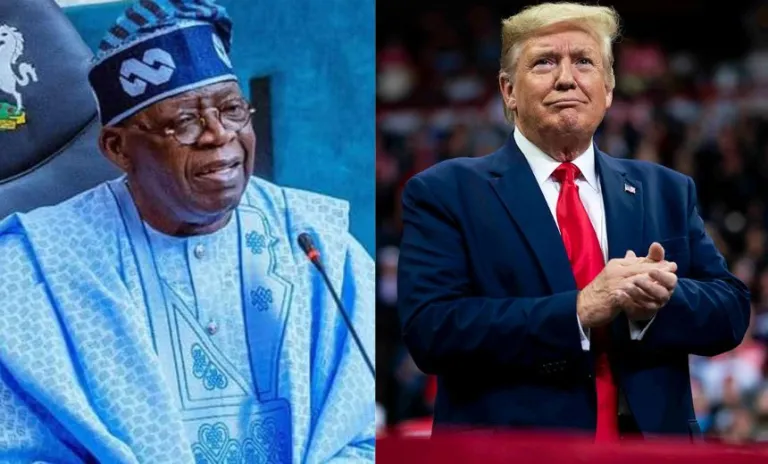
Walks down the crowded streets of Lagos, Kano, or Sokoto, and if you have a keen ear, you might overhear a common refrain: “I will tell my brother for you!” At first, it sounds like the bravado of a child, an attempt to summon a bigger, stronger ally from the mysterious realms of family lore. The kid does not really have a brother nearby. Maybe they do not even have a brother at all. But the words carry weight because the threat is convincing enough to make the listener pause.
Fast forward to the 21st century, and Nigeria’s adults have perfected the same rhetorical maneuver, but on a global stage. Only now, the “brother” is someone with a golden comb-over, a penchant for social media theatrics, and an office in Washington, D.C. Enter Donald Trump. In the bizarre theatre of Nigerian politics, religious advocacy, and civil society activism, some factions have apparently decided that the best way to deal with local chaos, be it kidnappings, banditry, or political gridlock, is to “tell Trump” for them.
This is not just an idle metaphor. The recent attack in Sokoto, where lives were lost and communities were left in fear, exemplifies a pattern that is both tragic and painfully familiar. Nigeria, despite decades of political evolution, still struggles with the most basic expectation of governance: protecting its citizens. And when domestic institutions fail, there is a temptation, sometimes subtle, sometimes blatant, to look abroad for sympathy, pressure, or intervention.
Let us be clear: appealing to a foreign power is not inherently wrong. After all, diplomacy is part of governance, and international support can catalyze change. But in Nigeria’s context, the spectacle often resembles a playground skirmish: instead of dealing with the immediate threat, the focus shifts to telling “the big brother” about the problem. The danger, the fear, the bloodshed, these become headlines, tweets, or press statements meant to attract attention from someone far removed from the actual crisis.
Consider the logic: If a teenager in Lagos threatens, “I will tell my brother for you”, it is not because the brother is in the next room ready to throw punches. It is because the imagined presence of authority carries weight. Similarly, when parts of Nigerian civil society and religious leadership raise alarms in international circles, they are leveraging the symbolic power of a figure who might act, even if the reality of action is uncertain. The difference? Children get bored and move on. Global attention, meanwhile, can last for months, but it does not solve the day-to-day insecurity faced by Nigerians, particularly Sokoto residents in this context.
This phenomenon reflects deeper systemic issues. Nigerian governance, across multiple levels, has historically struggled with accountability. Bandits terrorize communities, yet arrests are slow; corruption thrives, yet prosecutions are sluggish; policy failures abound, yet the rhetoric remains performative. In such an environment, looking outward becomes a coping mechanism, a way to signal distress without confronting the painful truth at home.
The humor in “I will tell Trump for you” is undeniable. It is absurd, almost cartoonish, to imagine that sending a memo, petition, or tweet across the Atlantic could substitute for functional governance. Yet the seriousness is unavoidable. Outsourcing accountability is dangerous because it normalizes a culture where citizens, and even organizations, rely on external actors to solve local problems. It allows elected officials to shrug, religious leaders to sermonize without practical follow-through, and ordinary citizens to feel powerless in their own communities.
Nigeria’s security challenges are the most glaring symptom of this problem. The Sokoto attack is just the latest in a string of violent incidents, from kidnappings in Kaduna to insurgent attacks in Borno, that reveal a fragile state apparatus. Local authorities often lack resources, coordination, or political will. And while appealing to international figures might generate headlines or diplomatic statements, it does not replace armed security personnel, responsive local government, or proactive policing.
Yet, there is something fundamentally human about the “I will tell Trump for you” approach. It reflects frustration, desperation, and the search for leverage. When internal systems fail, people naturally look for someone with influence, someone who can tip the scales, even symbolically. It is shorthand for “we are not safe, we cannot handle this alone, please help us.” And, as in childhood, the act of naming an authority figure, real or imagined, can provide a fleeting sense of security.
The problem is that Nigeria’s “big brother” is rarely in a position to intervene meaningfully. Tweets, speeches, and public condemnation are easy. Deploying resources, restructuring governance, and holding local actors accountable are not. In essence, the analogy of the child’s threat becomes painfully literal: the brother is far away, the kid is alone, and the problem remains unresolved.
Moreover, this dynamic has political consequences. Outsourcing accountability can allow domestic leaders to evade responsibility. If civil society and religious groups focus on appealing abroad, local politicians can feign cooperation or outrage without implementing real solutions. The international “big brother” becomes a convenient distraction, a figure whose symbolic presence masks the systemic failures that actually need addressing.
This is not to suggest that global attention is worthless. Pressure from abroad can sometimes catalyze domestic reform, attract funding, or force transparency. But it cannot replace the work of Nigerian institutions themselves. Therefore, security forces, state governments, and federal agencies must be strengthened; corruption must be confronted; policy must be implemented consistently. Until then, the “I will tell Trump for you” mentality will remain a coping mechanism rather than a solution.
In a broader sense, this habit reflects Nigeria’s enduring struggle with agency. There is a cultural expectation that someone else, whether a sibling, a community elder, or a foreign leader, will step in when things go wrong. It is comforting, it is familiar, but it is also dangerous. Empowerment, accountability, and local action are far more effective than symbolic appeals.
So, the next time you hear, “I will tell my brother for you,” remember this: in Nigeria, sometimes the brother is a kid next door, sometimes the president of the United States, and sometimes… well, the brother does not exist at all. What does exist are the problems that will keep coming until someone, somewhere, ideally at home, decides to take them seriously.
Nigeria can joke about Trump all it wants. But for the citizens of Sokoto, Lagos, or Abuja, this is no laughing matter. Outsourcing accountability is entertaining in theory, amusing in speeches, and even headline-grabbing in newspapers. In practice, it is deadly serious, and until the country confronts the failures at home, no foreign “brother” can fix what local leadership cannot.
Nigeria has grown past the age where it can rely on imaginary authority figures or symbolic interventions. It needs action, accountability, and courage. Until that happens, “I will tell Trump for you” remains a tragicomic reminder of what happens when power is deferred, responsibility outsourced, and citizens left to fend for themselves.
The irony is stark: in trying to summon help from afar, Nigeria risks losing sight of the fact that the solution has always been within reach, if only the country would stop waiting for someone else to swing by and save the day.


Between The Palace And The Police: Where Does Justice For Don Pedro Obaseki Lie? -By Isaac Asabor
Justice cannot lie in fear. It cannot lie in mobs. It cannot lie in silence. Justice lies in a firm...

“I Will Tell Trump For You”: Nigeria’s Age-Old Habit Of Outsourcing Accountability -By Isaac Asabor
The problem is that Nigeria’s “big brother” is rarely in a position to intervene meaningfully. Tweets, speeches, and public condemnation...

Holding the Line: Why the EFCC Deserves Support in a Difficult Fight -By Prof. John Egbeazien Oshodi
Yet there is something Nigerians must also remember: the men and women inside this institution have not surrendered. They are...


The Double-edged Sword: Social Media’s Impact On Teen Girls Mental Health -By Ibrahim Isa Muhammad
Social media itself is not entirely good or bad—its impact depends on how it’s used. Healthy habits include setting time...


India’s Priorities At BRICS Presidency Amid Rising Geopolitical Challenges -By Kestér Kenn Klomegâh
Since its inception, BRICS has undergone a transformation and has gone through several stages of qualitative change. The organizers are...