
Breaking News
Senate Moves to Harness Technology, Update Cyber Laws to Tackle Insecurity
The Nigerian Senate says it is working with key agencies to deploy technology against rising insecurity, as Senator Shuaibu Salisu confirms plans to repeal and replace the National Cybercrime Law and expand nationwide digital coverage.

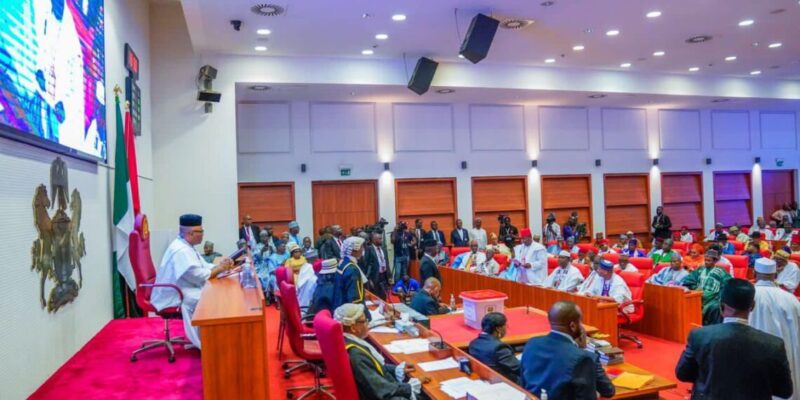
The Senate has reiterated its commitment to using advanced technology to address Nigeria’s worsening insecurity, revealing that it is working closely with key government agencies and stakeholders to strengthen the nation’s cyber and security frameworks.
Speaking with journalists shortly after the induction of new members and executives of the Abeokuta Sports Club 1904—led by its President, Alhaji Taoheed Awodele—the Chairman of the Senate Committee on ICT and Cybersecurity, Senator Shuaibu Afolabi Salisu, said the upper chamber is currently reviewing the National Cybercrime Law as part of efforts to curb rising security threats and technology-driven offences.
Salisu, who represents Ogun Central, noted that the Senate recently held a security engagement session in the South West and plans to replicate the consultations across all six geopolitical zones.
“We are working on a new National Cyber Security Law. We are going to repeal the existing law and promulgate a new one. Since the last law was promulgated, we have faced new technologies, artificial intelligence, and new manifestations of cybercrime. There was also a new UN Convention on Cyber Crimes,” he explained.
He added that the Senate has been interfacing with agencies such as NCC and NITDA to explore ways technology can help address nationwide security challenges.
According to him, “There is hardly any crime you want to commit now that does not have an input of technology. You want to make phone calls, you want to defraud people. So, we are putting in place, first and foremost, infrastructure to ensure that no part of this country is uncovered.”
The senator stressed the need for nationwide broadband coverage to enable security agencies deploy digital tools effectively. He noted that government intervention is crucial to extend telecom infrastructure to rural areas, highlighting the purpose of the Universal Service Provision Fund (USPF).
“We are also strengthening digital identity, meaning that whatever crime is committed, the criminal will leave a digital trace that will allow security agencies to know that this crime has been committed by this person,” he added.
Salisu encouraged organisations such as the Abeokuta Sports Club to support leadership development by offering clarity and civic guidance.
“Clubs like this should help provide clarity — to distinguish what is good in the long and short term and what is politically motivated. They are to serve as a repository of knowledge, helping policymakers shape and refine public policy,” he said.
Also speaking, Ogun State Deputy Governor, Engr. Noimot Salako-Oyedele, urged the club’s new leadership to focus on impact, harmony, and progress, adding, “Leadership is about leaving things better than you met them.”
In his acceptance remarks, the new President, Alhaji Taoheed Awodele, pledged to uphold the club’s three pillars: excellence in sports, strong community bonds, and sustainable legacy. He assured members that he would lead with integrity, transparency, and unwavering passion.
Opinion Nigeria News



Wanted! Where Is Our National Interest? -By Abdu Abdullahi
Indeed, the idea of the national interest is very striking by its pronounced and provocative vacuum in Nigeria.This spells doom...

The ECOWAS Democracy Paradox: A Flawed Arbiter in an Era of Autocratic Drift -By Jeff Okoroafor
As ECOWAS condemns Guinea-Bissau's coup, I analyze how its failure to address "constitutional coups" by elected leaders has eroded credibility...


South Africa Takes A Break From G20 -By Kestér Kenn Klomegâh
The United States this month took over the year-long presidency of the group of leading economies after largely boycotting South...


Did America Happen to Ademiluyi? -By Zayd Ibn Isah
If we must fix Nigeria, it will not be by glorifying foreign lands or demonising our own, but by confronting...


The Children We Hide: Why Society Must Stop Shaming Special Needs Children -By Bello Humulkhair
A small boy sits at the corner of his classroom not because he cannot play, not because he does not...