
National Issues
When Power Enters The Picture: Tinubu, Yahaya Bello, And The Quiet Degrading Of Nigeria’s Justice System -By Psychologist John Egbeazien Oshodi
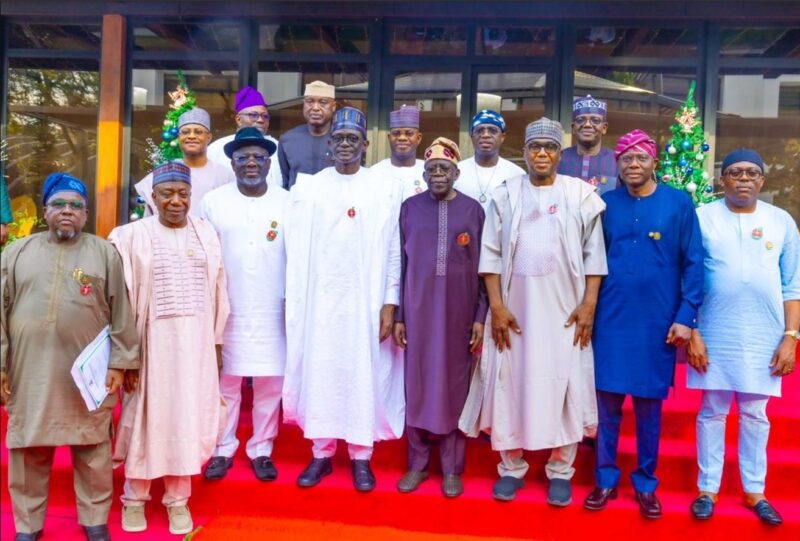
They saw the defendant — not quietly waiting for justice, not respectfully withdrawn from public visibility — but standing confidently inside a ruling-party portrait, smiling, positioned deliberately in the back row almost directly behind the President. They saw him included, acknowledged, visually protected. They understood, instantly, that millions of citizens would see the same image and begin forming conclusions about power, loyalty, and outcomes.

A Photograph That Became a National Lesson
There are political moments that do not shout — they quietly wound. They arrive without speeches, without explanations, and yet they settle inside the nation like a bruise. The photograph of the APC Strategy, Conflict Resolution, and Mobilisation Committee is one of those moments. In that image, President Bola Tinubu stands at the front, fixed confidently at the center of power. And almost directly behind him, in the middle of the back row, stands Yahaya Bello — smiling, visible, unmistakable — as though nothing in his recent history requires pause or caution. Everyone is standing upright, but the posture tells a deeper story: Bello is not tucked away, not kept low, not placed where controversy might appear respectful. He is positioned where the eye is gently guided toward him, as if the camera understood that the nation must see him — and accept it.
When that photograph moved across phones, television screens, and newspapers, it did not simply circulate; it pierced. Millions of Nigerians saw a man with unresolved court matters standing safely inside the symbolic heart of political authority. They saw inclusion where there should have been distance, affirmation where there should have been careful restraint. For a country already tired, already bruised by years of unbalanced justice, the image did not confuse — it hurt. It felt like watching accountability quietly step back, bow its head, and make room for power, while the rest of the nation was left to swallow the insult in silence.
Court Cases Require Ethical Space — Not Political Comfort
In democratic systems across the world, there is a principle that is both legal and cultural: when a public figure faces active court matters, the decent, responsible course is a temporary withdrawal from high visibility. This withdrawal is not humiliation, nor is it an assumption of guilt. It is a simple recognition that institutions deserve breathing space — a recognition that justice functions more honestly when those under scrutiny do not simultaneously enjoy political privilege. In Bello’s situation, the opposite occurred. Even while proceedings continue, he was visually welcomed back into planning sessions, as if legal uncertainty has no bearing on civic representation. Nigerians, many of whom struggle daily to obey laws without favor, immediately sensed the double standard. A country that should have been modeling patience instead modeled power. And in that subtle shift, a dangerous civics lesson was taught — one in which political belonging seems stronger than institutional caution.
A Legal Journey That Already Tested National Trust
It is important to recall that Bello’s legal narrative has not unfolded quietly. The public has watched numerous adjournments, delays, court disruptions, appearances and apologetic reappearances, and a stream of rhetoric aimed not at clarifying truth, but at weakening the credibility of those investigating. The EFCC chairman’s unprecedented expression of concern — implying that failure could damage national anti-corruption credibility — signaled how fragile the situation already was. In such an environment, leadership should sense that society is tired, suspicious, and emotionally exhausted. Instead of choosing restraint, leadership offered imagery of reintegration. Instead of reassuring the courts that their work remains sacred, it produced symbolism that appears to trivialize their struggle. When leadership underestimates the emotional temperature of the nation, cynicism expands — sometimes permanently.
Committee Inclusion Becomes Public Rebranding
Political committees may appear routine, but they are actually instruments of legitimacy. They indicate who is trusted, who is strategic, and who is welcome in decision-making environments. When Bello was included, the committee seat transformed into a form of quiet public rebranding. It suggested that his unresolved situation belongs not to the category of ethical concern, but to ordinary administrative life — as if corruption charges are simply episodes to be negotiated while governance continues unchanged. For ordinary Nigerians who do not receive such courtesy when dealing with legal matters, this image confirms a painful suspicion. It confirms that in Nigeria, justice does not always function as a neutral referee — it sometimes functions as a revolving gate, depending on who is passing through.
Reading Bello’s Smile: The Psychology of Untouchability
It may feel speculative to imagine what Bello might be thinking, yet psychology allows us to understand patterns in human behavior. A person who has undergone public investigation, resisted state attempts at compliance, faced law enforcement confrontations, apologized to courts, and still managed to appear in elite strategic spaces, may reasonably begin to feel that political networks offer protection that laws do not. In that photograph, the smile — whether polite or triumphant — sends invisible signals. It suggests survival, resilience, and perhaps an internal belief that power ultimately protects its own. When individuals under scrutiny sense that systems will bend around them, governance becomes distorted. Citizens watching that smile do not see legal fairness standing tall; they see political immunity beginning its work.
What Judges See — And Why This Places Them in an Impossible Position
Judges do not work inside sealed glass chambers. They are human beings — one a man, one a woman — each presiding over separate Bello-related matters, each with upcoming hearing dates already inked into their court calendars. They rise early, read case files, examine motions, study precedents, and prepare for sessions that will require calm minds and steady hands. They know that when those dates arrive, the courtroom must be a place of seriousness — a place where evidence, not influence, determines what happens next.
And then, in the quiet in-between days before those hearings resume, they saw the photograph.
They saw the defendant — not quietly waiting for justice, not respectfully withdrawn from public visibility — but standing confidently inside a ruling-party portrait, smiling, positioned deliberately in the back row almost directly behind the President. They saw him included, acknowledged, visually protected. They understood, instantly, that millions of citizens would see the same image and begin forming conclusions about power, loyalty, and outcomes.
In that moment, an unfair burden shifted onto their shoulders.
The male judge, tasked with guiding one branch of the case, must now walk into his courtroom knowing that the nation has already seen the accused embraced under party symbolism. The female judge, responsible for another phase, must now prepare rulings knowing that the ruling party is looking far ahead — toward 2027, toward election strategy, toward political cohesion — while her task is anchored firmly in the present: truth, law, and fairness.
They are not intimidated — but they are placed inside a psychological battlefield they did not create.
Even when both judges remain principled, disciplined, and fiercely independent, the public now wonders: How can judgment feel pure when politics has already staged a rehearsal? That question is corrosive. It suggests that courts walk beneath political shadow when, in reality, courts are meant to stand above every political timetable — including those aimed at securing advantage ahead of the 2027 elections.
Both judges deserve space to carry out their duty without images interfering. Instead, the photograph intruded into that sacred legal process, folding politics directly into the emotional climate surrounding their work. They now must fight not only through legal argument, but through perception — defending not only their rulings, but the dignity of their institution.
And that is a cruelty we should never impose on honest judges.
Inside EFCC Offices, A Quiet Pain
There is a kind of pain that does not scream — it sits quietly inside the chest and refuses to move. That is the pain that likely settled across EFCC offices when the photograph circulated. Behind the case file labeled “Yahaya Bello” are people who have walked through emotional fire for this investigation. Investigators have spent nights sleeping on office chairs, constructing timelines and evidence trails the public may never fully appreciate. Prosecutors have endured hostile courtroom confrontations, sharp public commentary, and the quiet fear of losing cases that should never have become political. EFCC leadership has carried the burden of defending the institution against pressure, ridicule, and coordinated attempts to discredit its work. Journalists who tracked every twist of the case have lived through suspicion, online hostility, and the exhaustion of reporting truth in a climate that rarely encourages it.
Then — the photograph arrived.
They saw Bello standing there, smiling, confidently positioned inside the ruling-party portrait. What followed was not noise. It was silence — a deep, heavy silence that says, “So this is what our sacrifice becomes.” It lingered in corridors, in conference rooms, in late-night emails and unanswered messages. It felt less like frustration and more like grief.
Some investigators likely lowered their eyes — not in fear, but in heartbreak. Prosecutors may have stared at their briefs, suddenly sensing they were now battling something far larger than any defendant. EFCC leaders surely remembered the speeches they had delivered about accountability and wondered whether those words still carried meaning. Even veteran journalists — trained to remain detached — felt their spirits sink, realizing they had risked so much for a truth that political power casually folded into convenience.
It is deeply shaming to demand courage from men and women, to send them into storms, to expose them to threats and reputational danger — only for politics to later place the subject of their struggle inside a celebratory frame. Some will quietly wonder whether courage is punished in Nigeria. Others will question whether future investigations are worth the emotional cost. And the most wounded among them will feel tears they cannot publicly acknowledge — grieving not merely a case, but a country appearing to bless what its own institutions are still fighting.
When the guardians of justice begin to feel abandoned, cracks open where strength once lived. Work continues, but hearts withdraw. Files move forward, but faith retreats. Democracies do not collapse with explosions — they collapse in quiet rooms, where exhausted professionals stare at a photograph that seems to whisper that their nation has walked away.
We All Remember the Drama
Nigeria remembers how this case unfolded. Bello’s legal troubles were never quiet; they were loud, public, and humiliating for national institutions. On September 18, 2024, EFCC officers moved to arrest him over an alleged major fraud case. Nigerians expected the law to take its course — instead, they witnessed something that looked disturbingly like a political thriller.
Bello reportedly evaded arrest with the help of his successor, Governor Usman Ododo. EFCC operatives, acting within the law, suddenly found themselves blocked by the shield of political office. Immunity — designed to protect governance — became a hiding place. And as officers waited, Ododo allegedly whisked Bello away, echoing a similar incident months earlier in April. The EFCC later declared publicly that obstructing its operations was criminal. Yet the message that echoed louder across Nigeria was simpler, darker, and unforgettable:
Power can help you run — and smile while you do it.
That memory did not disappear. So when Nigerians later saw Bello smiling behind the President in the APC committee photograph, it returned instantly. The earlier escape and the new political embrace fused into one painful realization: the same nation that once failed to restrain him now appeared ready to welcome him back into authority.
The Experience of Ordinary Nigerians Watching This Play Out
Across Nigeria, ordinary people live under a justice system that rarely hesitates. A market woman who violates a local rule is penalized before sunset. A young man who cannot pay a traffic fine is dragged off to spend the night in a cell. A student caught cheating feels the consequences immediately, sometimes losing years of academic effort in a single disciplinary decision. For the poor, the law arrives quickly — often harshly — and explanations are rarely invited.
These same Nigerians have watched Yahaya Bello’s story unfold. They saw the accusations, the court battles, the legal evasions, and then — unbelievably — the smiling photograph inside the ruling party’s committee. They watched someone whose case is still unresolved move effortlessly through political doors that slam shut on ordinary citizens. The message settles in their hearts like a quiet sadness: justice in this country wears two faces, and only one of them ever smiles kindly.
For many, the feeling is not anger first — it is humiliation. It is the sense that they live in a nation that demands obedience from the powerless while negotiating with the powerful. It teaches them that the law is not a moral compass, but a tool that bends depending on who is standing in front of it. Over time, something delicate begins to die. Patriotism loses its warmth. People stop believing in fairness and begin believing only in survival. They comply with laws not because they respect them, but because they fear punishment — and that is the slow emotional death of citizenship.
When citizens become emotionally detached from their country, corruption no longer shocks them. They simply shrug and say, “That is how Nigeria works.” And when that sentence becomes normal, a nation has already lost part of its soul.
Children, Students, and the Moral Memory Being Formed
The true tragedy of this moment lies not only in the courts or the political party halls — it lies in the minds of young Nigerians watching quietly from the sidelines. Children learn not from speeches, but from what adults normalize. Students absorb civics not from textbooks, but from the behavior of leaders.
When they see unresolved corruption standing comfortably beside power, a new moral language begins to form inside them. It tells them that mistakes are not corrected — they are negotiated. That character is optional. That if one day they hold enough influence, the rules that once frightened them will politely step aside. Some will grow up believing ambition matters more than integrity. Others will decide that honesty is only for those too weak to avoid scrutiny.
This moral damage does not fade with the next election cycle. It becomes part of the nation’s long-term memory. It shapes how future officials will treat money, how civil servants will treat responsibility, and how leaders will treat institutions. Long after today’s politicians leave the stage, the psychological lesson will remain: power protects its own.
Nations are not only governed by constitutions; they are governed by what children silently come to believe about right and wrong. And in this moment, we have written something dangerous into their hearts. We have told them, without saying a word, that in Nigeria integrity does not always win — proximity to power does.
That is not merely a political failure. It is a moral wound — one that will take generations to heal unless a different example is shown, loudly, clearly, and soon.
The International Glare: A Question of Seriousness
Outside Nigeria, observers track governance signals carefully. Development partners, democratic monitoring groups, academic researchers, and investment analysts look not merely at legal codes, but at behaviors surrounding them. The image of Bello embedded within strategic planning while still navigating court charges triggers disbelief. Some quietly wonder whether Nigeria wishes to be taken seriously on anti-corruption promises. Others see it as proof that political camaraderie continues to overpower institutional credibility. The global arena does not respond kindly to such symbolism. Credibility, once damaged, rarely repairs itself easily. Nations that trivialize accountability eventually discover that the world does not easily trust them again.
Leadership Must Respect the Power of Timing
Leadership, at its highest level, is not merely about appointing committees, signing bills, or directing agencies. It also involves understanding when restraint is healthier than display. Tinubu’s administration had an opportunity to communicate maturity by temporarily withholding Bello from strategic visibility. A simple message — “let the court process finish first” — would have calmed anxieties, strengthened institutions, and signaled seriousness. Instead, haste triumphed over caution. And once again Nigeria was reminded that power sometimes refuses to wait for principle.
Courtrooms Still Waiting — The Cases Are Not Over
This story is not complete. It is still alive on court dockets across Abuja.
One case before Justice Maryann Anenih was adjourned and assigned a fresh date.
Another federal proceeding was pushed forward again into the new year.
Other related hearings have moved from January to March, from November to later weeks, as motions and objections continue.
The judiciary has not declared closure.
The file is still open.
The system is still working — slowly, painfully, but working.
And yet, while judges prepare to reopen proceedings, the public is shown a political photograph that communicates comfort, acceptance, and return to influence.
Justice is still writing its story.
Politics behaved as if the ending had already been decided.
That is what wounds the national conscience. That is what humiliates the institutions charged with enforcing law. And that is why President Tinubu’s decision is not merely political — it is psychologically destabilizing to every arm of justice still engaged in this process.
This story is not complete. It is still alive on court dockets across Abuja.
One case before Justice Maryann Anenih was adjourned and assigned a fresh date.
Another federal proceeding was pushed forward once again, still awaiting hearing.
Other related matters have been shifted further down the calendar as motions and objections continue.
The judiciary has not declared closure.
The file is still open.
The system is still working — slowly, painfully, but working.
And yet, while judges prepare to resume proceedings, the public is shown a political photograph that communicates comfort, acceptance, and return to influence.
Justice is still writing its story.
Politics behaved as if the ending had already been decided.
That is what wounds the national conscience. That is what humiliates the institutions charged with enforcing law. And that is why President Tinubu’s decision is not merely political — it is psychologically destabilizing to every arm of justice still engaged in this process.
The Case for Reconsideration — Not Punishment
It is still possible to correct course. Removing Bello from visible strategic involvement until court processes conclude is not an act of cruelty. Nor is it a declaration of guilt. It is a protection measure — for the judiciary, for EFCC, for the credibility of leadership, and for the soul of the public conscience.
Nigeria cannot continue teaching citizens that unresolved corruption can coexist comfortably with political elevation. A nation already traumatized by inequality deserves the healing presence of restraint.
This Is Not About Guilt — It Is About Timing and Trust
No one is arguing that Yahaya Bello should live in isolation. He is a Nigerian citizen. He has friends, allies, colleagues, and political networks. And yes, he is not guilty in the eyes of the law until a court concludes otherwise. That principle must never be compromised.
But this conversation is not about denying him association. It is about responsibility in moments where symbolism shapes public trust.
When someone facing unresolved corruption charges appears in an image tied directly to national strategy and party authority, the message shifts from association to endorsement. It suggests comfort. It implies protection. It quietly tells the public that legal cases can run parallel to political elevation — and that the outcomes may no longer matter.
That is why caution is necessary.
Removing Bello temporarily from strategic public imagery is not punishment. It does not erase his rights. It does not pre-judge his case. Rather, it respects a simple psychological truth: institutions must be seen as clean if they are expected to command loyalty.
Imagine telling investigators to risk their safety fighting corruption, while those same individuals watch defendants appear in celebratory political frames. Imagine asking judges to remain neutral while national leadership creates pictures that look like decisions already made.
Trust does not die loudly. It fades quietly, one symbolic injury at a time.
This is why leadership must sometimes say: not yet. Wait until the courts finish. Not to humiliate. Not to condemn. But to protect belief in fairness, which is the oxygen every republic breathes.
Therapeutic Closing: The Emotional Health of a Republic
Every nation carries a psychological inner life. Nigeria’s inner life is layered with scars — promises made and broken, corruption cases that fade without answers, and a long memory of justice postponed. When citizens saw Bello standing inside that photograph, many of those scars reopened at once. People felt something familiar, something painful: that power in Nigeria still behaves more like a shield than a steward.
But it does not have to remain this way.
President Tinubu now stands at a crossroads — not simply a political one, but a moral and psychological one. His next decision will speak louder than any speech. Choosing to withdraw Bello from visible strategic roles until the courts complete their work would not be an act of humiliation. It would not declare guilt. It would not persecute anyone.
It would protect the integrity of the system itself.
It would give judges the breathing room they deserve.
It would restore emotional confidence among EFCC investigators who sacrificed so much.
It would remind law-abiding Nigerians that the rules still matter.
And it would teach our children that leadership is not about proximity to power, but proximity to principle.
This may appear to be a small administrative correction, but psychologically, it would represent a profound national shift. It would tell the public something they desperately need to hear: institutions come before individuals.
I am not blaming Bello here. He, like any citizen, remains entitled to defend himself in court. The real question is directed at leadership, symbolism, and timing. A nation traumatized by inequality cannot survive sustained political messages that normalize unresolved allegations alongside political honor.
True strength in leadership is not measured by who one includes in photographs.
It is measured by how one protects fairness when friendship becomes inconvenient.
Nigeria deserves the healing that comes when justice is allowed to walk ahead of politics — not behind it. A republic grows emotionally healthier when its leaders quietly communicate through their actions that no alliance, no convenience, and no election strategy will ever outrun the authority of the law.
Because in the end, the greatest legacy any leader can leave behind is not the number of allies gathered around him — but the trust of a people who finally believe that justice belongs to everyone.
About the Author
Prof. John Egbeazien Oshodi is an American psychologist and educator with expertise in forensic, legal, clinical, and cross-cultural psychology, including public ethical policy, policing, and prison science. A native of Uromi, Edo State, Nigeria, and son of a 37-year veteran of the Nigeria Police Force, he has long worked at the intersection of psychology, justice, and governance. In 2011, he helped introduce advanced forensic psychology to Nigeria through the National Universities Commission and Nasarawa State University, where he served as Associate Professor of Psychology.
He teaches in the Doctorate in Clinical and School Psychology at Nova Southeastern University; the Doctorate Clinical Psychology, BS Psychology, and BS Tempo Criminal Justice programs at Walden University; and lectures virtually in Management and Leadership Studies at Weldios University and ISCOM University. He is also the President and Chief Psychologist at the Oshodi Foundation, Center for Psychological and Forensic Services, United States.
Prof. Oshodi is a Black Republican in the United States but belongs to no political party in Nigeria—his work is guided solely by justice, good governance, democracy, and Africa’s development. He is the founder of Psychoafricalysis (Psychoafricalytic Psychology), a culturally grounded framework that integrates African sociocultural realities, historical awareness, and future-oriented identity. He has authored more than 500 articles, multiple books, and numerous peer-reviewed works on Africentric psychology, higher education reform, forensic and correctional psychology, African democracy, and decolonized models of clinical and community engagement.



Jesus: Born In Judea, Fled To Egypt; Thank God Not To Maga America -By Vitus Ozoke, PhD
So today – Christmas – watch carefully. Watch as MAGA Republicans who champion mass deportations attend church. Watch as they...


Lavrov Assesses Media Contributions Toward Developing Russia-Africa Relations During Cairo Ministerial Conference -By Kestér Kenn Klomegâh
During the previous two summits: in Sochi (2019) and in St Petersburg (2023), the theme on media was reviewed and...


It Is Christmas! -By Gabriel Agbo
You see, they did not celebrate Christ's birth at all. To them it was insignificant. They were far more concerned...


Why 2026 Must Be About Obeying God’s Word, Not Recycling Resolutions -By Isaac Asabor
Now, it is expedient to urge fellow Nigerians to stop pretending. The hard truth is this: many people enjoy making...

Russia Promoting Dialogue with Africa on Implementing 2023-2026 Strategic Action Plan -By Kestér Kenn Klomegâh
On December 19-20, the Second Ministerial Conference of the Russia-Africa Partnership Forum was held in Cairo, Egypt. It was held...