
Political Issues
Defection by Coercion: Dissecting the Political Engineering Behind Fubara’s Move to APC -By Jeff Okoroafor
Rivers Governor Fubara defected to the APC after failing to challenge his illegal suspension. Read my op-ed dissecting his surrender, Wike & Tinubu’s political takeover, and what it means for Nigeria’s dying democracy. No “Excellence” in cowardice.

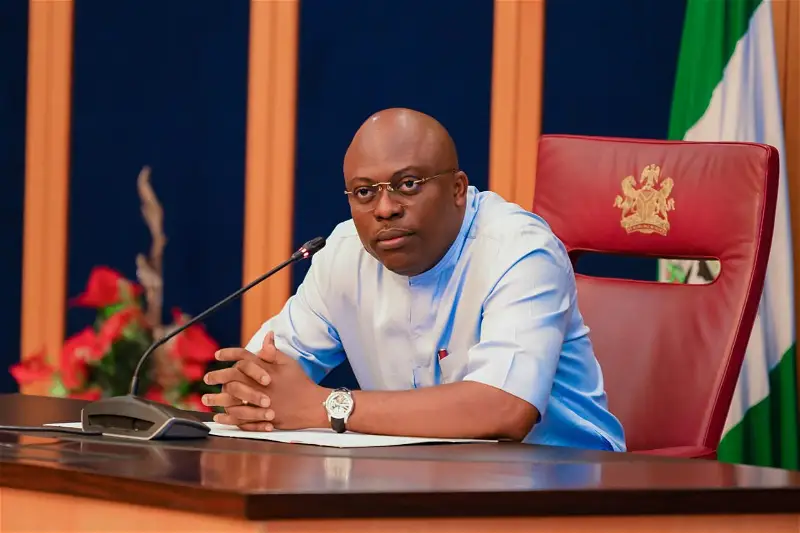
In the grand, tragic theatre of Nigerian politics, where principle is bartered for power and courage is traded for convenience, the defection of Rivers State Governor Siminalayi Fubara from the Peoples Democratic Party (PDP) to the All Progressives Congress (APC) is not a shocking plot twist. It is the predictable, pathetic climax of a farce written by bullies, brokered by overlords, and performed by a man who has revealed himself to be a governor in title only—a political serf in agbada.
Let us dispense with the courtesies. Siminalayi Fubara is not “His Excellency.” There is nothing excellent in capitulation. There is nothing honorable in a leader who, when faced with an unprecedented constitutional rape—the illegal declaration of a state of emergency in his state, his suspension, and his replacement by a sole administrator—chose not to stand and fight in the courts like a man defending his mandate, but to grovel at the feet of those who orchestrated his humiliation.
His defection, alongside the earlier migration of 17 state lawmakers, is not a strategic masterstroke for the people of Rivers. It is the final, cowardly surrender in a war he was too timid to wage. It is the whimper of a “weeping child,” as one observer aptly noted, who, after having his candy taken, decides to join the bully’s gang in hopes of scavenging future crumbs.
To frame this as a surprise is to ignore the open secret of Nigerian politics: the presidency, under Bola Tinubu, and the G-5 godfather, Nyesom Wike, have been conducting a slow-motion annexation of Rivers State. The peace deal brokered by President Tinubu between Fubara and Wike was not a truce; it was a terms of surrender. The reported clause of a defection to the APC was not a suggestion; it was a directive from the new power nexus that controls Nigeria’s political machinery.
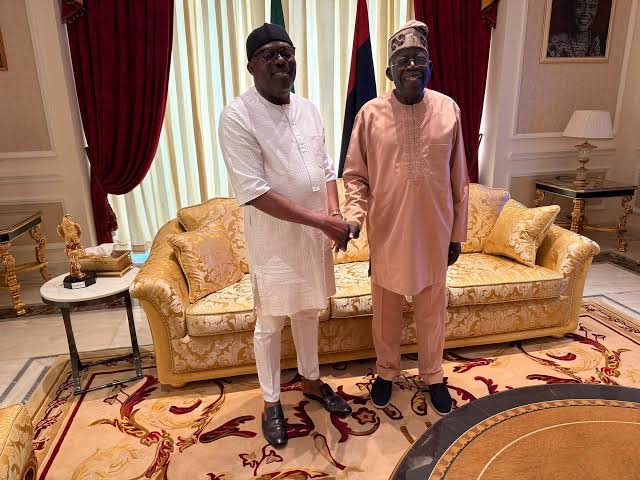
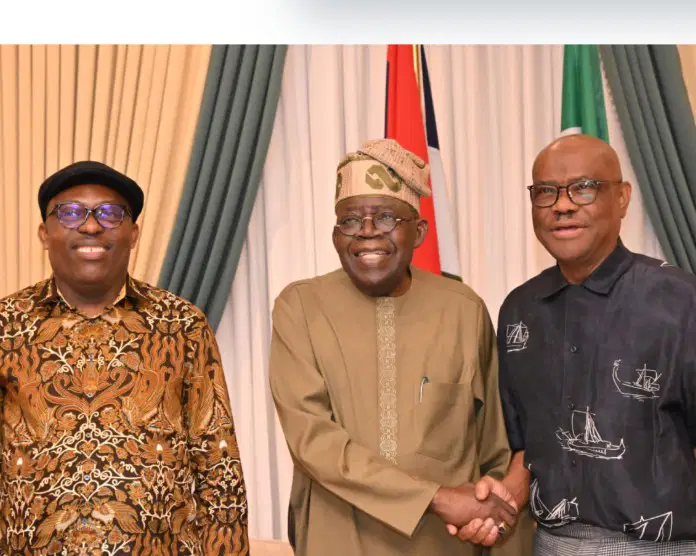
Fubara’s praise for Tinubu’s “support” in overcoming the state’s crisis is Orwellian newspeak. The “support” was the cessation of the very attacks launched by Tinubu’s federal might and Wike’s political machinations. The president did not save Fubara; he called off his hounds after the governor agreed to leash himself.
Consider the damning evidence of premeditated submission:
- The Judicial Abdication: When other PDP governors courageously went to court to challenge the patently illegal state of emergency in Rivers State, Fubara was conspicuously silent. He did not lend his name, his office, or his resources to a fight for constitutional sovereignty. This was not an oversight; it was a signal. He had already chosen the path of negotiation with the arsonists, rather than fighting the fire.
- The Hasty Exodus of the Assembly: The defection of the Speaker and 16 lawmakers, a move of dubious constitutional legitimacy given the provisions on defection in the Nigerian constitution, was the clearing of the chessboard. It removed the last institutional hurdle within the state, making Fubara’s subsequent move a mere formality.
- The Language of a Vassal: His announcement—“it is better for us to move from where we are to where it is better for Rivers State”—is the empty mantra of a man without agency. It is not an argument; it is a justification scripted by his handlers. Where is it “better”? For whom? For the people of Rivers, now locked into a one-party fiefdom? Or for Siminalayi Fubara, who secures a temporary shield from impeachment and access to federal patronage?
The Larger Cancer: Nigeria’s Drift to a One-Party Autocracy
Fubara’s defection is not just a Rivers affair. It completes the APC’s capture of all six states in the oil-rich South-South zone. This is not organic political growth; it is a conquest achieved through the weaponization of federal institutions, the exploitation of economic levers, and the coercion of weak-willed officials.
Nigeria is now, for all practical purposes, a one-party state. The opposition PDP is in terminal decay, cannibalized by its own warlords. The APC, under Tinubu, operates not as a political party but as a syndicate, using the immense power of the central government to strong-arm, entice, or destabilize opposition holdouts. The independent institutions meant to check this—the judiciary, the electoral commission, even the police—have been systematically compromised, neutered, or intimidated.

This is the system Fubara has now willingly joined. He is not a bold defector; he is a compliant recruit in Tinubu’s project of total political domination. His signature smile at the announcement was not the grin of a victor, but the relieved simper of a hostage who has decided to identify with his captors.
A Call to the People: Reject This Betrayal
The Rivers State PDP Chairman, Robinson Ewor, struck the only note of dignity in this sordid affair: “If he leaves the PDP today, I will not follow him anywhere.” This is the stance of a man who understands that politics must be about something more than personal survival.
The people of Rivers State, and indeed all Nigerians, must now recognize the truth. Governors like Fubara are not leaders; they are conduits. They are not defenders of the constitution; they are its willing saboteurs. They have traded the sovereignty of their people’s votes for the security of their own positions.
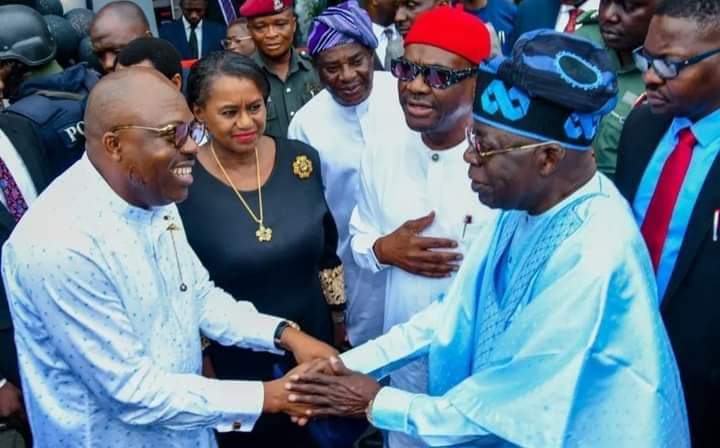
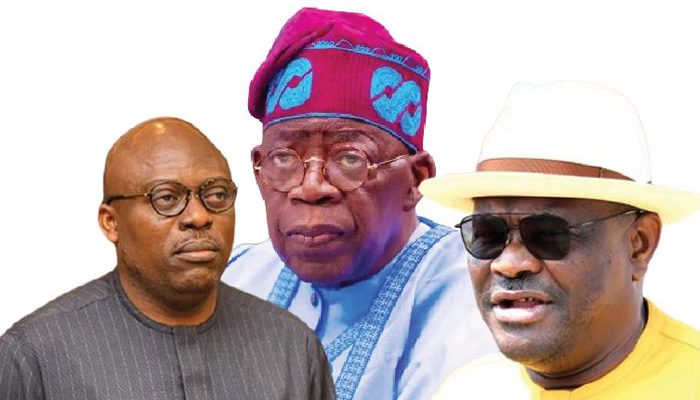
Sim Fubara and Tinubu
The title “His Excellency” is conferred not by a certificate of return, but by the courage to defend the mandate it represents. Siminalayi Fubara has failed this fundamental test. His story is a cautionary tale for Nigeria: a democracy where might makes right, where courts are avoided rather than embraced, and where governors kneel rather than fight, is not a democracy at all. It is an empire, and Fubara has just sworn fealty to its emperor.
The final chapter for Rivers is yet to be written. It will be written by the people when they realize that the real power was never in Government House, Port Harcourt, but in their collective will—a will that has just been profoundly betrayed.

Jeff Okoroafor
Jeff Okoroafor is a social accountability advocate and a political commentator focused on governance, accountability, and social justice in West Africa.



Accelerating Intra-Africa Trade and Sustainable Development -By Kestér Kenn Klomegâh
The AU Private Sector Forum has held several forums, with key recommendations. These recommendations provide valuable insights into the challenges...


Human Rights Day 2025: Advancing The Right To Food And The Rights of Africa’s Farmers -By Prof. Uche Ofodile
One of the most essential human rights is the right to adequate, safe, nutritious, and culturally appropriate food. This right...


Africa’s Democracy Time Bomb -By Patrick Iwelunmor
Africa is not lacking in potential; it is lacking in leadership. By virtue of its population, its resources and its...

Russia’s Lukoil Losses Strategic Influence Across Africa -By Kestér Kenn Klomegâh
United States sanctions has hit Lukoil, one of the Russia's biggest oil companies, like many other Russian companies, that has...

Inadvisability Of Worrying About The Osun Drama As Every First Lady Must Leave A Footprint -By Isaac Asabor
But here is the truth: there is absolutely no reason to worry. Nigerians are acting as though mild tension or...