
Breaking News
EFCC Recovers ₦566bn, Supports Tinubu’s Economic Reforms — Olukoyede
EFCC Chairman Ola Olukoyede says the agency recovered ₦566bn and thousands of assets in two years, investing ₦100bn in social schemes and aiding Tinubu’s economic reforms through anti-graft enforcement and institutional renewal.

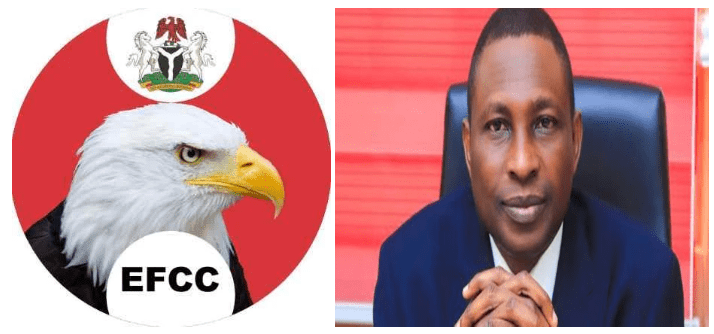
The Executive Chairman of the Economic and Financial Crimes Commission (EFCC), Mr. Ola Olukoyede, has revealed that the agency recovered over ₦566 billion within two years and played a key role in advancing President Bola Tinubu’s economic reform agenda through asset recovery, enforcement, and institutional renewal.
According to the EFCC’s Mid-Term Report released in Abuja on Thursday, the Commission’s recoveries and policy reforms have reinforced Nigeria’s anti-corruption framework and contributed to economic stability by channeling recovered funds into critical national development initiatives.
“Part of the funds recovered by the Commission in the last two years was invested in critical social investment programmes such as the Students Loan Scheme and the Consumer Credit Scheme. A total of ₦100 billion was invested in these two schemes,” Olukoyede stated.
Appointed on October 18, 2023, and confirmed by the Senate the following day, Olukoyede has overseen major progress in convictions, recoveries, and institutional reforms within the EFCC.
Between October 2023 and September 2025, the Commission received 19,318 petitions, investigated 29,240 cases, filed 10,525 cases in court, and secured 7,503 convictions. It also recovered ₦566.3 billion, $411.5 million, £71,306, €182,877, and other foreign currencies, alongside 1,502 forfeited real estate assets.
“On these two critical scores—convictions and recovery of proceeds of crime—the performance of the Olukoyede-led EFCC in the last two years is most inspiring. The numbers speak for themselves,” the report stated.
The document also detailed several high-profile prosecutions involving former governors, ministers, and senior public officials, as well as the revival of long-dormant corruption cases previously stalled in court.
Olukoyede highlighted that the EFCC had contributed to economic stability through targeted actions against currency racketeering, naira abuse, and cryptocurrency-related crimes.
“The campaign against currency racketeering and criminal speculation, including the clampdown on rogue cryptocurrency exchanges, helped to reduce pressure on the naira and supported the CBN’s efforts to stabilise the economy,” he explained.
He further disclosed that 792 suspects linked to investment and cryptocurrency fraud—192 of whom were foreigners—were arrested in a December 2024 Lagos operation, prosecuted, and deported.
Olukoyede also emphasized his administration’s focus on institutional reforms and ethical discipline. The EFCC, he said, established new directorates, including Fraud Risk Assessment and Control (FRAC), Digital Transformation and Innovation, and International Asset Tracing and Recovery. Fifty-five staff members were dismissed for professional misconduct.
“You cannot use corruption to fight corruption. From day one, I have continued to emphasise integrity and zero tolerance for unethical behaviour,” he said.
On international collaboration, the report highlighted strengthened partnerships with the FBI, UK National Crime Agency, Royal Canadian Mounted Police, INTERPOL, JICA, and law enforcement agencies in Spain and Germany. These alliances, Olukoyede said, facilitated the recovery and repatriation of stolen assets to victims overseas.
Olukoyede, who also serves as President of the Network of National Anti-Corruption Institutions in West Africa (NACIWA), was recently re-elected for a second term after establishing the organisation’s permanent secretariat in Abuja — a move hailed as a major diplomatic milestone for Nigeria.
He also announced the establishment of EFCC Radio 97.3 FM, the country’s first anti-corruption radio station, designed to promote civic education and public integrity.
“Under my watch, the EFCC has prioritised prevention as a cheaper and more effective alternative to enforcement. We are deploying risk-based approaches to monitor budget performance in MDAs and prevent fund diversion,” Olukoyede said.
He added that the EFCC is currently undergoing a rebranding exercise aimed at improving professionalism, transparency, and public trust, with a new logo and slogan set to be unveiled soon.
Reaffirming his commitment to President Tinubu’s Renewed Hope Agenda, Olukoyede said the EFCC would continue to align its anti-graft initiatives with national goals of transparency, accountability, and sustainable economic growth.
Opinion Nigeria News


Accelerating Intra-Africa Trade and Sustainable Development -By Kestér Kenn Klomegâh
The AU Private Sector Forum has held several forums, with key recommendations. These recommendations provide valuable insights into the challenges...


Human Rights Day 2025: Advancing The Right To Food And The Rights of Africa’s Farmers -By Prof. Uche Ofodile
One of the most essential human rights is the right to adequate, safe, nutritious, and culturally appropriate food. This right...


Africa’s Democracy Time Bomb -By Patrick Iwelunmor
Africa is not lacking in potential; it is lacking in leadership. By virtue of its population, its resources and its...

Russia’s Lukoil Losses Strategic Influence Across Africa -By Kestér Kenn Klomegâh
United States sanctions has hit Lukoil, one of the Russia's biggest oil companies, like many other Russian companies, that has...


Inadvisability Of Worrying About The Osun Drama As Every First Lady Must Leave A Footprint -By Isaac Asabor
But here is the truth: there is absolutely no reason to worry. Nigerians are acting as though mild tension or...