
Life And People
He Upset The Apple Cart: Murtala Muhaamed At 45! -By Ismail Misbahu

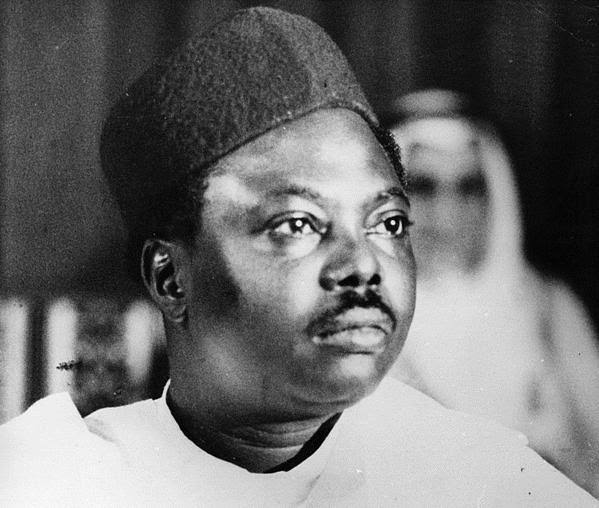
“I was his Orderly throughout to his last day during the Dimka coup. I was inside the car with him when he was killed. On the morning of that fateful February 13, we were going to the office from Ikoyi to Dodan Barrack. Sergeant Adamu Michika was the driver, Sergeant Akintunde Akinsehinwa, his ADC, sat behind the driver. As an Orderly, I was in front with the driver, while the Head of State sat behind me ― having been the one who opened the door for him ….” ‘The car was Mercedes Benz 600.
“When we got to the Alagbon junction, the traffic warden stopped the vehicle and as usual we didn’t go with sirens, escorts or some accompanying riders, or road-closed signs etc, and so we remained In the queue. We were the fifth or sixth vehicle behind, and the secretariat at that time was under construction. They put zincs around the compound behind that secretariat, then some soldiers who initially wore uniform disguised their identity in Agbada, while carrying AK-47 rifles. One soldier from Golf Road shot and got our driver, Sergeant Michika and our motor was neutralized.
“Between me and the driver was an arm-rest. On that arm-rest was the General’s brief case which he used to maintain his civil dresses purposely for Friday prayers, because the General doesn’t like going back to Ikoyi to change. Then some soldiers converged upon us, and began to spray us from the back. All of us took cover. I fell on top of the driver; and the blood of the driver covered my head, and they thought I was bullet off. After the first shooting in which they had faced no encounter from any of us, they must have assumed we were all dead. Then they ran to the NBC to broadcast the assassination.
“But fortunately for us then in the car, except the driver who was killed, none of the three of us was dead yet, but we were seriously injured. Unfortunately for us then, also, the ADC who was still alive, thinking the soldiers had gone, fatefully opened the door of the Benz. No sooner had he opened the door, than one soldier who was still remained within the range, shouted “he never die, he never die”!, alerting others to return back and finish their entire magazines. They returned and messed it off. I was the only one who survived perhaps because of the driver’s blood covering my head.
“They took everybody to the mortuary at Igbosere Hospital, not far from Kam Salem Police Headquarters. Because of the extreme cold of the mortuary, my left hand started shaking and one of the attendants saw it and called the nurses (“or doctors”) and said somebody was still alive. They checked and confirmed I was still breathing. So they had to look for a vehicle to carry me to Dodan Barrack where they eventually called for an Ambulance and took me to Military Hospital at Awolowo road.
“The assassins were formed into three groups, one waiting for Obasanjo when he was about to go to the office; another was waiting for TY Danjuma at Bourdillon, while ours’ was at Ikoyi road. It happened we were the first target as we moved early from the house to the office.
“Fortunately for Obasanjo and TY Danjuma, before they moved to the office, they heard the radio announcement of the assassination of their General”.
The above is a paraphrased extract from the account of Sergeant Michael Otuwu, then the “Orderly” to General Murtala Muhammed. He spent about six months in that military hospital before he got himself fully convalesced!
Had he been alive, Murtala Muhammed would have been 83 years old by now (13, February, 2021) and exactly 45 years since his assassination on Friday 13th of this same month, 1976.
Those who heard the booming sound of the gun-shot that early morning of Friday, 13, 1976, knew it was trouble. That reveals the infamous killing of an African hero known to the global World, whose virtues we are meant to learn, write, share and emulate. For that should better serve the meaning of the mourning because certainly there is nothing to be mourned about the demise of Murtala Muhammed almost half a century ago ― just as we do morn the deads. May with His infinite mercy, grant him peace and permanent relief in Jannatul-Firdaus. Ameen.
To so many Nigerians, apart from the stern pasture that resembles a real army officer, the General is a potential hero, a dogged fighter of corruption and fearless warrior whose fearlessness was a reflection of a great intimacy and patriotism towards the unity of Nigeria and Africa, as well as a hell fire to the evil demons of Nigeria and African unity and progress.
They killed him because he broke the log jams and expelled out thieving office boys and messengers of imperialism. He was killed because he mercilessly uprooted the tinctures of decay and called into question the bureaucratic tendencies that hooked-lined-and-sinker the Nigeria-led pan-African national economic and political reforms and policies. They killed him because of his hydra-headed venoms to instigate policies and regain the country’s long economic travails.
Some U.S. diplomatic cabal were allegedly claimed to have painted in their various memos, a sordid picture of a man regarded by many Nigerians and Africans alike as a liberation fighter and a lion hunter against the malicious bureaucratic office holders. One of such memos was sent to the then U.S. Secretary of State, Mr. Henry Kissinger by the former U.S. Ambassador to Nigeria, John E. Reinhard on August 18, 1975, and had the following statement:
“The leader of the coup against General Yakubu is an erratic, vainglorious, impetuous, corrupt, vindictive, intelligent, articulate, daring Hausa”.
Those hack mobilizers ― the remnants of 19th century colonialists’ deception were at a great discomfort with the man’s love of his continent. A progressive pan- African whose style of administration and radical foreign policy ushered so much in the fight and struggle for African liberation movement. They killed him because of his iron -army- command, and his firmed stand to confront and fight imperialism!
Those who subsequently heard the jumbled words of the principal assailant, Lt. Colonel Buka Suka Dimka on the air waves as he imposed a dawn to dust curfew, rightly upgraded the omens of trouble to an unmitigated disaster. After he messed it up ― killing the Head of State along with his Aide-De-Camp (ADC), Lieutenant Akintunde Akinsehinwa—the youngest and lowest ranking officer to have ever held the position of ADC to the Head of State, and his driver Adamu Michika, Dimka moved over from the death scene near the Federal Secretariat, Ikoyi to the nearby studio of the then National Broadcasting Corporation (NBC) to proclaim his infamous mutiny to the world.
A tape of martial music was already inserted in the broadcast which was procured through one of the staff of the station, Abdulkareem Zakari, while Dimka made his now infamous broadcast. Zakari was the only civilian among the 38 persons executed for the coup.
Within seven (7) hours after the broadcast, while the loyal troops under Theophillus Yakubu Danjuma regained their composure, strategies were laid down on how to nap Dimka and subvert the broadcast. Dimka at that time had already fortified himself with among fellow rebels at the premises of the broadcast station at Ikoyi. This task was given to Colonel Ibrahim Babangida, a senior officer of the Armored Corps.
At that very time, the coup had never bothered so much outside Lagos, Ilorin and a little while in Benin as the infamous broadcast was only restricted to Lagos only. It was therefore of no significance in the rest of the country. It was so in Lagos because that was the scene where the coup took place. While the coup bit a game in Ilorin as Colonel Ibrahim Mantu, the then Military Governor of Kwara state; and who once happened to be the National Co-coordinator of the counter coup of July 29 1966, was also killed. But fortunately for Dimka, his repeated broadcast continued unabated and had already reached the local stations at Calabar and Kaduna.
On why Danjuma chose Babangida to oust Dimka has remained inconclusive. But it hinted at the later being a “close” friend to the assassin, and this may sound convincing looking at the way Babangida approached Dimka “harmlessly” in spite of the war tankers, mammy wagons and armored columns he arranged against him. Whatever Babangida told his friend, the man must not leave without having heard the buulet sound that death is coming near to him!
The Coup Of 15th Jan, 1966
Since the promotion of the General to the rank of T∕ Major, he had remained in Apapa until the first coup of 15th January, 1966. And unknown to him at that time, the soldiers from the signal unit at Apapa were used by Major General Emmanuel Ifeajuna meant for Lagos operation during the coup. This perhaps worried the General so much to an unmitigated anger!
As usual, promotion in the army in-a-war-time is often secured by selfish interest and lightly, for various other reasons. At the onset of the crises, the now T∕ Major was temporarily elevated to the rank of Lt. Colonel in April, 1966 by the then Commander in Chief (C-in-C), Major General Aguiyi Ironsi, who also made the General the Inspector of Signals of the Nigerian Army. Alas, this latter appointment however, appeared to have hidden the Ironsi’s intent purpose to divert the attention of northerners from perceiving the promotion going on in the Army, as an “Igbo bonanza”!
Certainly various instances have concurred with the assertion that the coup of January, 1966 was an “Igbo coup” largely given the fact of the number of Igbo army involved in it. Whatever the impression given to this assertion, the General found it incoherent and irrational, and eventually played a crucial role in mobilizing his opinion among northern soldiers and officers in Lagos for the second military coup (known to experts in military history as “counter coup”), which was postponed three times before it became a reality on 29th July, 1966. The delay was transpired following the unplanned sequence of events at Abeokuta in which Lt. Colonel Gabriel Okonweze, Major John Obienu and others were impulsively shot to death in the Officers Mess by northern NCOs.
As things settled down after all the moves by coup actors: Murtala Muhammed, Martin Adamu and others, and after the initial orgy of killings in Abeokuta, Lagos, Ibadan and Kaduna, Lt. Colonel Yakubu Gowon, a senior officer to Murtala Muhammed; and the then Chief of Staff to Ironsi, emerged as the C-in-C of the Nigerian Armed Forces. One may however, worry whether if that was the “filthy dog” that crossed the line of relation between Murtala Muhammed who wished he had taken the position of C-in-C, and the now his rival power victor, Gowon!
Such a brief stint had spoken words in volumes about what seems to be the General’s “disobedience” during the course of the civil war. For most of the time, indeed right from the onset of the war, Murtala Muhammed was not after the various 1966/1967 constitutional conferences ― most notably the 1967 Aburi meetings, but he was after his old senior master at the Officers Training School Ghana, the man he must believe had nothing to do with such conferences, Yakubu Gowon.
The Civil War 1967-1970
The General diligently participated in the civil war, and he was such an army at 28 to have scratched a new Army Division, and eventually succeeded in recapturing Benin city back to the Federal control by checking the Biafran units at Ore, in a flanking attempt to enter the Mid-west through Okenne. Whatever the dramatic events taking the course of war at Asaba, Onitsha and other places like Agbor, the General was successful in defeating the Biafran Army which saw the eventual incorporation of the Mid-west (which was by 1976 became known as the Bendel state, and currently Delta and Edo states) under the Federal control.
The Dynamism Of 198 (Or 201) Eventful Days
Upon becoming the Head of State and C-in-C of the Nigerian Armed Forces on 30th July, 1975, the General launched an assertive radical foreign policy which saw the liberation and independence of the M.P.L.A Government in Angola; ended the Apartheid in South Africa; as well as shared with FRELIMO, the nationalist struggles and liberation movements that eventually and saw the independence of Zimbabwe and Mozambique. That was when Nigeria became the Center Piece of Africa’s foreign policy! That was when she became the continent’s giant neck at the midst. That was the period when, if Nigeria sneeze, the whole Africa would get cold. That was when Nigeria says a word; the World must chew and test.
Notwithstanding the decisive tempo of external policies, internally also, the General announced “a low profile” policy which centralized “self-discipline”, “self-denial”, “immediate dispatch” for public office holders. Among other things, he added seven more states by popular demand to the already existing 12 created by his predecessor, and moved our political capital from an overstretched Lagos to an expensive Abuja “Virgin land”.
The downfall
The man, like any other was not without his shortcomings. His mistakes could have been attributed to his being “naturally hasty and worry in the execution of policies without due process …..’ One major impact of such approach had been the mass purge of the civil service and parastatals he initiated. On many instances however, the perceived weaknesses ‘fingered’ to the General were mere mucky-charged fallacies and fabrications. His alleged being the architect and leader of the separatist faction (“Northern Araba”) in Lagos, and at one point commandeered a passenger Jet to transport northerners out of Lagos back to the north, and all that was sticky moistured in his special position to communicate with northerners over this issue, were all promoted by those who couldn’t have captured the whole gamut of events taking the course of history around the General, Emmanual Ifeajuna and other notable military personalities.
His alleged mass murder of Igbo, in what is described as “Asaba Massacre” and what presumably had become its consequent protraction against the peaceful takeover of Onitsha, were all brought in details by John D St. Jorre in his book “The Nigerian Civil War”. He made it clear that, of course the General was the Commander of the Second Division in Mid-west, but certainly he was not in Asaba when the massacre took place. He was not involved, nor was he ordered the killings ― the worst he could have done noticeably had he intended to! He was at the Divisional HQs of his command at Umunede, he was nowhere near Asaba.
Again, his alleged loot of the Central Bank’s $5.6 in Benin which seemed to have led to the change of currency by the Federal Central Bank at Lagos, was also brought in details by Emmanuel Okocha, in his book titled “Blood on the Niger”, in which he carefully mentioned those involved. The General was perfectly known to have never taken himself closer to corruption, indeed he was killed because he eliminated such inanimate objects.
All other myriad issues jumbled as “tribalist”, “ethnic chauvinist”, “most daring Hausa” etc were all cooked by the muggy colonial chestnuts ― the debris of white imperialism. As a Fulani “tribalist”, the General couldn’t have married Yoruba, and allowed Yoruba to take the management of the ITT, which had become the embryonic affluence of Moshood Ola Abiola!
Finally, the bold error that spelled out the general’s clay-footed imprint, was his appropriation in 1975 of 60% of the shares of the Lagos based Daily Times under Alh. Babatunde Jose — an appropriation balanced by his complete takeover of New Nigeria — the Kaduna based Northern Nigeria-owned newspaper.
It says that ‘the humble pay for the mistakes of their leaders’. Prayer is what many, including this writer choose to pay for the mistakes of the late General Murtala Muhammed. May Allah grant him peace at all the times.
Mr. Misbahu wrote via:
ismailmusbahu15@gmail.gmail.com.


At 72, A Father’s Embrace: Akume, Alia, And The Future Of Benue -By Leonard Karshima Shilgba
As our leader turns 72 in December 2025—a significant and symbolic age—I humbly call on the Benue State Government and stakeholders to initiate...

United States and Russia Resolving Trade Issues and Pursuing New Opportunities -By Kestér Kenn Klomegâh
The American Chamber of Commerce (AmCham) will be working in the system of the Chamber of Commerce and Industry (CCI)...

Nigeria’s Middle Class Is Slipping Into Poverty — And We Are All at Risk -By Abdulhamid Rabiu
What is urgently needed is a shift from abstract economic targets to people-centered policies. Inflation control must be prioritized. Wages...

Second Ministerial Conference: Shaping Russian-African Strategic Partnerships -By Kestér Kenn Klomegâh
As indicated from above, the most important issues of multifaceted development are included on the Russian-African agenda, with a focus...


When Matrimony Is Dead On Arrival, The Wedding Was Only A Ceremony -By Isaac Asabor
Marriage is not for everyone, and that truth needs to be said plainly. It requires emotional intelligence, self-control, humility, and...