
National Issues
In Blood And War: Kano, Northern Nigeria . . . August, 1966 -By Gloria Ogo
His eyes brim over, and his lower lip trembles with the effort of the words he swallows. He buries his face into my thigh. His tiny arms wrap around my leg, drawing courage for the quiet the moment needs. I run a hand over his low-cropped hair and force myself to look outside.


HORROR HAS A face. It breathes.
More than a hundred Southerners are struck down in the streets of Sabon Gari and set on fire. Husbands, wives, and children try to outrun men with clubs and sticks. Outside, their feet thunder like the hooves of a thousand frightened horses. Wrappers come undone from the women’s chest, entangle fleeing legs, and billow in the breeze to litter the ground; colourful souvenirs from a horrid feast deserted in a hurry.
I step back from the window, my body out of sight, chest heaving as I watch the massacre unfold.
Only the guilty hide.
Mama’s rebuke filters through the air like the murmur of an ancient ghost and slams me against the wall. I wheeze, my breath coming in violent gasps.
I was only twelve when Mama spat those words at me in front of her small, airless hut back in Uturu. Her disappointment will resurface, if she could see me hiding at seventeen. For her, death would be nobler than cowering in my corner, more honourable. I touch my cheeks, and flinch from their hotness against my palms, warm with the shame of cowardice.
The wind picks up smoke and clogs my nostrils with the smell of burning flesh. Saliva gathers at the back of my throat, but when I bend over, a dry retch racks my body and makes my eyes water. I wipe my mouth with the back of my hand.
Across the distance, I perceive the men’s lust for more killing—a rage-purge in opposition of the unification decree.
The mob’s attacks, ignited since the last moon, begin ¬without warning. One minute I am barely asleep with an eye open, and the next I jerk awake to the screams of the dying.
This time, the moon is yet to disappear when the mob surges into our side of town, Sabon Gari, the settlement for strangers. Like a swarm of bees, they fill the streets and ransack the buildings. Mud-brick houses continue to burn into the afternoon. Flames lick the blackened sky as walls collapse, pulling their roofs in with them.
I choke on a sob as the mob hurls giant stones. Rocks strike the heads of terrified runners as steps falter and knees buckle before they go down. A slender, shirtless boy, about my age, wearing ankle-length bogus trousers, jabs Uchenna, the textile dealer, in the ribs with his elbow. Almost unrecognizable in a bloody singlet that hangs in shreds, the textile dealer stumbles, and his body hits the ground, raising red dust. I close my eyes, only then aware of the wetness rolling down my cheeks.
“Get up!” I whisper, urging Uchenna to cheat death this once, even though he cannot hear me.
Hands tug at my gown. I open my eyes.
My younger brother, Nma, stares up at me with a tear-stained face. The red of the rose petals imprinted on his flowery shirt is a perfect match for the colour of today’s atrocity.
The brown of his pupils darkens to a shade I recognize as the colour of fear. At seven, he knows the killing is happening again.
“Sister Chekwa, I—”
“Shhh.” I press a finger against his lips. My gaze commands him into silence.
His eyes brim over, and his lower lip trembles with the effort of the words he swallows. He buries his face into my thigh. His tiny arms wrap around my leg, drawing courage for the quiet the moment needs. I run a hand over his low-cropped hair and force myself to look outside.
The textile dealer is swift. Desperate to save what is left of his life, Uchenna rolls over on his back, arms up to protect his sand-coated face from the boy’s descending stick. A fat club slams into his skull, tears the skin, and releases blood that spurts like a crimson fountain.
“Banza!” accompanies each strike. The shirtless boy screams the one word with a hate that shakes his bony body.
For a moment, a black veil drops over my eyes. I see nothing until Uchenna’s wail pierces through my fog. His cries come in sharp yelps, reminding me of a beaten dog. Then he mellows to the resigned whimpers of one caught in the throes of death.
Pursuers hack at the fallen bodies, as though the flesh that opens and exposes crimson entrails belongs to cows at the slaughter market.
“Banza!”
Bastard is what the charred bodies are, after they are set ablaze and turn black, their necks and limbs twisted into unnatural angles.
The burnt flesh, similar to roasted suya meat, does not belong to random corpses, but my people. I should lie among them, out there on the smoking ground, in the blazing afternoon sun under swarms of buzzing flies and hovering vultures.
“Mutu alade!” ‘Die, pig!’ the youth spits. He pokes and turns Uchenna’s body over with his stick, and then kicks the stiff figure, as if it were possible to cause it more pain.
My fate will be no different when the mob catches and drags me out. Just a whiff of my presence in Shahid’s hut, and the new neighbours will blow the death whistle for my slaughter. Those men will hack and bash me into a fleshly pulp. No disguise will save me, not this black, flowing caftan that Shahid gave to me. Even memorizing the Quran is futile; my Igbo accent is a dead give-away. I do not tell Shahid these things. I do not want him to think I have given up on ever getting out.
Nma’s grip tightens around my leg and his little body rattles against me like a squeaky railway track. I trap a sweat trail on my forehead with the back of my thumb and flick it away.
“N’ihi gini?” His voice is low. For a moment, I wonder if I imagined it in the chaos.
“N’ihi gini?”
This time I hear him. Why? he asks, his question unfinished, yet I understand. Why are they killing us?
I squat and pull his small body into a hug. The answer echoes in my head, yet I do not say it.
Nothing. We did nothing.
Excerpt #InBloodAndWar
By Gloria Ogo

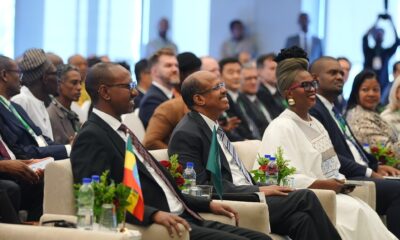

Accelerating Intra-Africa Trade and Sustainable Development -By Kestér Kenn Klomegâh
The AU Private Sector Forum has held several forums, with key recommendations. These recommendations provide valuable insights into the challenges...


Human Rights Day 2025: Advancing The Right To Food And The Rights of Africa’s Farmers -By Prof. Uche Ofodile
One of the most essential human rights is the right to adequate, safe, nutritious, and culturally appropriate food. This right...


Africa’s Democracy Time Bomb -By Patrick Iwelunmor
Africa is not lacking in potential; it is lacking in leadership. By virtue of its population, its resources and its...


Russia’s Lukoil Losses Strategic Influence Across Africa -By Kestér Kenn Klomegâh
United States sanctions has hit Lukoil, one of the Russia's biggest oil companies, like many other Russian companies, that has...


Inadvisability Of Worrying About The Osun Drama As Every First Lady Must Leave A Footprint -By Isaac Asabor
But here is the truth: there is absolutely no reason to worry. Nigerians are acting as though mild tension or...