
Breaking News
Mokyr, Aghion, and Howitt Win Nobel Prize in Economics for Research on Technology-Driven Growth
Joel Mokyr, Philippe Aghion, and Peter Howitt have been awarded the 2025 Nobel Prize in Economics for their pioneering work on how technological innovation drives and sustains long-term economic growth.

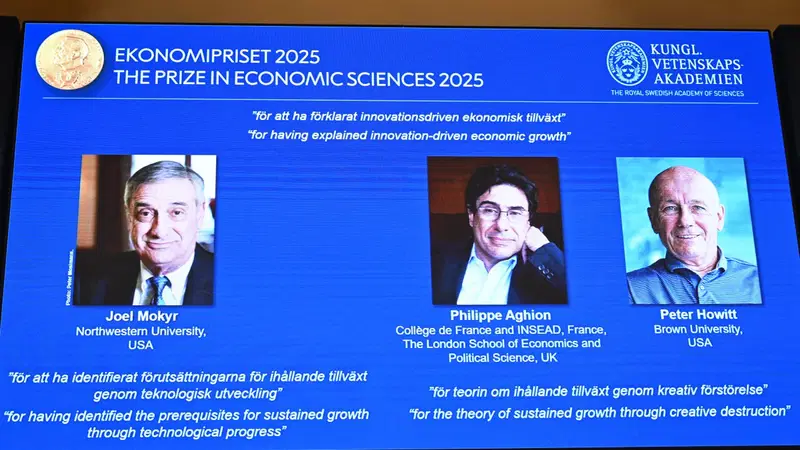
The 2025 Nobel Prize in Economics has been awarded to Joel Mokyr, Philippe Aghion, and Peter Howitt for their groundbreaking work on how technological innovation fuels and sustains long-term economic growth.
Announcing the prize on Monday, the Royal Swedish Academy of Sciences said that Mokyr, 79, an American-Israeli scholar at Northwestern University, received half of the award “for identifying the prerequisites for sustained growth through technological progress.”
The remaining half was jointly awarded to Aghion, 69, of France, and Howitt, 79, of Canada, “for their theory of sustained growth through creative destruction.”
John Hassler, chair of the Nobel committee, said their collective research explained “how technological innovation drives economic growth and how such growth can be sustained over time.”
“For most of human history, living standards changed little from generation to generation. Economic growth was essentially zero,” Hassler said. “But the past 200 years have been an extraordinary exception.”
Kerstin Enflo, a member of the prize committee, added that while the last two centuries have seen unprecedented prosperity, “the laureates’ work reminds us not to take progress for granted. Society must continue nurturing the factors that generate and sustain growth.”
Mokyr’s historical analysis traced how technological advances became central to economic progress, while Aghion and Howitt developed a mathematical model of “creative destruction” — the process through which innovation replaces outdated products, industries, and ideas.
Reacting to the award, Aghion told reporters by phone:
“I’m still speechless. It came as a huge surprise. I can’t find the words to express what I feel.”
He also cautioned that trade barriers and lack of openness could undermine growth:
“Openness is a driver of growth. Anything that gets in the way of openness is an obstacle.”
Aghion further urged European nations not to cede technological leadership to the United States and China, saying:
“We should no longer let them dominate innovation.”
The Nobel Prize in Economic Sciences, officially established in 1968 by the Swedish central bank, is the only Nobel not included in Alfred Nobel’s 1896 will, but it follows the same rigorous selection process as the other prizes.
This year’s Nobel season also recognized achievements in medicine, physics, chemistry, literature, and peace. The economics laureates will receive their awards — including a gold medal, diploma, and $1.2 million prize — at ceremonies in Stockholm and Oslo on December 10, the anniversary of Alfred Nobel’s death.
Opinion Nigeria News


Accelerating Intra-Africa Trade and Sustainable Development -By Kestér Kenn Klomegâh
The AU Private Sector Forum has held several forums, with key recommendations. These recommendations provide valuable insights into the challenges...


Human Rights Day 2025: Advancing The Right To Food And The Rights of Africa’s Farmers -By Prof. Uche Ofodile
One of the most essential human rights is the right to adequate, safe, nutritious, and culturally appropriate food. This right...


Africa’s Democracy Time Bomb -By Patrick Iwelunmor
Africa is not lacking in potential; it is lacking in leadership. By virtue of its population, its resources and its...

Russia’s Lukoil Losses Strategic Influence Across Africa -By Kestér Kenn Klomegâh
United States sanctions has hit Lukoil, one of the Russia's biggest oil companies, like many other Russian companies, that has...


Inadvisability Of Worrying About The Osun Drama As Every First Lady Must Leave A Footprint -By Isaac Asabor
But here is the truth: there is absolutely no reason to worry. Nigerians are acting as though mild tension or...