
Breaking News
Nigeria Spends ₦3.53 Trillion on Raw Material Imports in H1 2025, Defying Import Substitution Goals
Nigeria’s manufacturing sector spent ₦3.53 trillion on imported raw materials in H1 2025 — a 19.7% increase year-on-year — highlighting the failure of the government’s import substitution policy and growing dependence on foreign inputs.

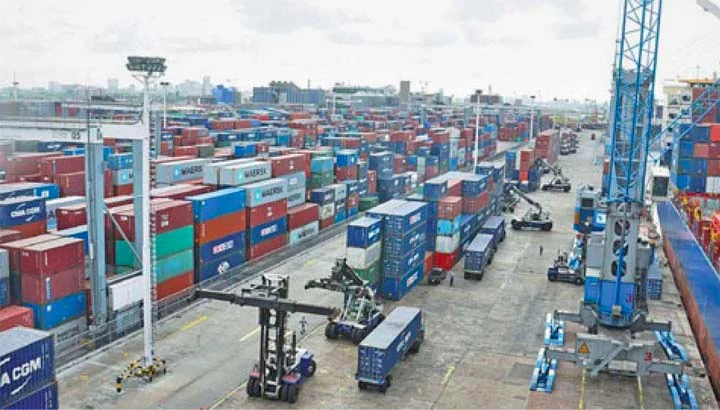
Despite long-standing government policies promoting local production, Nigeria’s manufacturing sector remains heavily reliant on imported raw materials, spending a staggering ₦3.53 trillion on imports in the first half of 2025 (H1’25).
Data obtained by Financial Vanguard from the National Bureau of Statistics (NBS) shows that raw material imports rose by 19.7% year-on-year, up from ₦2.95 trillion recorded in the same period of 2024 (H1’24).
Key imports included sugarcane and derivatives for sugar refining and confectionery, additives for lubricants, veneering sheets, hides and skins for leather goods, and gypsum for cement production. These imports came largely from Brazil, the U.S., the U.K., France, China, Germany, and Tanzania.
Stakeholders expressed concern that the country’s deepening dependence on imported materials undermines the government’s import substitution policy, designed to encourage local production, conserve foreign exchange, and create jobs.
Analysts attributed the trend to high energy costs, currency depreciation, and limited local processing capacity, which have made imported inputs cheaper and more accessible than domestic alternatives.
70% of Inputs Still Imported — RMRDC DG
The Director-General of the Raw Materials Research and Development Council (RMRDC), Prof. Nnanyelugo Ike-Muonso, revealed that over 70% of materials used in Nigeria’s manufacturing sector are still sourced abroad.
He described the situation as a “structural weakness” that inflates production costs, limits job creation, and reduces industrial competitiveness.
“Unless urgent reforms are made, Nigeria risks remaining trapped in a cycle of economic dependency,” Ike-Muonso warned.
He urged the federal government to reduce the country’s raw material import dependence by at least 60% within five years, through policies that incentivize local sourcing and innovation.
The RMRDC boss disclosed that the government has approved new tax incentives for manufacturers that use locally sourced materials, saying:
“Very soon, manufacturers who research, develop, and patronize local raw materials will pay significantly lower taxes than those who don’t.”
He added that RMRDC is promoting technology-driven manufacturing, industrial clusters, and research–industry collaborations to boost local production.
Manufacturers Blame Structural Weakness — MAN
The Director-General of the Manufacturers Association of Nigeria (MAN), Segun Ajayi-Kadir, said manufacturers spent ₦6.64 trillion on raw material imports in 2024, with over 70% of inputs still imported.
He blamed poor infrastructure, energy shortages, and currency depreciation for discouraging local sourcing.
“Locally sourced raw materials are supposed to be cheaper. Sadly, in many cases, imported ones are even cheaper,” he lamented.
Ajayi-Kadir called on the government to implement targeted incentives, technology adoption policies, and industrial hubs to encourage backward integration and reduce dependence on imports.
Former MAN President Mansur Ahmed echoed similar concerns, describing Nigeria’s manufacturing base as “weak and dependent on imported inputs.”
“We must work with government and stakeholders to transition to a system that relies less on foreign materials and forex,” he said.
Import Substitution Policy Failing — LCCI
The President of the Lagos Chamber of Commerce and Industry (LCCI), Gabriel Idahosa, said Nigeria’s import substitution policy has largely failed due to limited local capacity.
He argued that while importing raw materials is not inherently harmful, it becomes unsustainable when the country lacks exports to balance forex spending.
“In some areas, we cannot do backward integration because we lack the raw materials or the technology,” Idahosa explained.
Policy Reform Needed — CPPE
The Chief Executive of the Centre for the Promotion of Private Enterprise (CPPE), Dr. Muda Yusuf, stressed that genuine import substitution could revitalize Nigeria’s economy, reduce production costs, and expand the value chain.
“The government must support manufacturers with policies that drive backward integration and lower dependence on imported raw materials,” Yusuf said.
He noted that Nigeria possesses over 120 commercially viable solid minerals and vast agricultural potential, but lacks “strategic coordination and technology-backed implementation.”
Legislative Action
In a related move, the National Assembly recently passed the RMRDC (Amendment) Bill, 2025, mandating that no raw material leaves Nigeria without at least 30% processing or value addition, a measure aimed at curbing the export of unprocessed commodities and stimulating local industries.
Opinion Nigeria News



Accelerating Intra-Africa Trade and Sustainable Development -By Kestér Kenn Klomegâh
The AU Private Sector Forum has held several forums, with key recommendations. These recommendations provide valuable insights into the challenges...


Human Rights Day 2025: Advancing The Right To Food And The Rights of Africa’s Farmers -By Prof. Uche Ofodile
One of the most essential human rights is the right to adequate, safe, nutritious, and culturally appropriate food. This right...


Africa’s Democracy Time Bomb -By Patrick Iwelunmor
Africa is not lacking in potential; it is lacking in leadership. By virtue of its population, its resources and its...


Russia’s Lukoil Losses Strategic Influence Across Africa -By Kestér Kenn Klomegâh
United States sanctions has hit Lukoil, one of the Russia's biggest oil companies, like many other Russian companies, that has...


Inadvisability Of Worrying About The Osun Drama As Every First Lady Must Leave A Footprint -By Isaac Asabor
But here is the truth: there is absolutely no reason to worry. Nigerians are acting as though mild tension or...