
National Issues
Nigeria’s Tiger Base: A Police Unit That Hunts Its Own Citizens -By Nnamdi Prince
What happened after #EndSARS offers a cautionary tale. SARS was disbanded amid international pressure and domestic outrage, but its personnel were simply dispersed to other units. The underlying culture of impunity, the financial incentives for extortion, the political utility of having police units willing to operate outside the law; none of that has been thoroughly addressed. Tiger Base is the predictable result: SARS reborn under a different name, committing the same abuses in a different location, protected by the same institutional complicity.

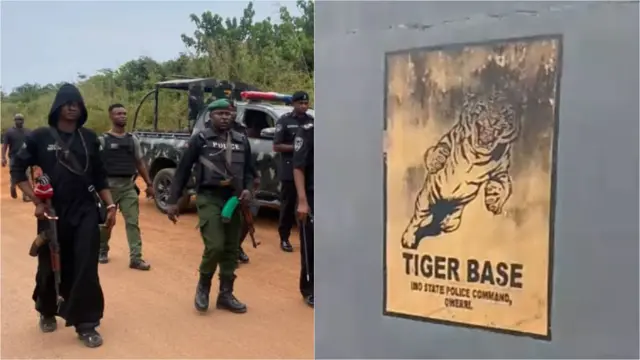
How a specialized anti-crime unit became a death trap for innocent Nigerians—and why the world should care.
On a September evening in 2025, Magnus Ejiogu was arrested at a police checkpoint in Owerri, southeastern Nigeria. His family would never see him alive again. For over a month, they were denied any contact with him. His lawyers were turned away. Even when Nigeria’s National Human Rights Commission wrote to the country’s top police commander warning that Magnus was being tortured and demanding his release, nothing happened. On October 27, more than a month after that warning, his family learned he had died in custody. Police claimed he fell ill. His family believes he was tortured to death.
Magnus is one of at least fifty people documented to have died in the custody of the Anti-Kidnapping Unit of Nigeria’s Imo State Police Command, a facility known locally by a name that has become synonymous with terror: Tiger Base. The death toll is likely far higher. Some of the former detainees describe a commander who conducts twice-daily head counts, taking notes of prisoners who have been there for “too long”, then quietly ordering his officers: “I don’t want to see this person next time.” By the following count, that person has vanished. Some bodies are never returned to families. Others disappear into unmarked graves or, as one survivor whispered, into a pit somewhere on the grounds.
This is not a rogue officer problem. These are not a few bad apples. This is systematic state violence operating with complete impunity at the Tiger Base, in Imo state, and may as well represent other torture chambers of Nigeria’s police force—and it represents a pattern that should alarm anyone who cares about human rights, democratic policing (governance), and the rule of law.
Tiger Base was created to combat kidnapping and violent crime in a region genuinely plagued by armed attacks and insecurity. But like the erstwhile notorious Special Anti-Robbery Squad (SARS) that sparked Nigeria’s massive #EndSARS protests in 2020, the unit has transformed from law enforcement into a criminal enterprise operating under police colours. The difference is that while SARS was disbanded after sustained public outcry, Tiger Base continues operating today, torturing, killing, and disappearing citizens, because the lessons of #EndSARS were never actually learned.
A walk through the cases, and a horrifying pattern emerges. Japhet Njoku, a 32-year-old security guard, was arrested in March 2025 over unsubstantiated theft allegations and tortured to death by May 2025. A coroner’s court ordered an autopsy and commanded the officers responsible to come forward to testify. They simply refused. The autopsy has been blocked three times. The officers remain on duty. One has been promoted.
Gloria Okolie, a 21-year-old woman, was arrested and accused of being an IPOB (proscribed separatist group) member’s girlfriend, an allegation requiring no evidence beyond the accusation itself. For ten months, she was held as a slave for police officers, forced to cook, clean, and do their laundry while her parents desperately searched mortuaries, thinking she was dead. It took an international court ruling to win her compensation. The officers who enslaved her faced no consequences.
Then there are the disappeared. Sunday and Calista Ifedi, a married couple, were arrested in 2021 and transferred between security facilities until they vanished entirely from official records. Their daughter Merit and her siblings haven’t seen their parents in over four years. Some have dropped out of school. When journalists tried sending Freedom of Information requests to Nigeria’s State Security Service asking about the couple’s whereabouts, the agency twice refused to even accept the letter. In addition, Pastor Chinedu, Reverend Cletus Nwachukwu, Onuocha Johnbosco, Linus Onyewuchi Anyanwu; the list of the disappeared goes on, each name representing a shattered family living in agonizing uncertainty.
What makes Tiger Base particularly insidious is the sophisticated system of impunity protecting it. When Nigeria’s National Preventive Mechanism, operating under presidential authority and international treaty obligations, attempted to inspect the facility in June 2025, they were denied access to the detention areas. Officers relocated prisoners before the inspection team arrived. No detention records were produced. The five detainees presented for interviews pre-selected. None had access to lawyers. Most had been held far beyond the constitutional 48-hour limit. One man’s arms hung limp from being tied up for hours. Others showed clear and visible signs of torture.
This obstruction wasn’t just bureaucratic incompetence; it was calculated defiance of presidential directives and international law. Yet no officers were disciplined. No access was eventually granted. The facility continues operating exactly prior to the attempted spot check, perhaps, because everyone from the local police commander to the leadership of the Nigeria Police Force to the federal government understands that Tiger Base serves purposes beyond crime-fighting. It generates revenue for its immediate and remote managers through extortion, extracting payments of ₦200,000 to N20 million (roughly $130 to $15,000) from families desperate to save their loved ones. It settles political scores, with detainees subjected to formal partisan vetting before release. It suppresses dissent. A former state commissioner was arrested in Nigeria’s capital, Abuja, by officers from the Tiger Base who traveled from Imo State specifically to arrest and detain him after he criticized the state governor, Hope Uzodinma.
The international community should pay attention to Tiger Base not only because Nigeria is uniquely terrible but because it represents a pattern playing out globally: security forces claiming to combat legitimate threats while preying on their own populations, protected by the actions or inactions of layers of oversight mechanisms meant to constrain them. When a country’s human rights commission can document torture and the victim still dies in custody despite warweaponizedhe top police commander, it may as well mean that every accountability mechanism has failed. When international treaties guaranteeing inspection rights are openly violated, national sovereignty is being weaponized against citizens rather than protecting them.
Nigeria is a signatory to the UN Convention Against Torture, the International Covenant on Civil and Political Rights, and the African Charter on Human and Peoples’ Rights. It has a National Preventive Mechanism established under presidential order. It has constitutional protections against torture, arbitrary detention, and denial of legal representation. Yet none of this protected Magnus Ejiogu. None of it saved Japhet Njoku. None of it has brought Sunday and Calista Ifedi home to their children, and none of it could save the unborn child of Melody Anyanwu
The excuses are predictable: Nigeria faces real security challenges from separatist violence and organized crime. Specialized units need operational flexibility. Oversight would compromise effectiveness. These arguments always sound reasonable until you meet the grandmother searching for her disappeared son, the widow whose husband was tortured to death over a fabricated allegation, the children who haven’t seen their parents in four years because security services refused to acknowledge holding them.
What happened after #EndSARS offers a cautionary tale. SARS was disbanded amid international pressure and domestic outrage, but its personnel were simply dispersed to other units. The underlying culture of impunity, the financial incentives for extortion, the political utility of having police units willing to operate outside the law; none of that has been thoroughly addressed. Tiger Base is the predictable result: SARS reborn under a different name, committing the same abuses in a different location, protected by the same institutional complicity.
Breaking this cycle requires more than expressions of concern. It demands that Nigeria’s international partners condition security assistance on verifiable human rights compliance through a functional and applicable Human Rights Due Diligence Policy (HRDDP), which is a tool rooted in the UN Guiding Principles on Business and Human Rights (2011). This requires the UN Human Rights Council to establish an independent commission of inquiry into systematic violations by Nigerian security forces. And by extension, it prepares the ground for the International Criminal Court must assess whether these patterns of torture, enforced disappearance, and extrajudicial killing constitute crimes against humanity. Ultimately, the Tiger Base exposition demands that myriads of diplomatic engagements aimed at Police Reforms and the larger Criminal Justice Administration reforms should prioritize human rights over convenient partnerships.
Most importantly, it requires standing with Nigerian civil society organizations, journalists, and activists who risk their lives documenting these abuses. Organizations like the Coalition Against the Tiger Base have compiled overwhelming evidence against some officers of the Tiger Base’s crimes. Brave survivors have given testimony knowing they face potential rearrest and death. Families of the disappeared continue searching despite threats and intimidation. They need more than sympathy; they need concrete international pressure that makes maintaining Tiger Base politically untenable for Nigerian authorities.
The next #EndSARS is may not be far-fetched.
The current trajectory fast-tracks and guarantees it. You cannot indefinitely torture, kill, and disappear citizens while calling it law enforcement without eventually triggering catastrophic backlash. Nigeria’s youth have shown they will mobilize when pushed too far. The question is whether Nigerian authorities will dismantle units like Tiger Base before that breaking point, or whether they will wait until the streets again fill with angry and destructive protesters, this time with even less faith that previous reform promises meant anything.
Tiger Base exists because impunity – backed by political leaders- works. Officers torture and kill without consequence. Commanders obstruct justice and get promoted. Oversight bodies receive evidence and take no action. International partners maintain business as usual. Every day this continues sends the same message to police across Nigeria: abuse is acceptable, torture is tolerated, and murder will be protected if it serves political and institutional interests.
The alternative is straightforward but requires political courage: investigate culpable officers, repurpose (or outrightly disband) Tiger Base immediately, criminally prosecute all implicated officers regardless of rank, release or charge every detainee held beyond constitutional limits, establish genuinely independent civilian oversight, and provide comprehensive compensation to victims and families. These aren’t radical demands—they’re basic requirements of the rule of law that Nigeria’s constitution and international treaties already mandate.
When Magnus Ejiogu was arrested, Nigeria’s human rights commission tried to save him. They failed because they have only documentation authority but no enforcement power. When Gloria Okolie’s family searched desperately for their enslaved daughter, Nigerian courts issued orders for her release. Police ignored them for months. When families seek information about disappeared loved ones, security services refuse to even accept the questions.
This is what state failure looks like, not the absence of government, but government wielded as a weapon against citizens it claims to protect. And it’s happening not in some distant, irrelevant corner of the world, but in Africa’s most populous nation, a major oil producer, a significant U.S. security partner, and a country whose stability matters for an entire region.
The bodies are piling up. The disappeared list grows longer. The families still searching for answers multiply. And Tiger Base continues operating, confident that no amount of evidence will trigger accountability. Until the cost of maintaining this system exceeds the benefits it provides to those protecting it, nothing will change.
The question for the international community is simple: Will we wait for another crisis, or will we demand action now, while it might prevent yet another catastrophe? Because the survivors of Tiger Base, the families of the disappeared, and the millions of Nigerians living in fear of their own police force deserve better than sympathy after the next explosion of public rage. They deserve justice now.
Nnamdi Prince is a human rights researcher with extensive experience documenting police violence in Africa. This op-ed is based on comprehensive field investigations and testimony from survivors of Tiger Base detention.


State Duma Pushes for Russia’s Investment in Burundi -By Kestér Kenn Klomegâh
Speaker of the National Assembly of Burundi and Chairman of the State Duma, signed an Agreement on Cooperation, and both...


Wanted! Where Is Our National Interest? -By Abdu Abdullahi
Indeed, the idea of the national interest is very striking by its pronounced and provocative vacuum in Nigeria.This spells doom...

The ECOWAS Democracy Paradox: A Flawed Arbiter in an Era of Autocratic Drift -By Jeff Okoroafor
As ECOWAS condemns Guinea-Bissau's coup, I analyze how its failure to address "constitutional coups" by elected leaders has eroded credibility...


South Africa Takes A Break From G20 -By Kestér Kenn Klomegâh
The United States this month took over the year-long presidency of the group of leading economies after largely boycotting South...


Did America Happen to Ademiluyi? -By Zayd Ibn Isah
If we must fix Nigeria, it will not be by glorifying foreign lands or demonising our own, but by confronting...