
Political Issues
Party supremacy or parallel government -By Lewis Obi

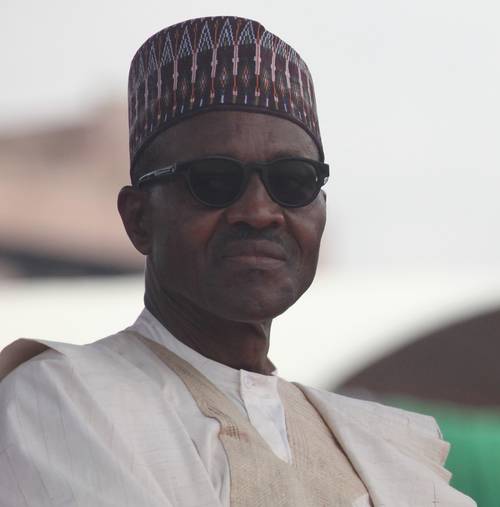
Muhammadu Buhari during the inauguration day.
At the time the leadership elections were held in the National Assembly last week, the political parties ought to have been superfluous. In the United States, no one would be blaming the All Progressives Congress (APC) for the snafu. Everyone would be blaming the APC Senate Caucus.
Issues like this keep reminding everyone that we still think presidential but act parliamentary, confirming that the Westminster system cannot be purged from our political psyche. It also shows the fundamental difficulty of operating the presidential system in Nigeria. Everyone knows the system is essentially corrupt, even in the least corrupt places, but it has the redeeming feature of being practical. It works. And in Nigeria’s particular circumstance, the country is corrupt from the bus stop all the way to the parliament, and on top of all this operating a system that is greased by corruption.
In the United States, the Senate Minority Leader has a good chance of emerging Senate President if his party finally wins and becomes the governing or majority party. But it does not disqualify other members of the Senate from running. It is the same situation in the House of Representatives. Ambitious members of parliament begin to sound out their colleagues as soon as the election is over. Then the House or Senate caucus of the majority party meets and conducts a n e lection. W hoever emerges becomes the official candidate of the majority party. So, when the Senate or House convenes, therefore, the election of the Speaker or President is usually a matter of formality because the caucus has decided who gets the big chair.
It is not as if many members of the APC caucus are unaware of the regular way of choosing legislative officers. But unable to convene a credible caucus meeting of the APC senate, they fell back on the party to do the hard work for them, which turned out to be embarrassing to everyone, including President Buhari who vehemently refused to be part of the exercise but was caught in the middle when it became a national embarrassment for the APC.
The wisdom of keeping the party distant from the government seems not to have any meaning for Nigerian politicians. From the First Republic to the 2nd Republic political parties were used as tools for corruption, to obtain kickbacks and to funnel money into the political parties themselves. Old habits die hard and the Peoples Democratic Party (PDP) apparently continued the old habit which the APC has now reaffirmed. The vituperations against those considered to be disobedient to the party and threats of all manners of sanctions against them ensures that no one crosses the party in future and that the fear of the APC is the beginning of wisdom for its members.
While this may be good for party chieftains, in the mind and perception of the average Nigerian, the APC is now, like the previous ruling parties before it, a parallel government. I t has backed itself into double jeopardy. It has now to defend two turfs whereas Nigerians have now two outfits it suspects of all the usual kinds of political malfeasance.
The American systems is free of this anomalous situation because as soon as the primaries end, the convention holds, and elections are concluded, no one remembers the party for two reasons. First, Americans don’t have national parties. Party discipline is enforced by the elected executive who is the party’s flag-bearer; in the legislature by the party whips. To get to these elected positions, the candidates would have satisfied the voters about their faith and conformity with the party’s planks and manifestoes. They don’t need to be double-checked.
Republicans are having a problem choosing from a crowded field of 16 and counting presidential candidates for 2016 election. Unlike the Democrats who boast of a ready-made overwhelmingly favored candidate in Mrs. Hillary Clinton, the Republican field will take a while to crystallize. Even Governor Jeb Bush whose father and brother had been presidents don’t seem to be having a field day. Indeed Americans are wondering how many presidents they want to get out of the Bush family.
A Black brain-surgeon, Ben Carson, is making some impression; the young Senator of Cuban descent Marco Rubio is also receiving attention, both are Obama wannabe’s in the GOP. Donald Trump announced last Tuesday boasting of his $9 billion in assets. Senator Ted Cruz has excited many Republicans, a very eloquent man. Senator Rand Paul, like his father, wants to close all US military bases abroad and stop America being the world’s police man. Millions of Americans would love to try such a foreign policy, but Republican primary voters won’t let him survive Iowa. I t will be a miracle if he makes it to South Carolina.
This stage of the campaign attracts mostly the primary voters who now do the screening themselves. On the side of the Democrats, Senator Bernie Sanders (Vermont) runs to the left of Secretary of State Clinton, like Gov. Lincoln Chafee (Rhode Island), the so-called progressive wing of the Democratic Party. After |Ralph Nader’s independent candidacy which practically elected George W. Bush and defeated Al Gore in 2000, Democrats are now wary of far left candidates who might lure away vital votes from mainstream Democratic candidates. To that extent I think the progressive wing is a no-hoper in this cycle.
I think the American system lets the party to wither away after the election. If a man can go through hell and high water to get elected president, as American presidents do, it would be unreasonable second-guessing him on matters of ideology, in either the right or the left. To a large extent same applies to Congress men and women. Occasionally, Congress men wander off the reservation and had to be pulled back by the party whips. But every vote cast in Congress is recorded, so you cannot afford to wander off too many times or else you might be inviting a primary challenge. And the fear of the primary challenge is the beginning of wisdom in American politics.
Half of the top echelon of the APC was of the PDP in their first life as politicians which underlines the absence of any strongly-or delicately-held beliefs about anything. T hat is probably why the APC could afford to spend time grieving about its mismanaging its own legislative officers selection and making the country pay for it. But whatever happens it has left the impression that it intends the party to be a parallel government and must be ready for the consequences that come with parallel governments.



Africa Squeezed Between Import Substitution and Dependency Syndrome -By Kestér Kenn Klomegâh
The key buyers of Russian grain on the continent are Egypt, Algeria, Kenya, Libya, Tunisia, Nigeria, Morocco, South Africa, Tanzania...

Accelerating Intra-Africa Trade and Sustainable Development -By Kestér Kenn Klomegâh
The AU Private Sector Forum has held several forums, with key recommendations. These recommendations provide valuable insights into the challenges...


Human Rights Day 2025: Advancing The Right To Food And The Rights of Africa’s Farmers -By Prof. Uche Ofodile
One of the most essential human rights is the right to adequate, safe, nutritious, and culturally appropriate food. This right...


Africa’s Democracy Time Bomb -By Patrick Iwelunmor
Africa is not lacking in potential; it is lacking in leadership. By virtue of its population, its resources and its...

Russia’s Lukoil Losses Strategic Influence Across Africa -By Kestér Kenn Klomegâh
United States sanctions has hit Lukoil, one of the Russia's biggest oil companies, like many other Russian companies, that has...